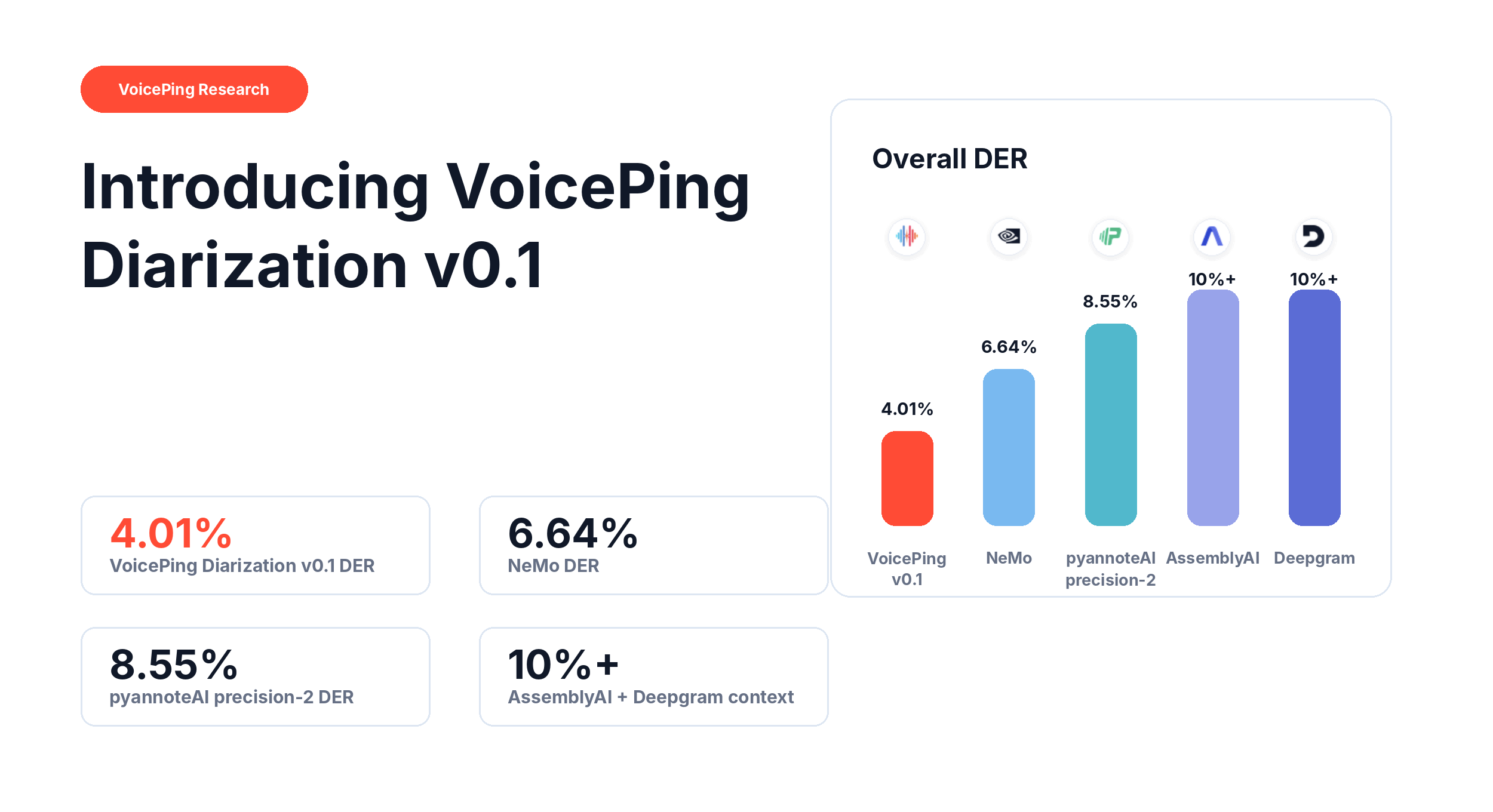
VoicePing Diarization v0.1 ek multilingual speaker diarization model hai, jise 42-file benchmark mein NeMo, pyannoteAI precision-2, AssemblyAI aur Deepgram ke saath evaluate kiya gaya.
VoicePing Diarization v0.1 ka Parichay
VoicePing Diarization v0.1 hamara pehla public diarization model release hai. Yeh multilingual meetings ke liye speaker segmentation model hai, jo downstream speaker identity matching se pehle yeh pehchanta hai ki kaun kab bola.
Yeh article July 2026 ke 42-file multilingual benchmark ke through model ko introduce karta hai. NeMo, pyannoteAI precision-2, AssemblyAI aur Deepgram ko evaluation context ke roop mein include kiya gaya hai, taaki readers samajh sakein ki VoicePing Diarization v0.1 familiar open aur commercial speaker-labeling options ke comparison mein kahan khada hai.
Ek caveat zaroori hai: VoicePing Diarization v0.1 selected benchmark row ki public model identity hai, live production registry check nahi. Production model selection runtime configuration se control hota hai, aur production mein is diarization-only benchmark ke bahar downstream speaker identity matching bhi shamil hai.
Evaluation setup
benchmark mein 42 files aur lagbhag 10.5 hours audio hai: English, Japanese, Korean, Vietnamese aur Mandarin ke paanch monolingual sets, plus do code-switched multilingual files. Scenarios 30 seconds se 1 hour tak hain, 2-9 speakers aur 0-30% overlapping speech ke saath.
Yeh files real single-speaker recordings se stitched synthetic conversations hain. Isse exact reference labels aur repeatable scoring milta hai, lekin yeh kai real meetings se cleaner hai. Results ko controlled benchmark ke roop mein dekhna chahiye, out-of-domain meeting evaluation ka replacement nahi.
evaluation set raw internal export se jaan-boojhkar narrower hai. NeMo ko main local open baseline ke roop mein include kiya gaya, rerun artifacts se NeMo Neural MSDD result use karke. pyannoteAI precision-2 sabse clear dedicated commercial diarization service ke roop mein include hai. Deepgram aur AssemblyAI isliye include hain kyunki buyers speaker-attributed transcript evaluations mein unhe aksar compare karte hain, lekin masked cells direct headline ranking mein use nahi hote.
Methodology details: DER ko pyannote.metrics-style diarization error rate se score kiya gaya, fair collar, overlap scored aur corpus time-weighted aggregation ke saath. July 2026 research evaluation export ne voiceping-inc/titanet Hugging Face snapshot (titanet_finetuned.nemo) se VoicePing Diarization v0.1 benchmark row, NeMo Neural MSDD baseline, pyannoteAI precision-2, aur AssemblyAI/Deepgram se speaker-attributed transcript speaker-label outputs use kiye.
Overall results
| System | Files | DER | Role | RTF |
|---|---|---|---|---|
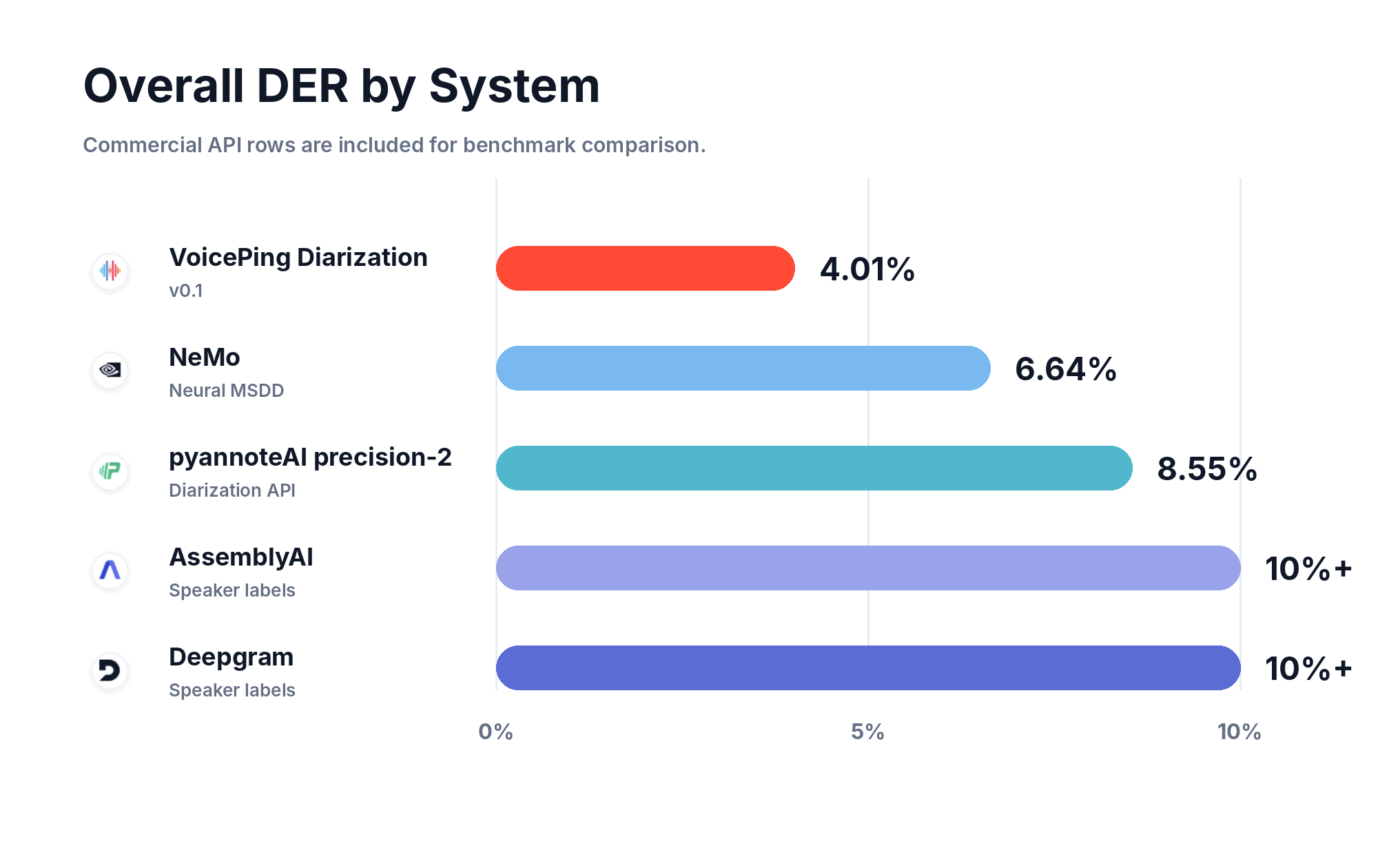
| VoicePing Diarization v0.1 | 42 | 4.01% | VoicePing diarization model | 0.024 |
| NeMo | 42 | 6.64% | NeMo Neural MSDD baseline | 0.020 |
| pyannoteAI precision-2 | 42 | 8.55% | Dedicated commercial diarization API | 0.028 |
| AssemblyAI | 42 | xx | speaker-attributed transcript speaker labels | 0.049 |
| Deepgram | 41 | xx | speaker-attributed transcript speaker labels | 0.006 |
Clean headline simple hai: controlled benchmark mein VoicePing Diarization v0.1 lead karta hai, uske baad NeMo, phir pyannoteAI precision-2. Dedicated diarization API serious external comparison ke liye kaafi close hai. speaker-attributed transcript rows context ke liye included hain, jabki core accuracy comparison VoicePing Diarization v0.1, NeMo aur pyannoteAI precision-2 ke beech rehta hai.
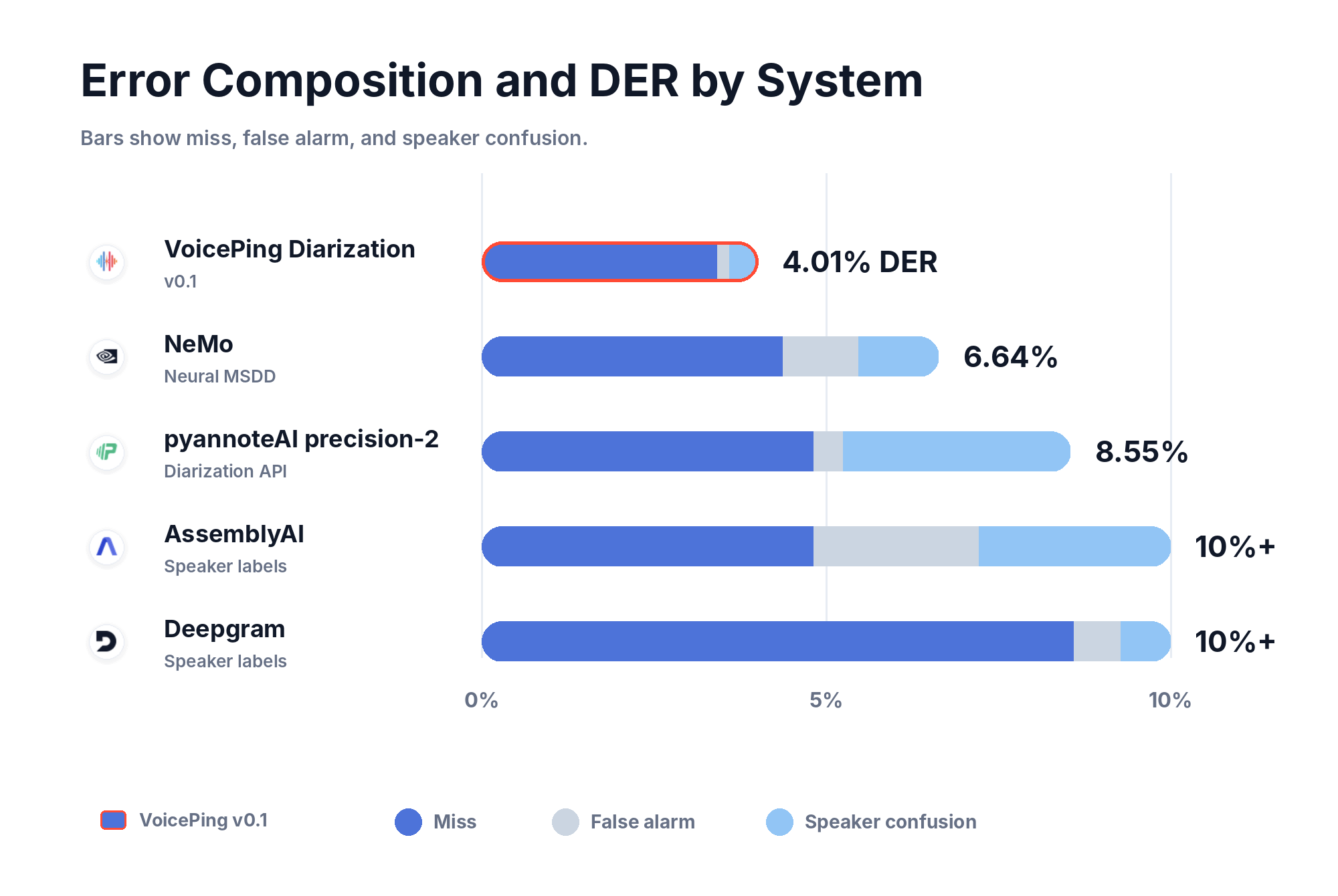
component view paanch public rows ko include karta hai. VoicePing Diarization v0.1, NeMo aur pyannoteAI precision-2 apne headline DER labels ko miss, false alarm aur speaker-confusion segments ke paas dikhate hain. AssemblyAI aur Deepgram speaker-attributed transcript context rows ke roop mein proportional component segments aur masked DER labels ke saath include hain.
Language-wise results
| Language | VoicePing Diarization v0.1 | NeMo | pyannoteAI precision-2 | AssemblyAI | Deepgram |
|---|---|---|---|---|---|
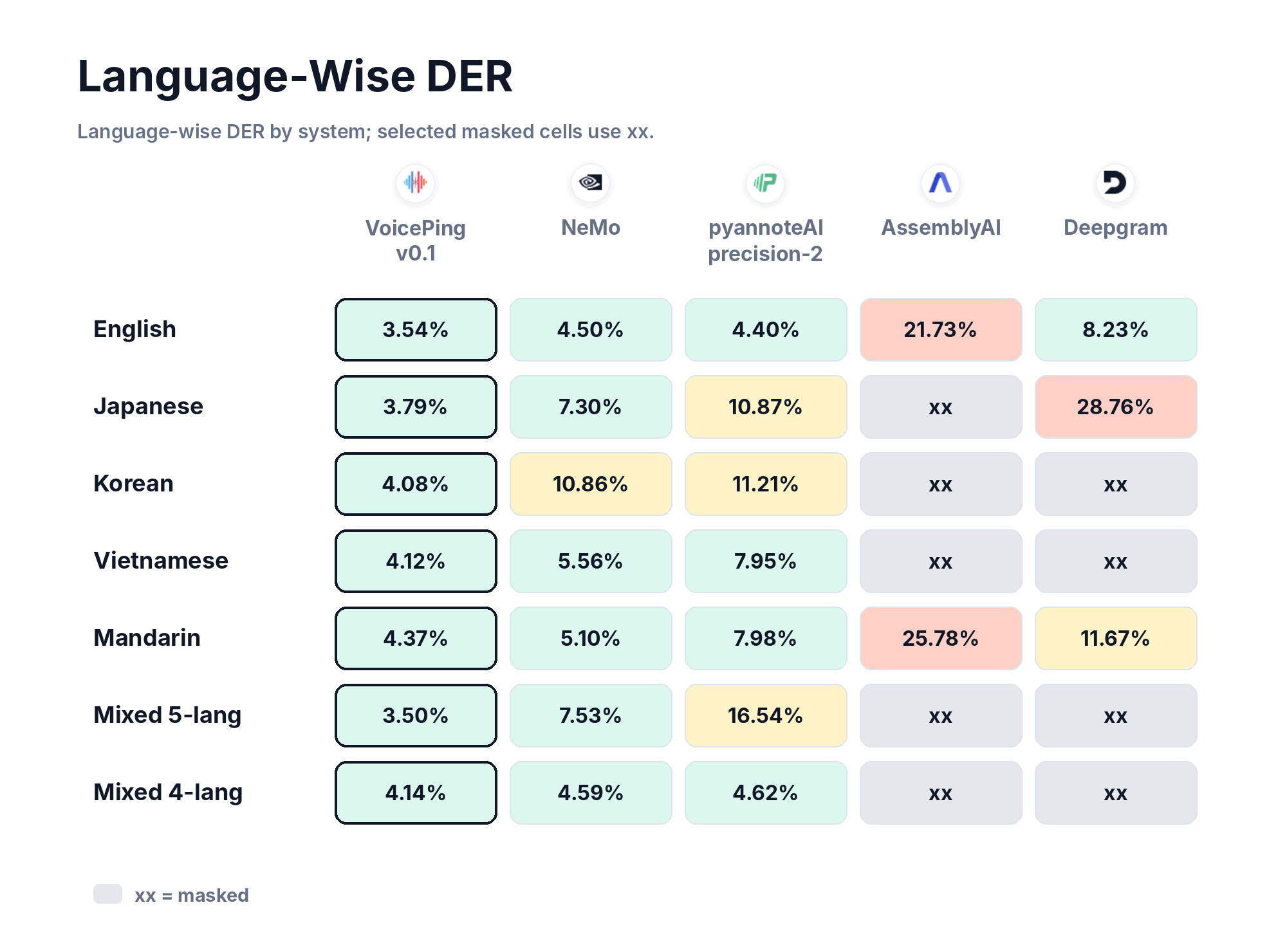
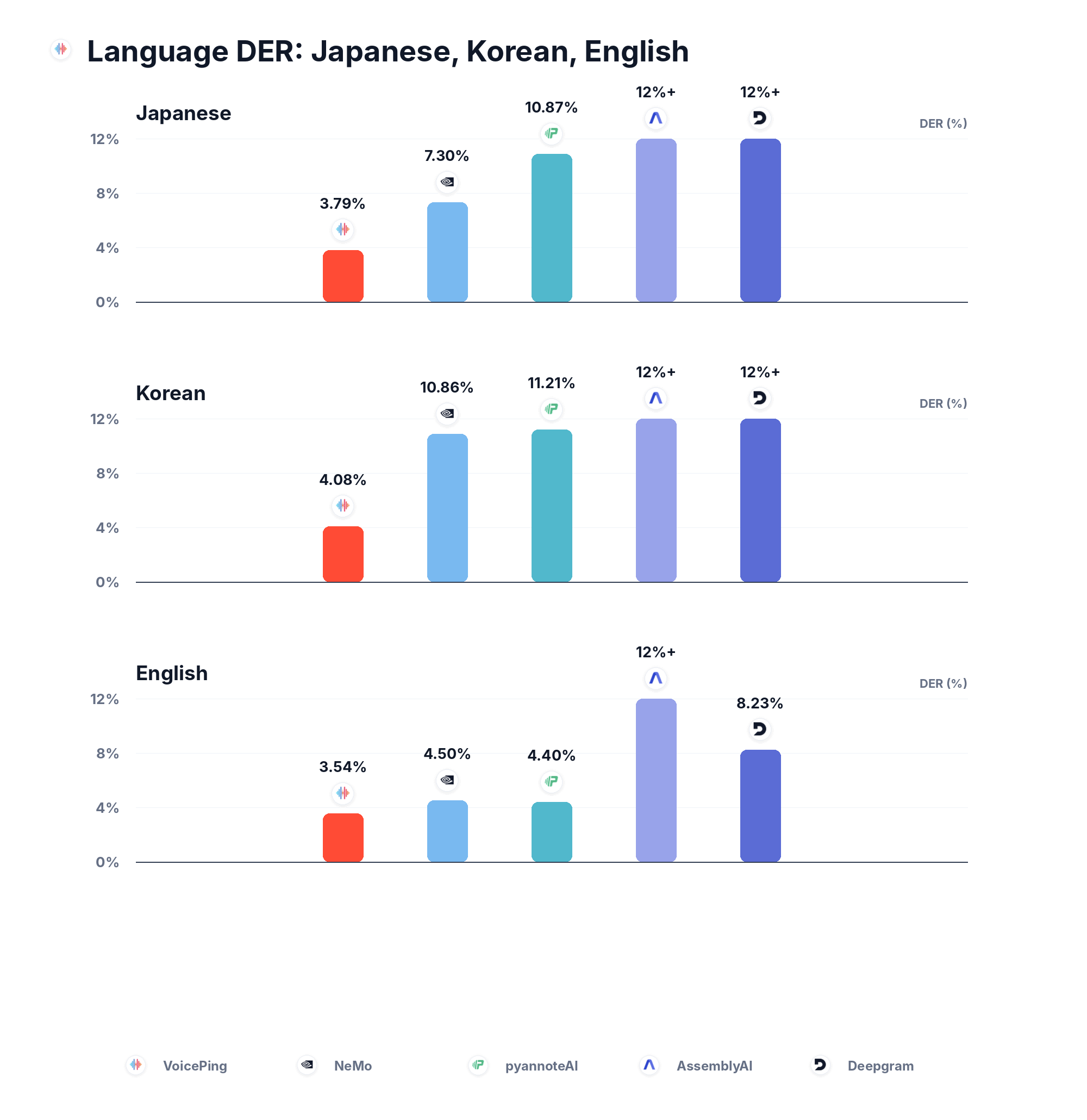
| English | 3.54% | 4.50% | 4.40% | 21.73% | 8.23% |
| Japanese | 3.79% | 7.30% | 10.87% | xx | 28.76% |
| Korean | 4.08% | 10.86% | 11.21% | xx | xx |
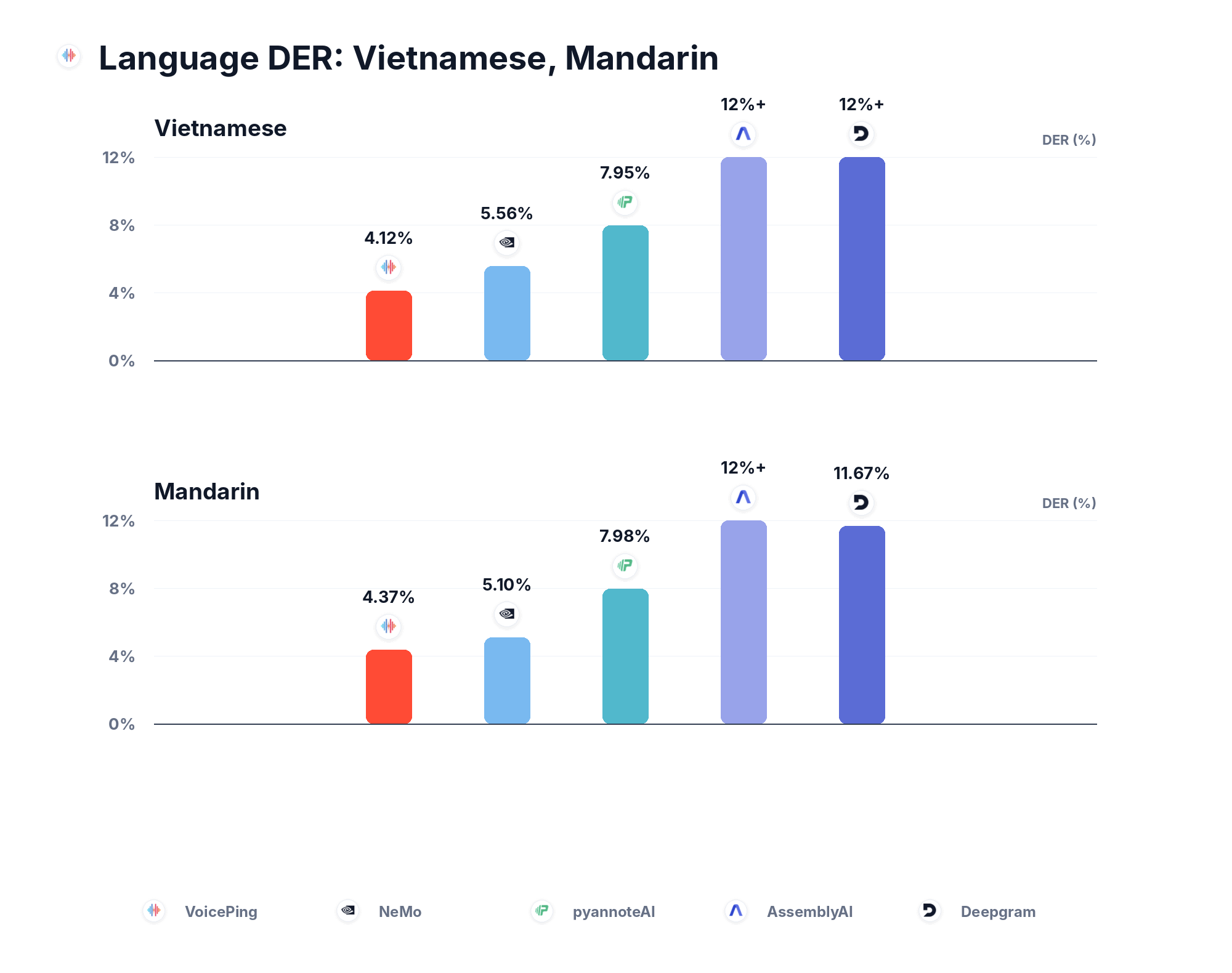
| Vietnamese | 4.12% | 5.56% | 7.95% | xx | xx |
| Mandarin | 4.37% | 5.10% | 7.98% | 25.78% | 11.67% |
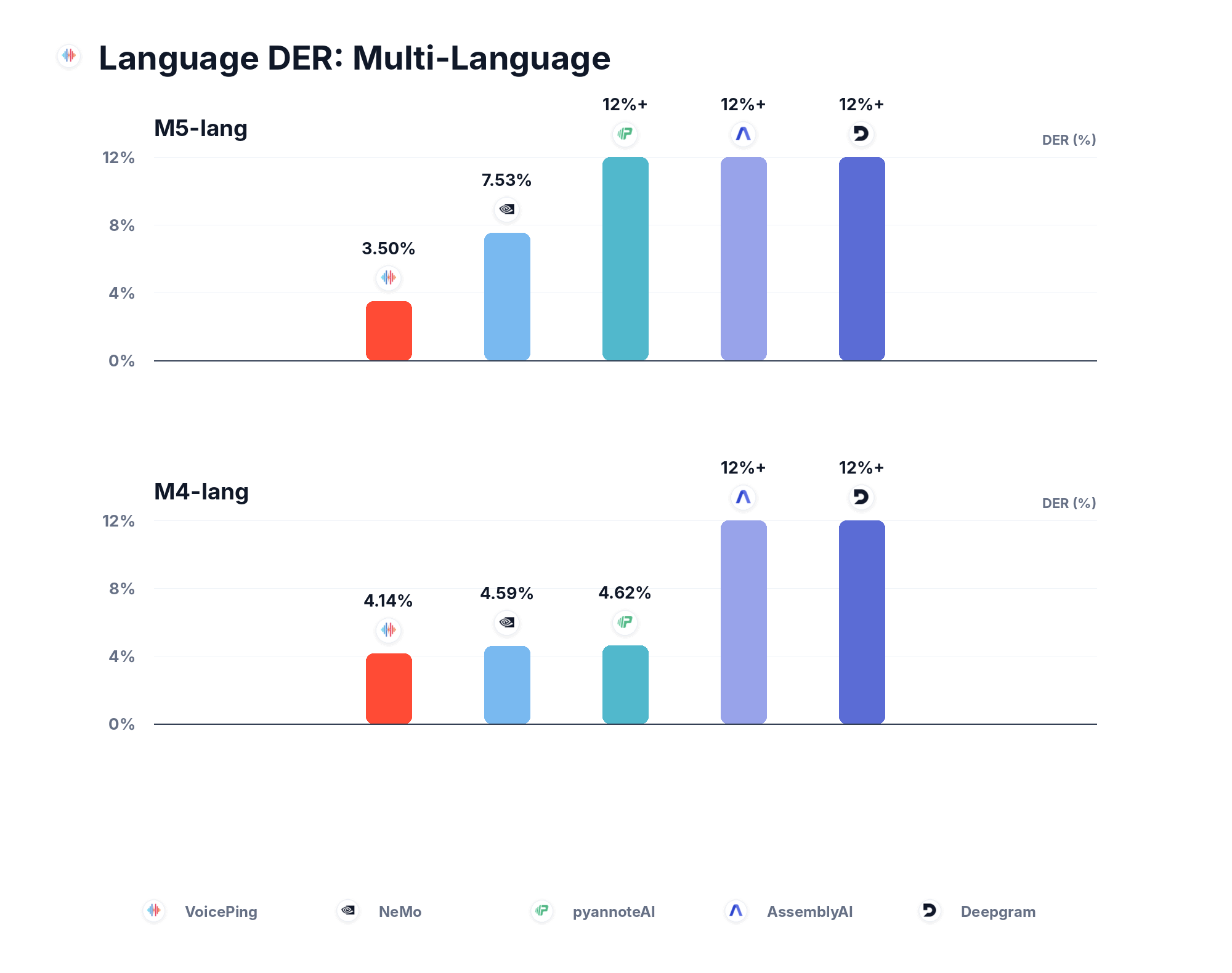
| Mixed, 5 languages | 3.50% | 7.53% | 16.54% | xx | xx |
| Mixed, 4 languages | 4.14% | 4.59% | 4.62% | xx | xx |
language-wise, is public table ke saare seven language buckets mein VoicePing Diarization v0.1 strongest row hai. NeMo ab bhi useful open baseline hai; yeh row NeMo Neural MSDD use karti hai. pyannoteAI precision-2 languages ke across consistently viable hai, lekin yahaan har bucket mein VoicePing Diarization v0.1 se peeche hai.
API rows ek alag kahani batate hain. Deepgram aur AssemblyAI speaker-attributed transcripts ke liye useful references hain, lekin public table dikhata hai ki inhe multilingual speaker timelines ke direct diarization replacements ke roop mein present nahi karna chahiye.
Scenario aur short-audio takeaways
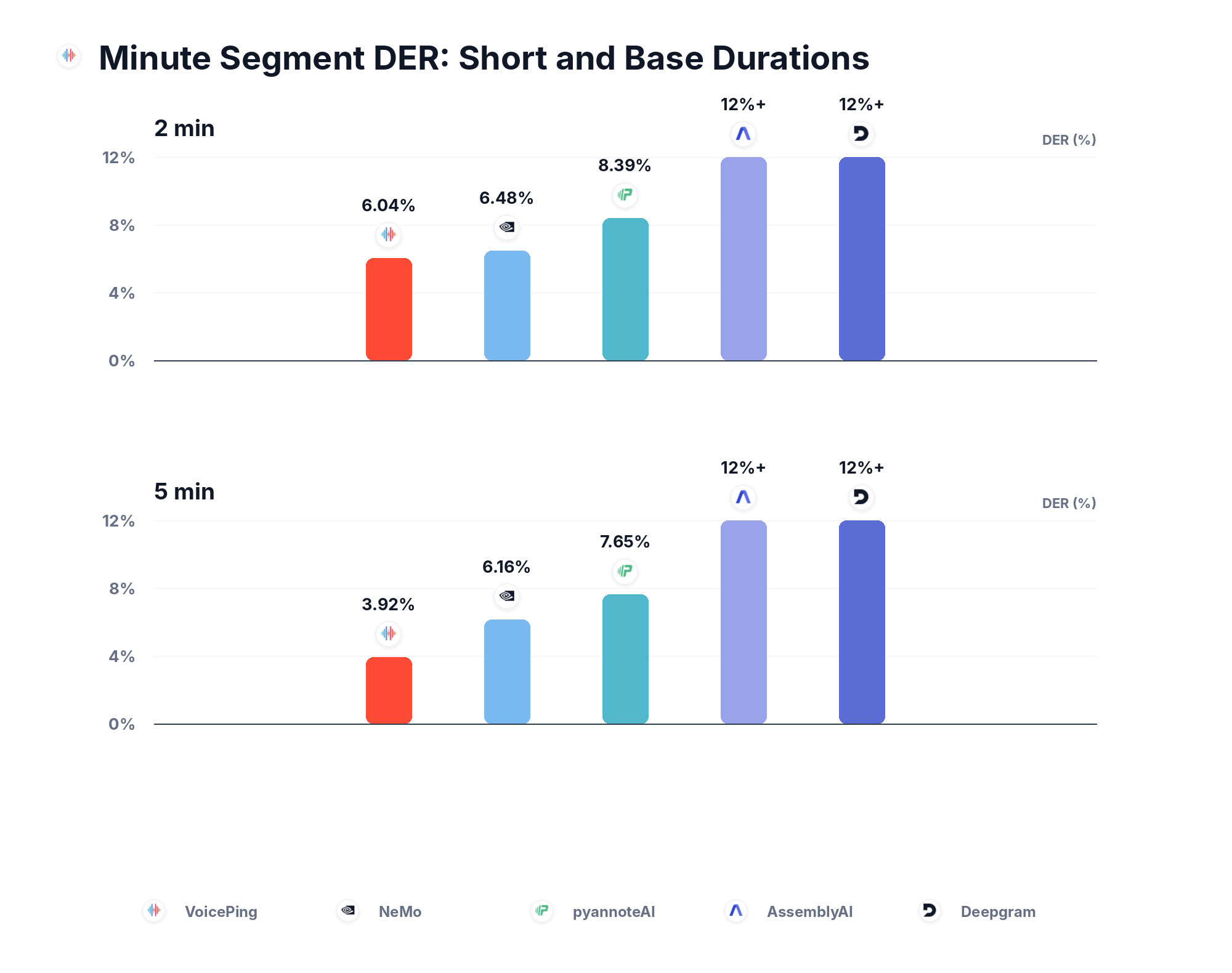
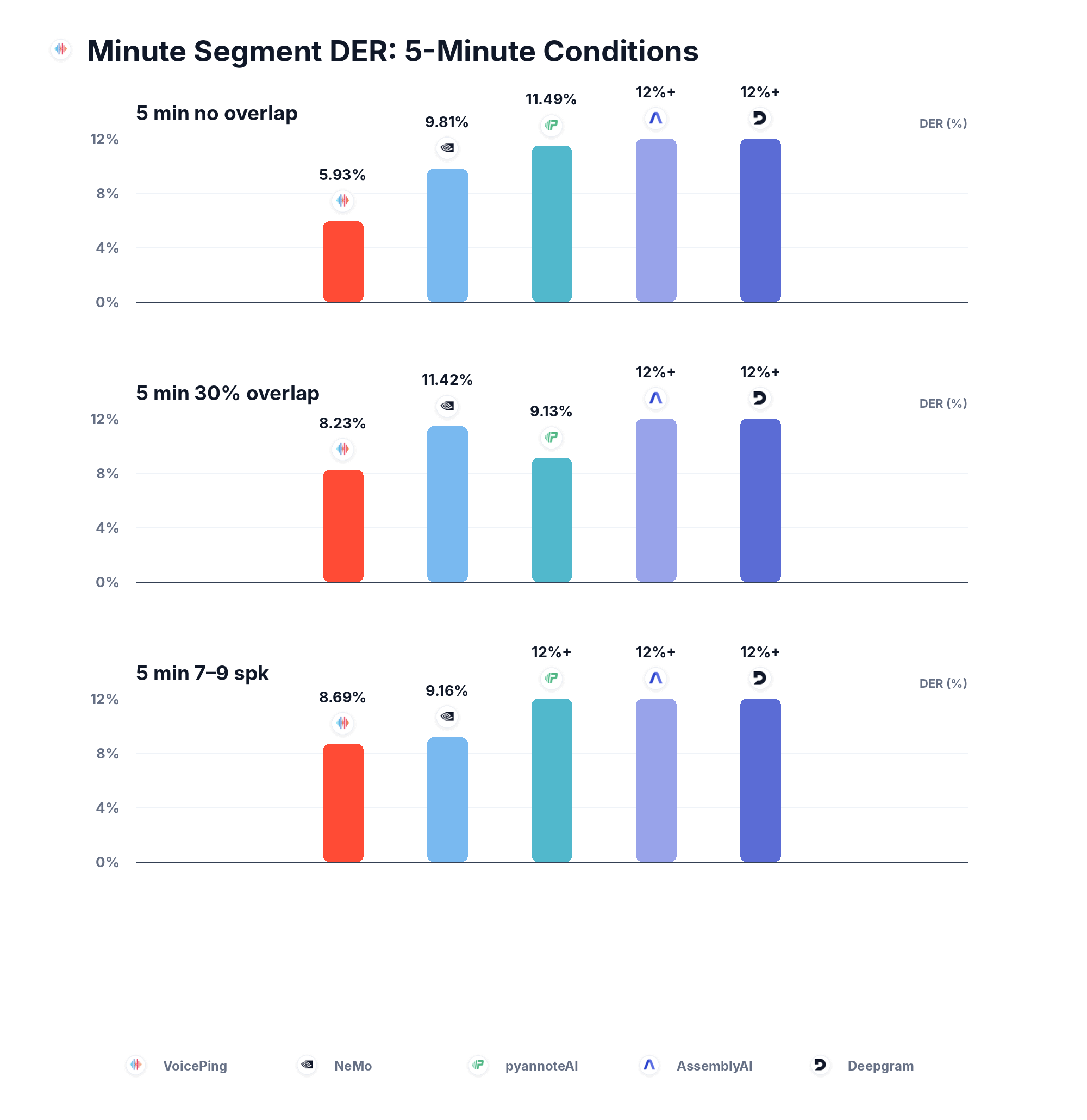
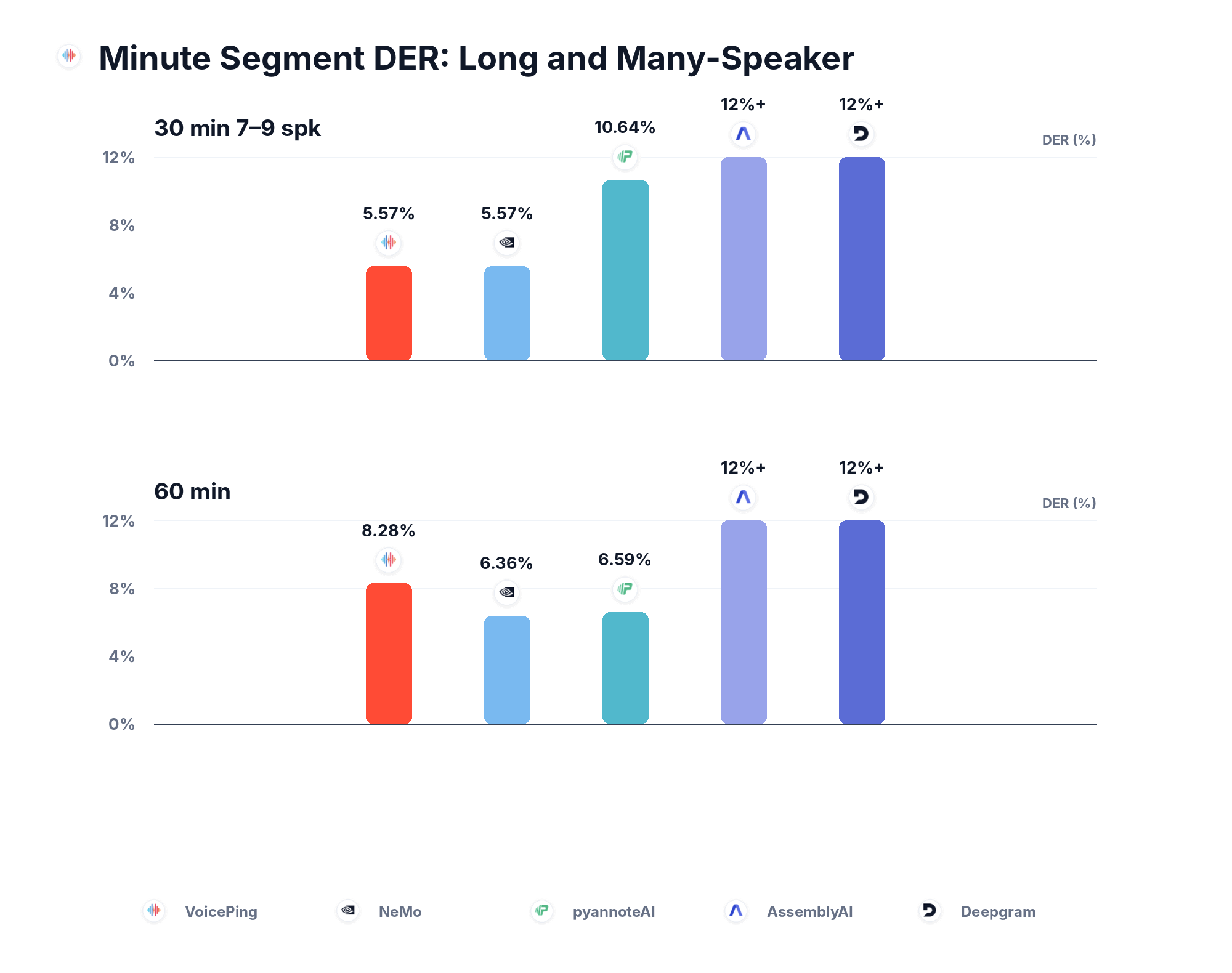
scenario view ko segment by segment padhna chahiye, single suite-level average ke roop mein nahi. VoicePing Diarization v0.1 5-minute base bucket mein 3.92% DER ke saath strongest hai, 2-minute audio par 6.04%, 5-minute no-overlap audio par 5.93%, aur 30-minute 7-9 speaker audio par 5.57% ke saath mid-single digits mein rehta hai. Phir harder meeting buckets mein badhta hai: 30% overlap wale 5 minutes par 8.23%, 7-9 speakers wale 5 minutes par 8.69%, aur 60-minute audio par 8.28%.
Product planning ke liye humein teen questions alag rakhne chahiye. First, full meetings ke liye kaunsa diarization pipeline strongest hai? Second, jab har speaker ke paas kam speech ho to kaunsa embedding model robust hai? Third, MSDD refinement aur speaker identity matching ke baad full production pipeline ka behavior kaisa hai? Yeh post segmentation layer par sirf pehle part ka answer deta hai.
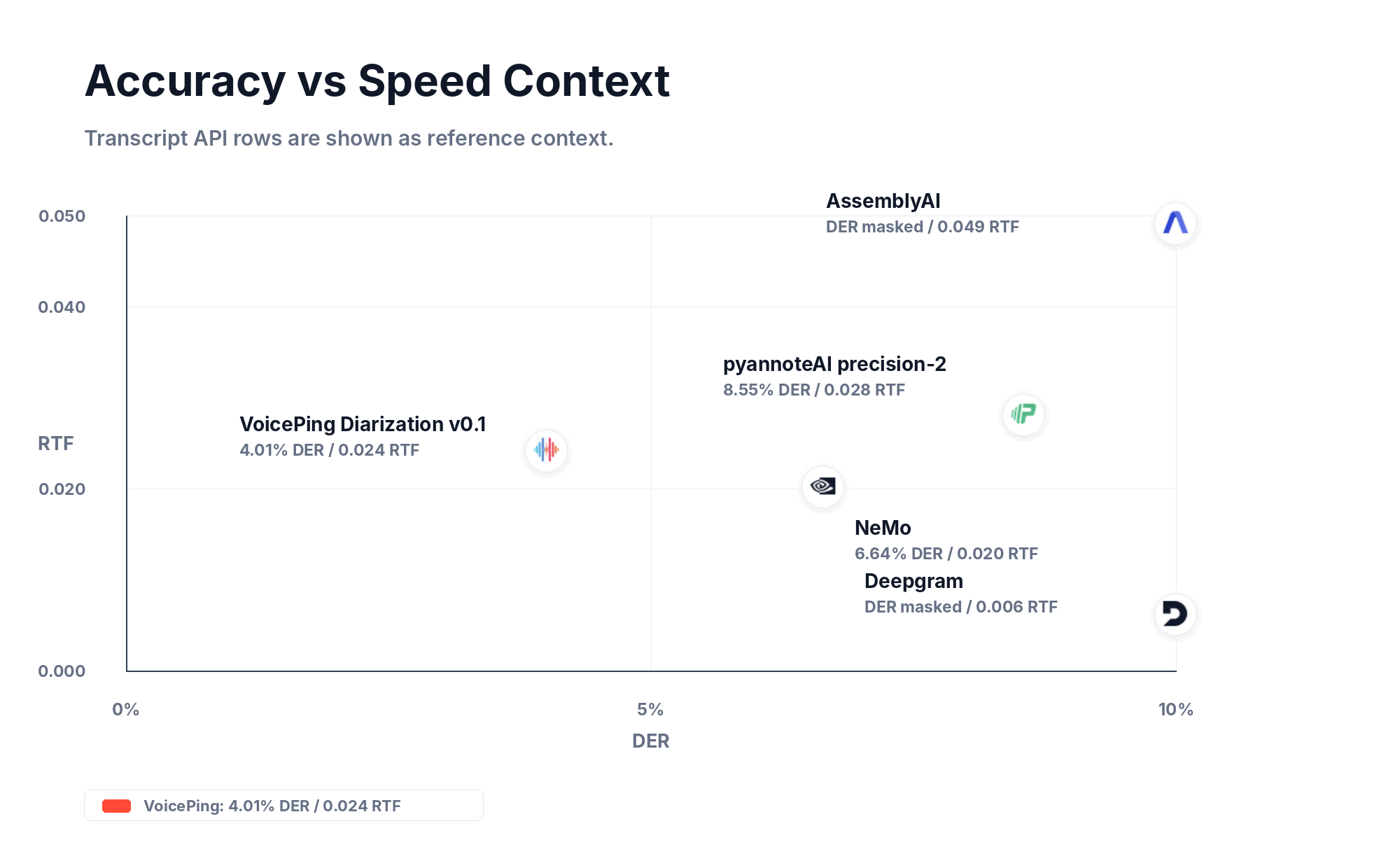
Local systems ke liye speed favorable rehti hai. PC-54 full-suite export VoicePing Diarization v0.1 ko 0.024 RTF, NeMo ko 0.020 RTF aur pyannoteAI precision-2 ko 0.028 RTF report karta hai. API timings provider behavior include karti hain aur unhe hardware-normalized benchmark nahi, operational context ke roop mein padhna chahiye. Speed chart AssemblyAI aur Deepgram ko masked DER operational context ke roop mein rakhta hai taaki timing comparison operating context par focused rahe.
speaker-attributed transcript APIs: useful, lekin different
Deepgram aur AssemblyAI transcription output mein speaker labels attach karte hain. Jab user ko speaker-attributed transcript chahiye, yeh useful hai, lekin full audio timeline ko diarize karna iske samaan nahi. Agar speech transcribed nahi hoti, ya kisi language mein transcript unstable hai, to speaker timeline bhi woh limitation inherit karti hai.
AssemblyAI Deepgram se zyada acoustic tareeke se behave karta hai, lekin public table mein kuch rows ab bhi masked hain. Is article mein dono providers methodology, overall view aur language views mein rehte hain kyunki woh common buying-path references hain, na ki isliye ki woh strongest diarization competitors hain.
VoicePing ke liye iska matlab
Yeh article selected VoicePing benchmark result ko VoicePing Diarization v0.1 ke roop mein present karta hai. Isse story internal experiment names ki jagah customer-facing model identity par focused rehti hai. VoicePing Diarization v0.1 benchmark lead karta hai, aur serious comparison to watch pyannoteAI precision-2 hai.
Isse continued internal diagnosis ki importance kam nahi hoti. Production diarization sirf ek stage hai: transcript alignment, speaker segmentation, aur phir known workspace voices ke against speaker identity matching. Final stage anonymous labels ko meetings ke across same colleague name mein convert karta hai, jo benchmarked APIs provide nahi karte. Next public follow-up ko full production pipeline evaluate karna chahiye, sirf is isolated segmentation row ko nahi.
Isi wajah se article unstable short-clip anecdotes ko ratios ke roop mein publish karne se bachta hai. Short files real failure modes expose kar sakti hain, lekin story ko ek scenario par overfit hone se bachane ke liye enough examples wala separate acceptance test chahiye. Production question sirf yeh nahi ki segmenter controlled corpus jeetta hai ya nahi; question yeh hai ki users live meetings, uploaded calls aur short voice snippets mein consistently correct speaker names, stable turns aur useful transcripts dekhte hain ya nahi.
Limitations aur conclusion
Main limitation evaluation set hai. Synthetic conversations exact references deti hain, lekin real meetings se cleaner hain aur hamare training data se related domain se aati hain. Timeline bhi wall-to-wall speech ke kareeb hai, isliye false-alarm behavior par enough stress nahi aata. Final production claims se pehle harder overlapping-speech recordings wala real out-of-domain multi-speaker set ab bhi zaroori hai.
In limits ke andar main conclusion hai: VoicePing Diarization v0.1 42-file benchmark lead karta hai, pyannoteAI precision-2 dedicated commercial API row hai jise watch karna chahiye, aur jahan masked cells appear hote hain wahan speaker-attributed transcript products qualitative references rehne chahiye. Next work ko production model identity, short-audio behavior, aur end-to-end production pipeline benchmark par focus karna chahiye.