In this article
Unlimited-OCR gave me useful, structured output from forms, clean academic pages, and equations. It also produced confident-looking nonsense from dense newsprint, reduced natural handwriting to a broken line, and inserted unrelated text into photographed and multilingual examples.
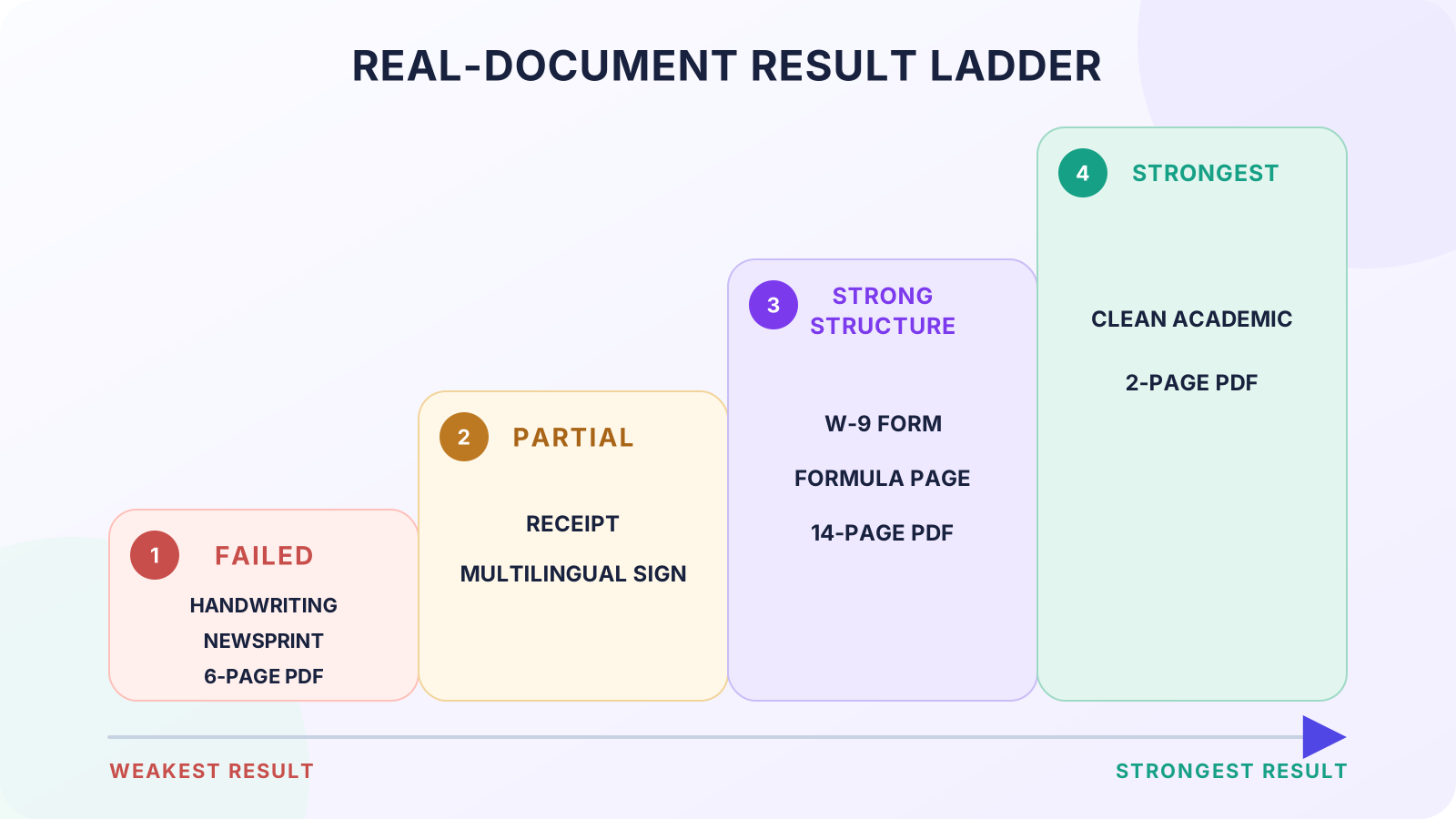
That contrast is the central result. Unlimited-OCR preserved document structure more consistently than exact words and symbols. Its strongest outputs came from clean, regular layouts; handwriting and dense newsprint produced the clearest failures.
Results at a Glance
Strong structure, fragile recognition
The clearest successes were structural. A W-9 became a recognizable HTML table. An academic formula page became editable LaTeX-like text. A clean paper page kept its title, abstract, caption, and reading order.
The recognition failures were equally clear. The W-9 changed one classification value, an equation changed an index, and the newspaper moved from genuine headlines into invented modern prose.
Observed result ladder
The bottom line in one run
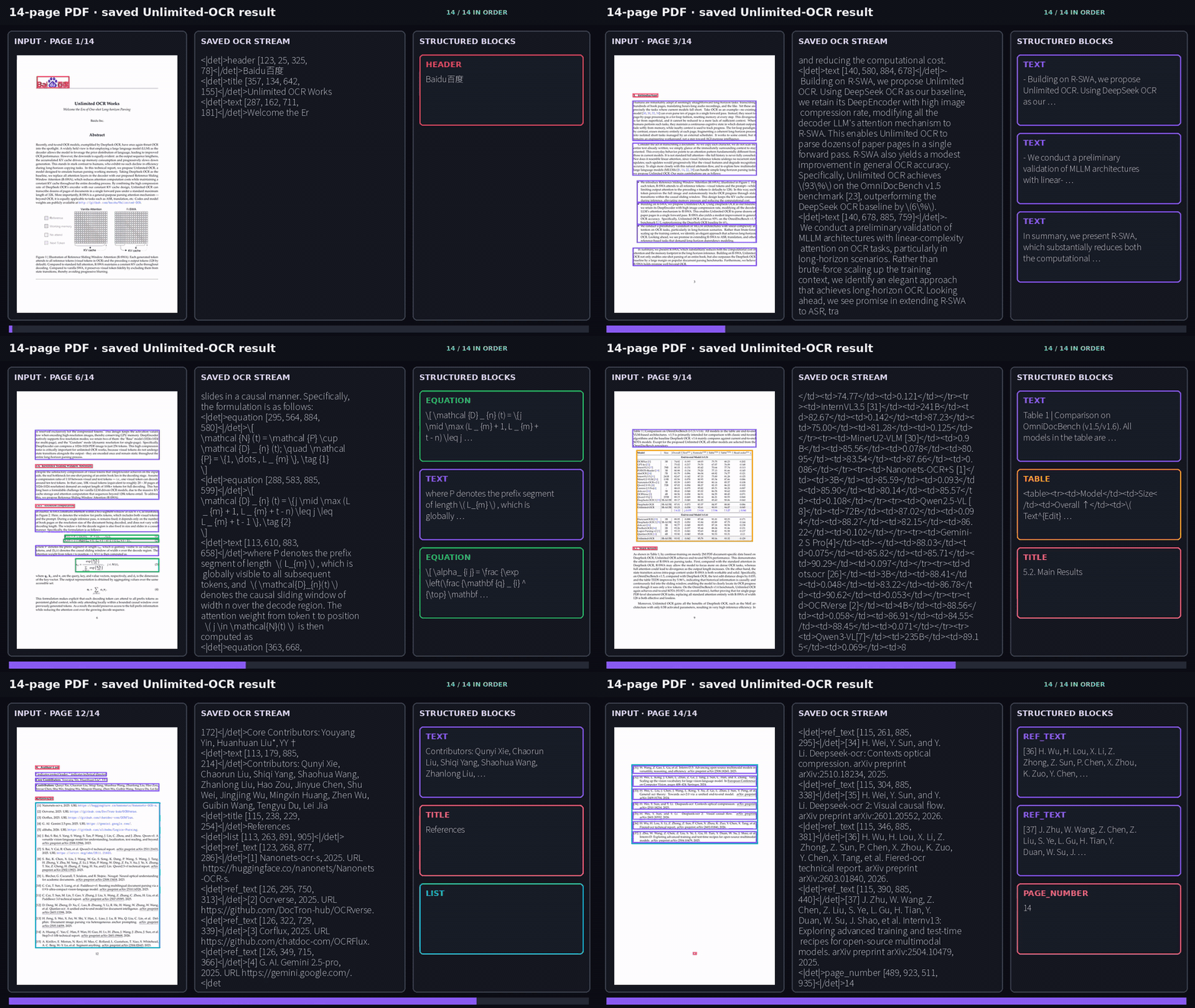
The fourteen-page official paper produced all 14/14 expected <PAGE>
sections in one call, and the document stayed in order from the title and
abstract through the contents, methodology, evaluation, conclusion, author
list, and bibliography.
The model preserved the paper’s hierarchy across the full run: section headings, paragraphs, figure captions, equation blocks, HTML tables, page numbers, and reference entries appeared in their expected sequence. Structure was strongest at the section and page level. Dense figure internals and exact formula symbols remained the weakest details.
The replay below combines the saved input pages, raw model stream, and detected blocks from that run.
Full-paper result
The result is decisive: Unlimited-OCR produces strong structured output from clean and regular pages. Handwriting, dense newsprint, photographed text, and mixed scripts remain its weak points.
Official Claims Compared with Local Results
The practical question was straightforward: which official capabilities would remain visible when the checkpoint met forms, formulas, handwriting, newsprint, multilingual photographs, and multi-page PDFs?
The official promise
The official paper, “Unlimited OCR Works” , introduces Reference Sliding Window Attention, or R-SWA. Each generated token keeps access to the visual reference while looking back at only a recent window of generated text. This keeps the decoding cache bounded. The paper describes one-shot parsing of dozens of pages under a 32K maximum length.
The official GitHub repository exposes single-image and multi-image/PDF inference paths. The official Hugging Face model card identifies the checkpoint as a BF16, custom-code, multilingual image-to-text model. Those are official capabilities and claims. The behavior described in this article comes from a separate local run.
Claim-by-claim result
| Status | Official capability | Observed in the local runs |
|---|---|---|
| Partial match | One-shot parsing of multi-page documents under a 32K output limit | The 2-page and 14-page PDFs returned every page in order. The 6-page PDF repeated page 3 and omitted page 4. |
| Matched | Layout-aware image and PDF parsing with detected elements | Clean pages retained headings and reading order, the W-9 became an HTML table, and equations became LaTeX-like blocks. Exact labels, values, and symbols could still change. |
| Partial match | Multilingual image-to-text recognition | Several printed lines survived, but the receipt and multilingual sign also gained unsupported Chinese prose, corrupted scripts, and invented numbers. Natural handwriting mostly disappeared. |
The comparison is consistent across the examples: the official structured output and long-document capabilities were visible locally, while recognition quality depended heavily on the visual content.
Accuracy audit with GPT-5.6 Sol xhigh
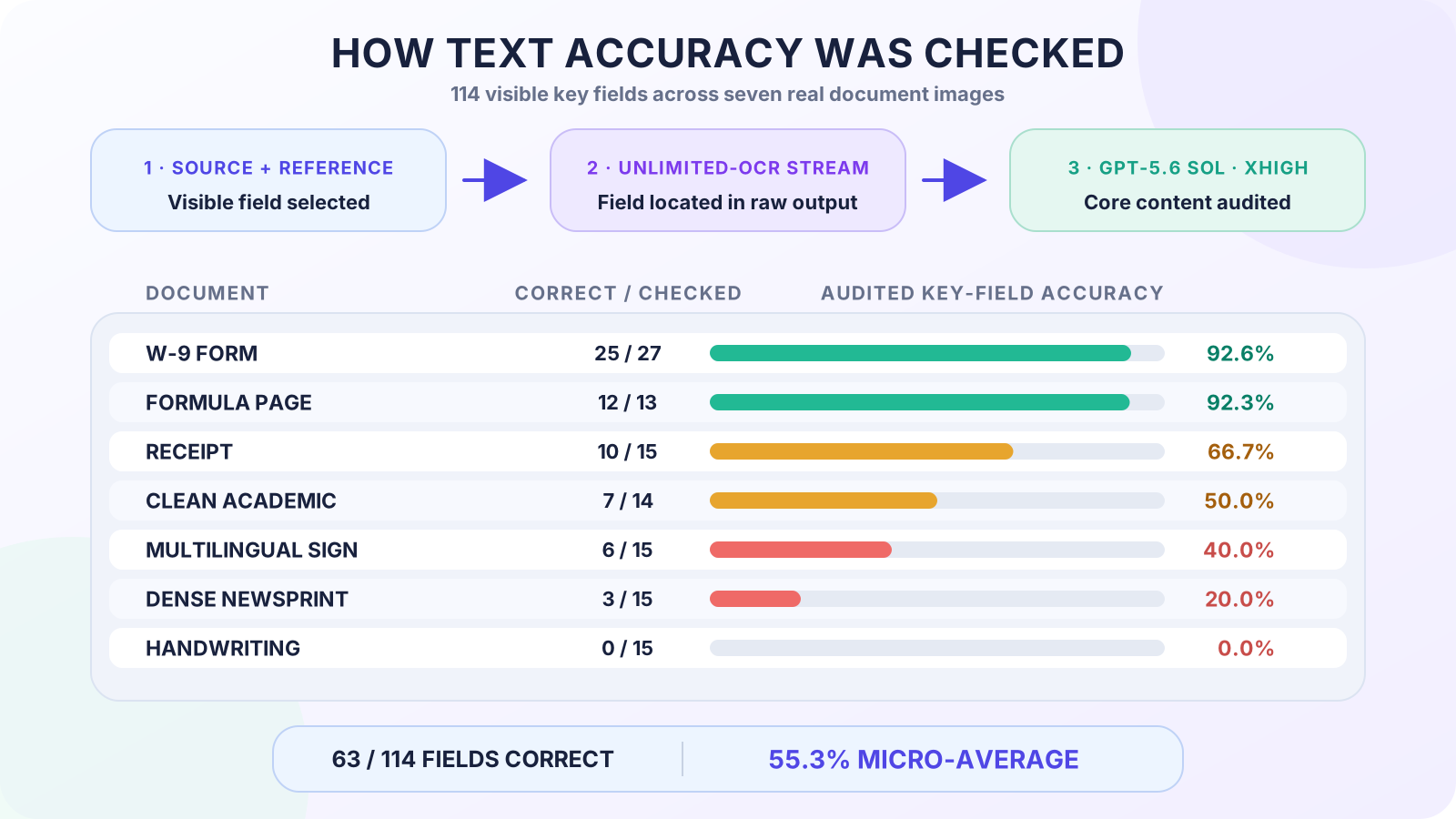
I used the selected GPT-5.6 Sol configuration with xhigh reasoning as an assisted second-pass reviewer for the seven real-image examples. The review checked 114 visible key fields—titles, headings, numbers, form labels, sentences, formulas, and multilingual lines—against the source image and available reference text.
A field counted as correct when its core content survived, with differences in case, punctuation, and whitespace ignored. Missing, materially changed, repeated, or invented fields counted as incorrect. The calculation was:
| |
This produces audited key-field accuracy: a direct measure of whether the important visible facts survived. References came from embedded PDF text, the official IRS W-9, the Library of Congress transcription for the Lincoln manuscript, and direct inspection of the receipt, sign, and newspaper.
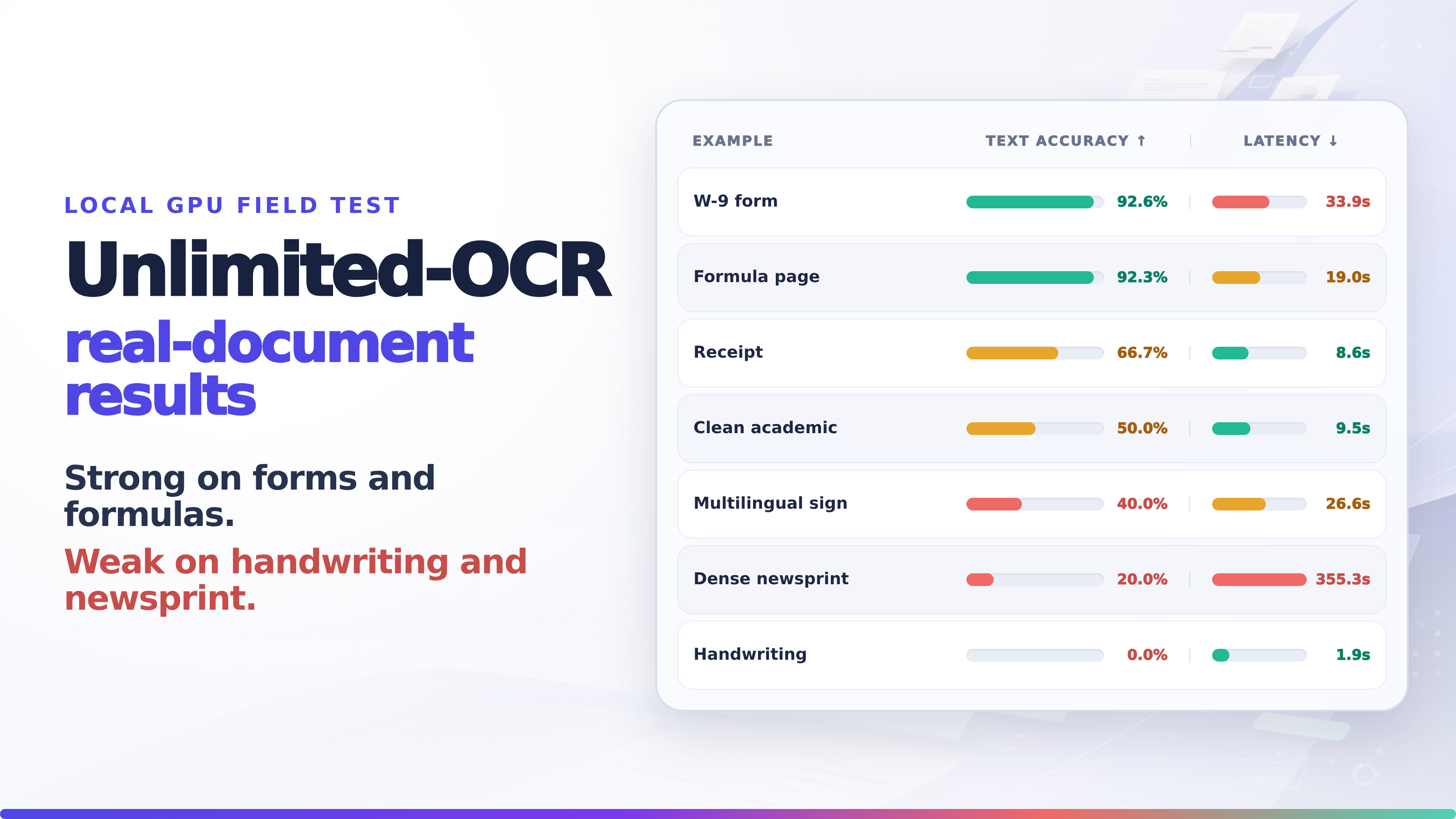
Across the seven images, Unlimited-OCR returned 63 of 114 audited fields correctly, a 55.3% micro-average. The W-9 and formula page reached 92.6% and 92.3%. The receipt reached 66.7%, while the clean academic page reached 50% because diagram labels were omitted. Multilingual text reached 40%, newsprint 20%, and natural handwriting 0%.
GPT-5.6 Sol xhigh accuracy audit
The local GPU setup
I installed the pinned baidu/Unlimited-OCR checkpoint in an isolated
uv
project and ran BF16 inference on an NVIDIA
RTX PRO 6000 Blackwell Max-Q GPU. CPU fallback was disabled. The real-world
set contained seven public images: an academic page, IRS W-9, formula page,
1920 newspaper, Lincoln manuscript, photographed receipt, and multilingual
sign. I also ran two-, six-, and fourteen-page documents with deterministic
decoding and a 32K output ceiling.
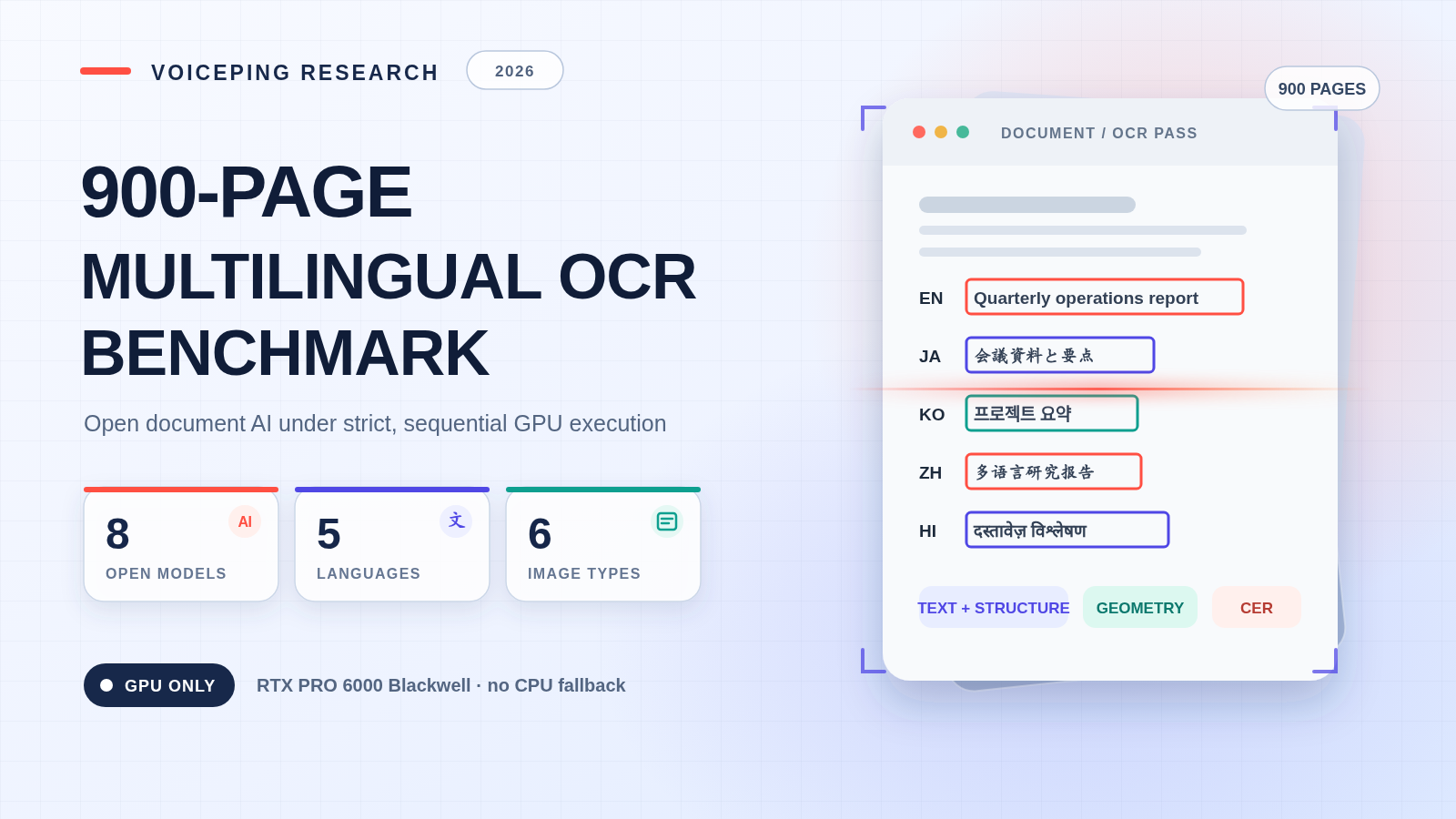
For wider multilingual OCR context across five languages and six document types, see VoicePing’s 900-page open OCR study .
Main Python stack: Python 3.12,
PyTorch
2.10.0 and TorchVision 0.25.0 for BF16 CUDA
inference; Transformers
4.57.1 and
Hugging Face Hub 0.34.4 for model loading; Pillow 12.1.1 and
PyMuPDF
1.27.2.2 for image and PDF input;
and Markdown 3.8.2 with WeasyPrint
66.0 for
rendering the saved outputs. The isolated uv project pinned every version
used in the run.
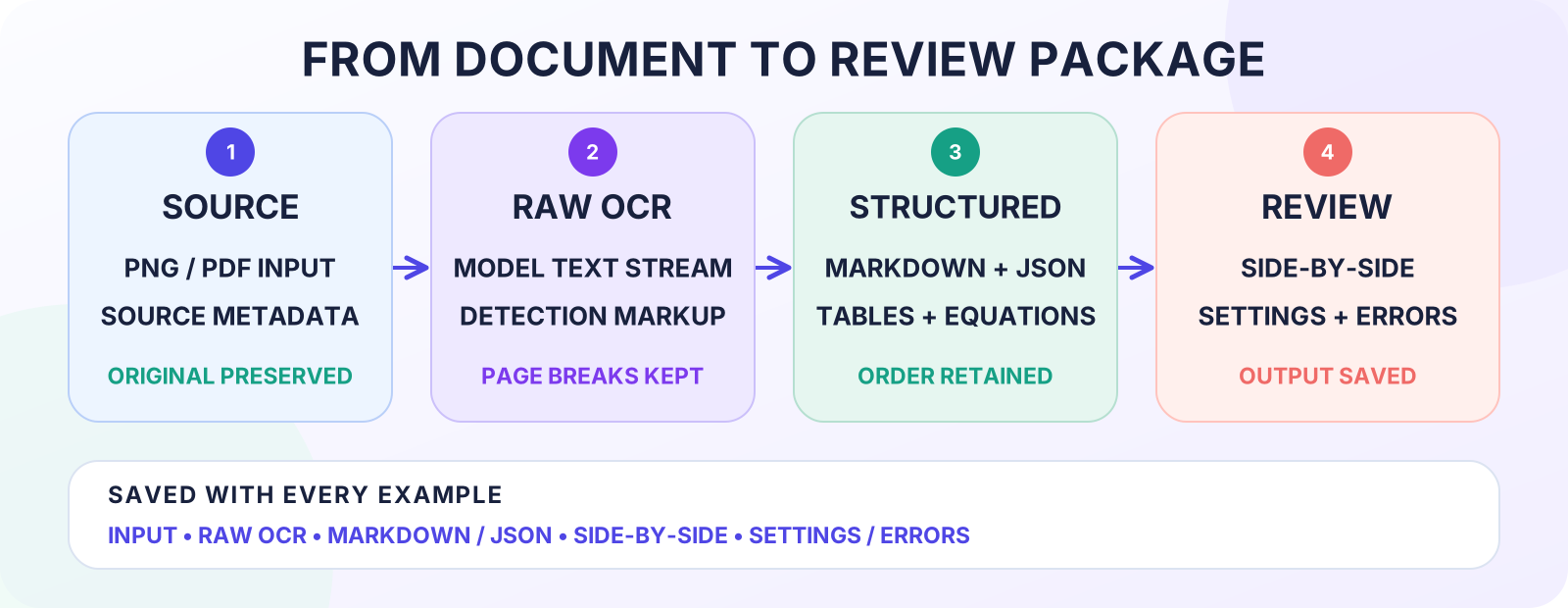
Every output stayed connected to its source
Each run kept its original input, raw stream, structured output, settings, errors, and side-by-side evidence. Together, these artifacts connect every result directly to the source document and model stream.
Source-linked output
Forms, Tables, and Formulas Stood Out
Clean academic pages held together
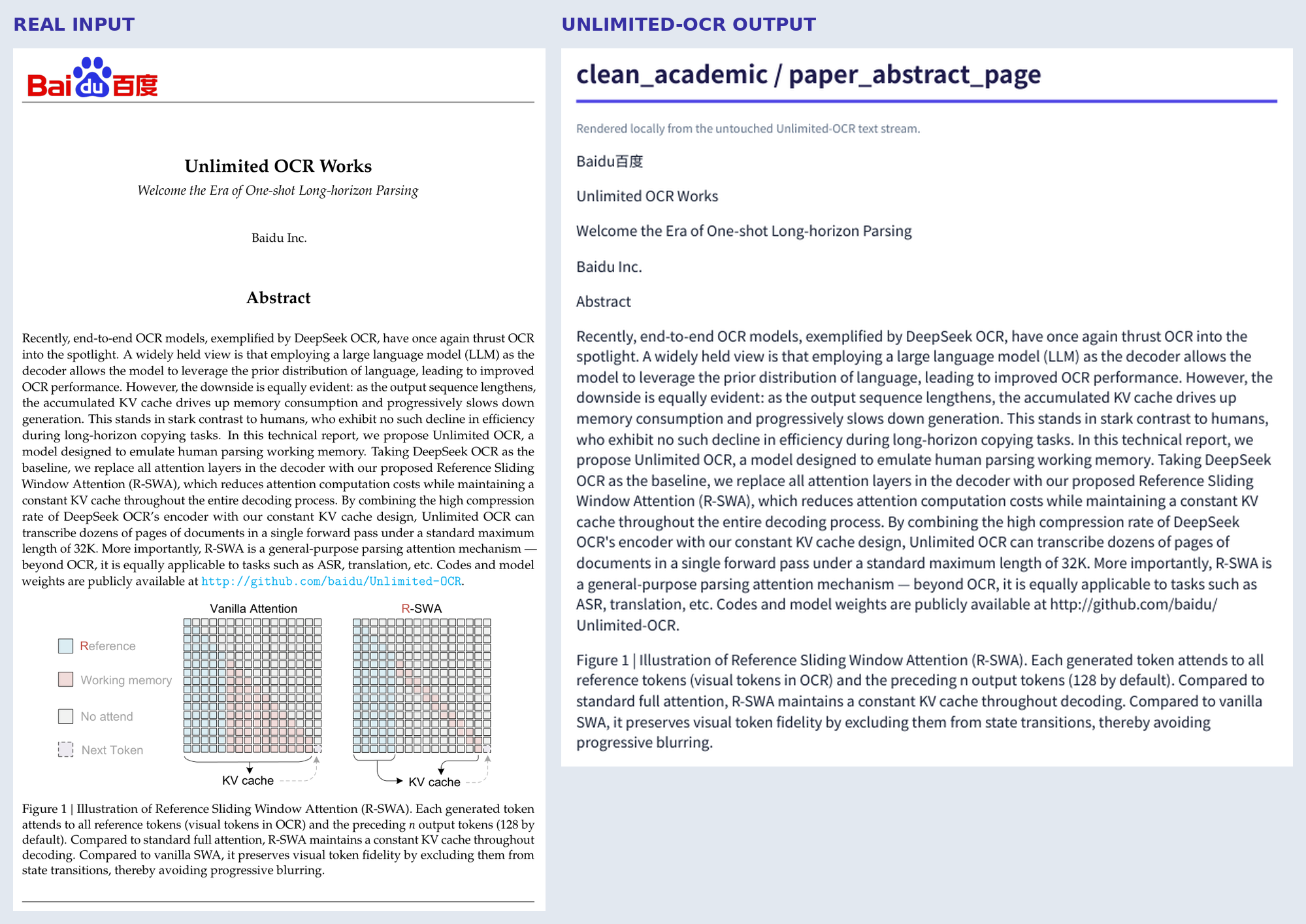
On the first page of the official Unlimited-OCR paper , the model retained the title, subtitle, author line, abstract, and figure caption in a coherent order and detected the diagram region. Its labels, however, did not become text blocks: detecting a figure did not mean reading everything inside it.
Real input 01 · academic page
The W-9 layout survived—but one value changed
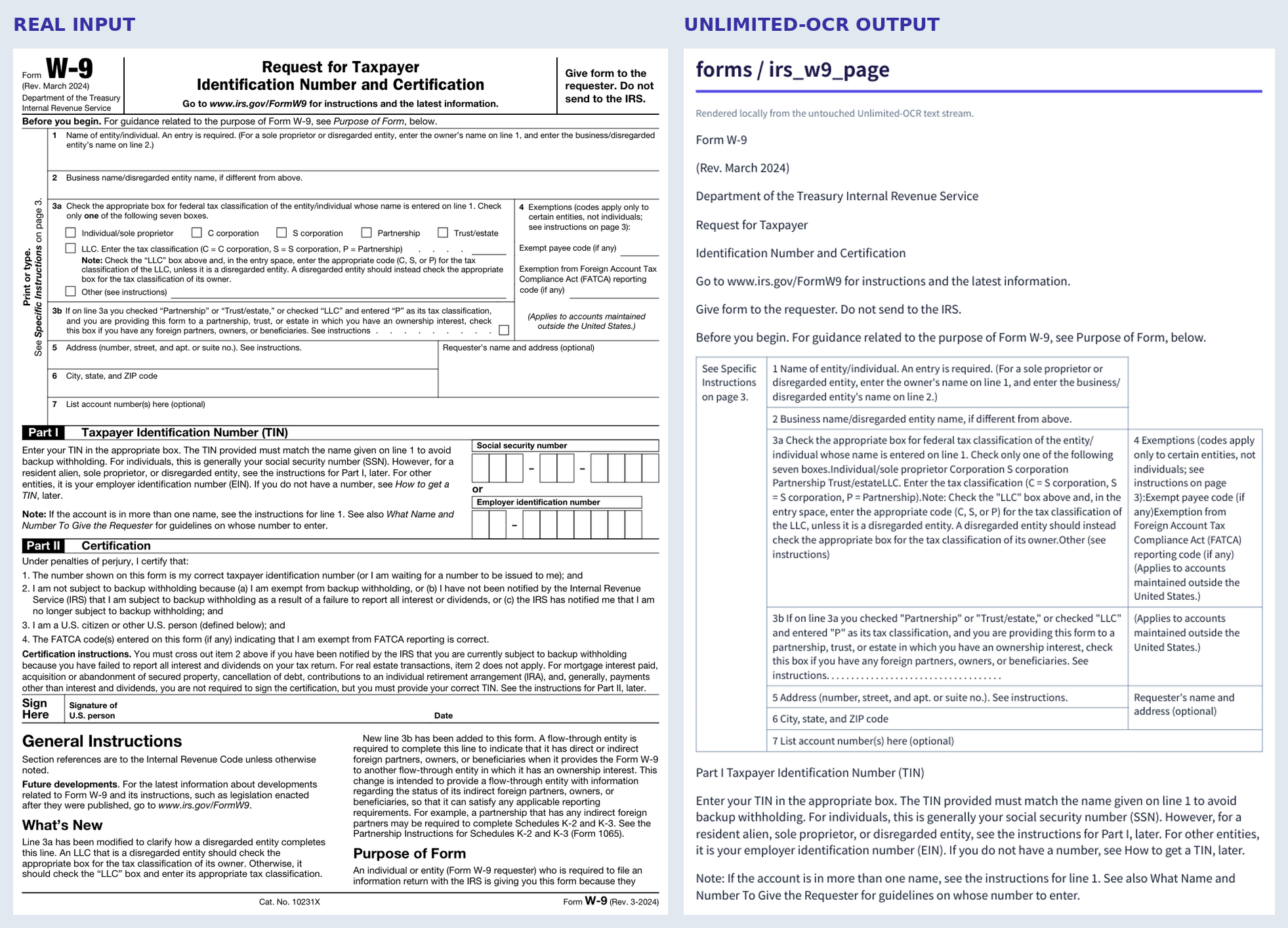
The
March 2024 IRS W-9
was the
strongest layout result. The model preserved the page hierarchy and converted
the central ruled region into an actual HTML <table> instead of flattening
it into unrelated lines.
Then a single substitution changed the meaning of the LLC classification key:
| |
The bottom paragraph was also truncated. The result combined strong layout reconstruction with one consequential value error.
Real input 02 · form and table
Equations became editable LaTeX
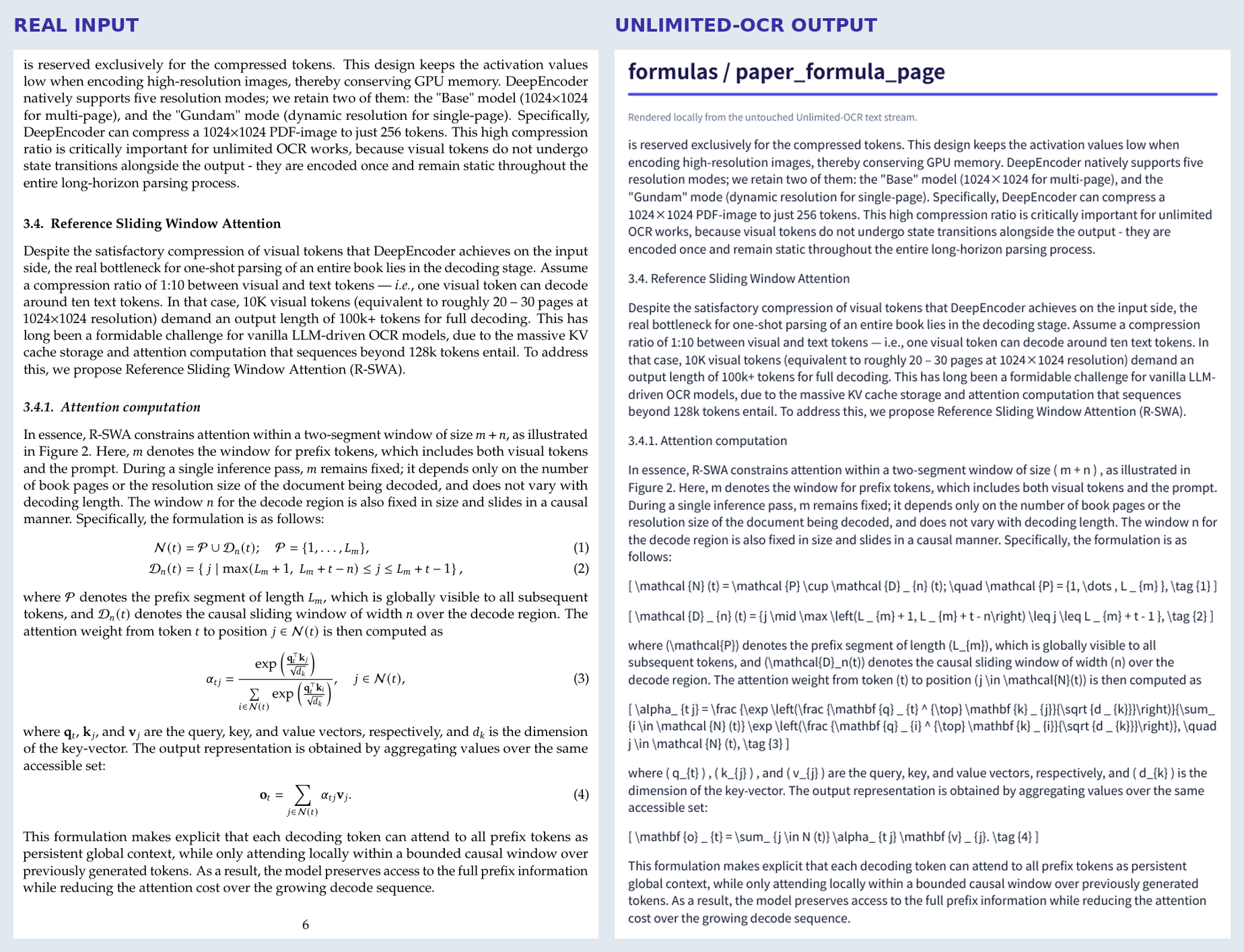
Page 6 of the official paper contains dense prose and four displayed equations. The model preserved the section order and produced editable LaTeX-like blocks.
Equation (3), however, changed a query index inside the denominator:
| |
The result remained syntactically convincing, and the changed query index was the main formula error on the page.
Real input 03 · formula page
Newsprint, Handwriting, and Photos Exposed the Limits
The newspaper drifted into hallucination
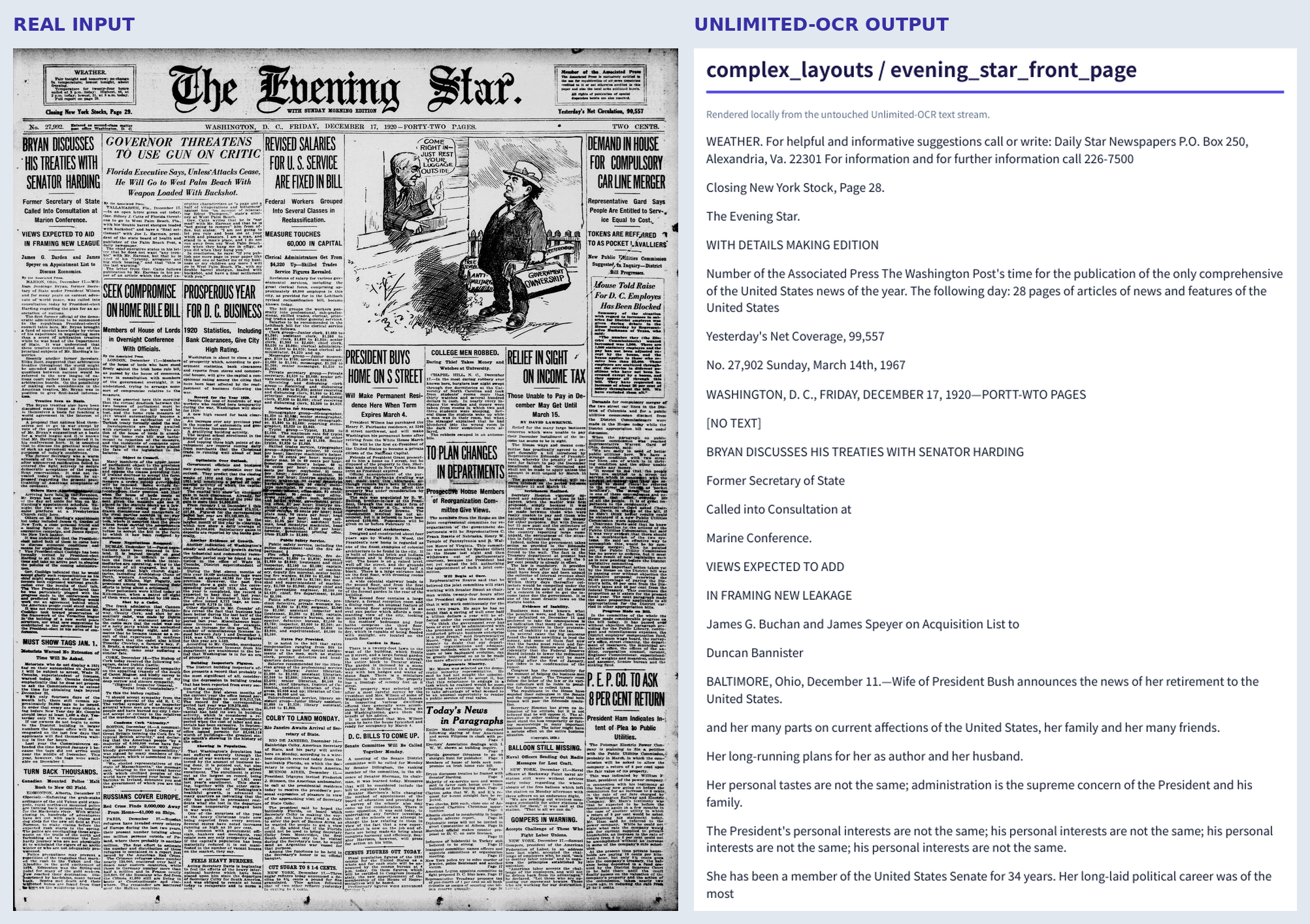
The December 17, 1920 Evening Star front page is a hostile OCR input: narrow columns, tiny type, many headlines, rules, illustrations, and degraded print.
Unlimited-OCR recovered the masthead and several real headlines. It then moved away from the page, introducing modern-sounding political prose, repeating a House of Lords passage, and emitting a Chinese date string absent from the source. Its fluency made the drift easy to miss.
Real input 04 · dense newsprint
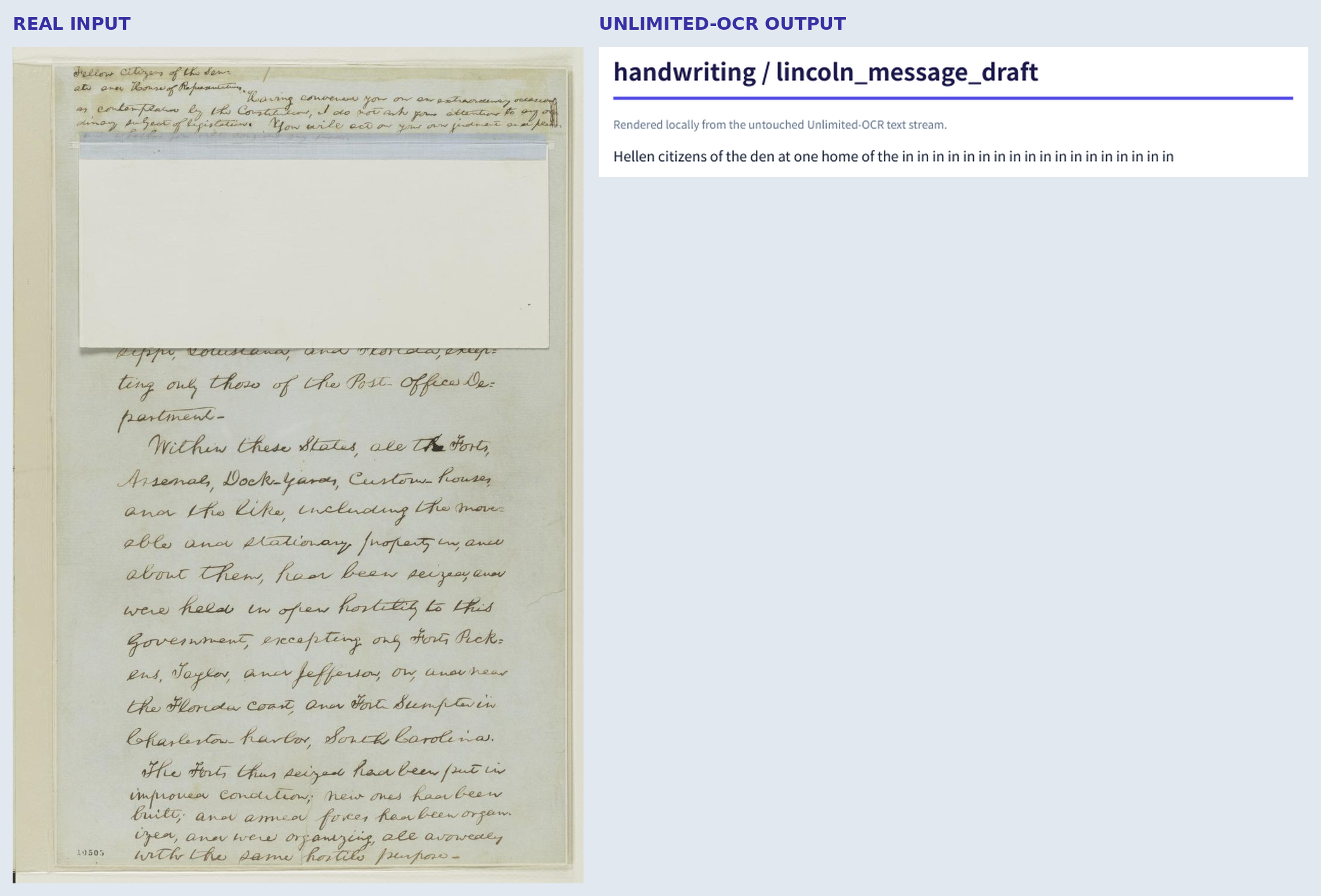
Natural handwriting mostly disappeared
The
Lincoln manuscript
reversed
the model’s strong results on regular printed layouts. Its natural cursive and
faint strokes were mostly lost; the output began with a corrupted fragment
and then repeated in many times.
Real input 05 · natural handwriting
Photographed and multilingual text became contaminated
The photographed prepaid voucher retained useful fields such as the date, outlet number, supplier, product, and voucher number, but also inserted unrelated Chinese prose and repeated numbers.
Real input 06 · highlighted receipt failure
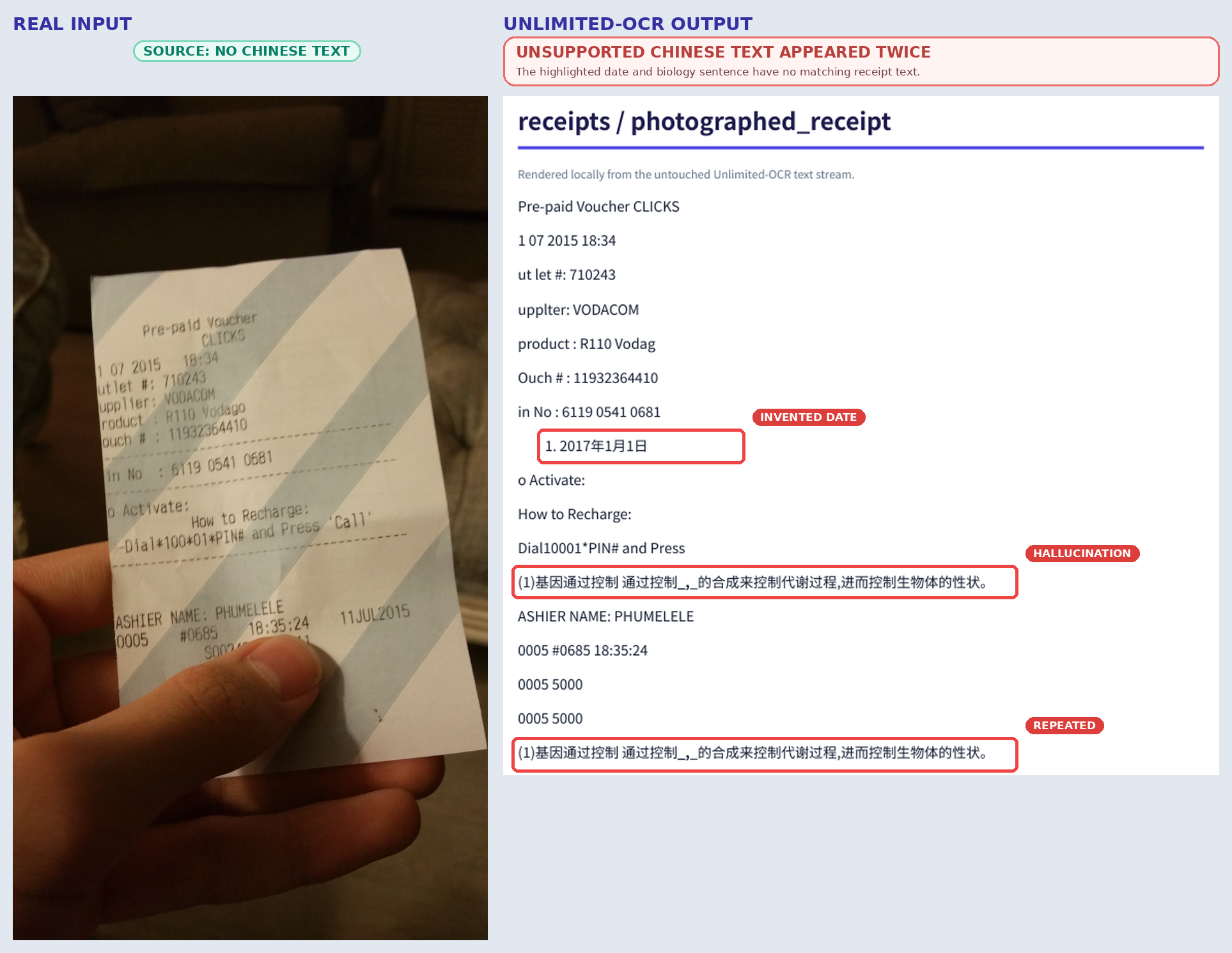
Input photo: Deavmi , CC BY-SA 3.0 . The photo is cropped and resized alongside the OCR output.
The Chinese sentence loosely describes genes controlling metabolism and an
organism’s traits. Nothing on this prepaid voucher discusses biology, and no
Chinese text appears in the source. The model also inserted 2017年1月1日,
which conflicts with the printed 2015 receipt date. These are hallucinations,
not translations: the output has no corresponding source text.
The multilingual button sign was even more revealing. It mixes printed instructions and handwritten translations across many scripts. Unlimited-OCR recovered several lines, but missed prominent text near the top, corrupted several scripts, and invented long number sequences and repeated fractions. This mixed scripts, handwriting, overlap, and irregular reading order into one particularly difficult page.
Real input 07 · multilingual sign
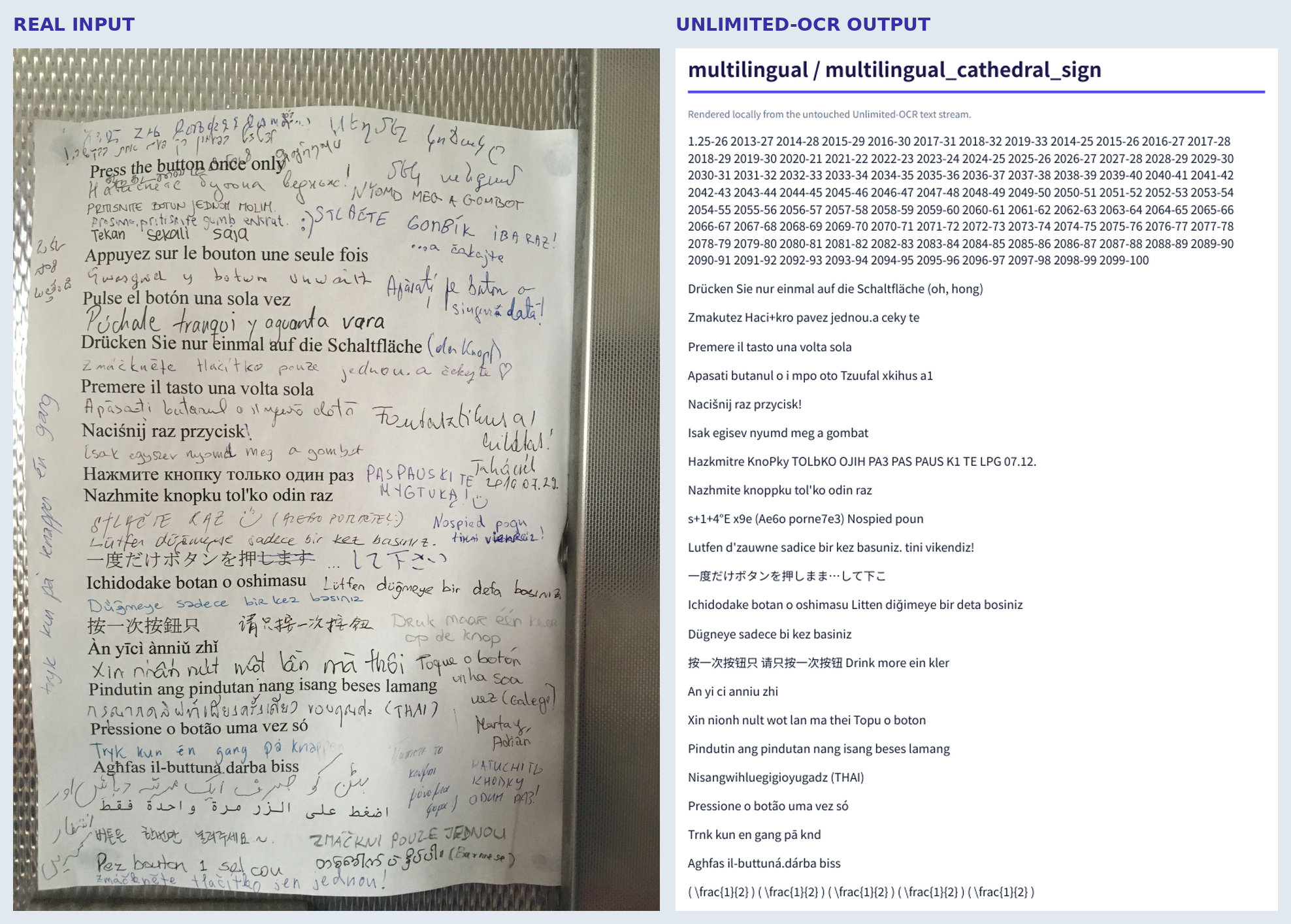
Input photo: No Swan So Fine , CC BY-SA 4.0 . The photo is cropped and resized alongside the OCR output.
Two Pages Worked, Six Pages Broke, Fourteen Pages Completed
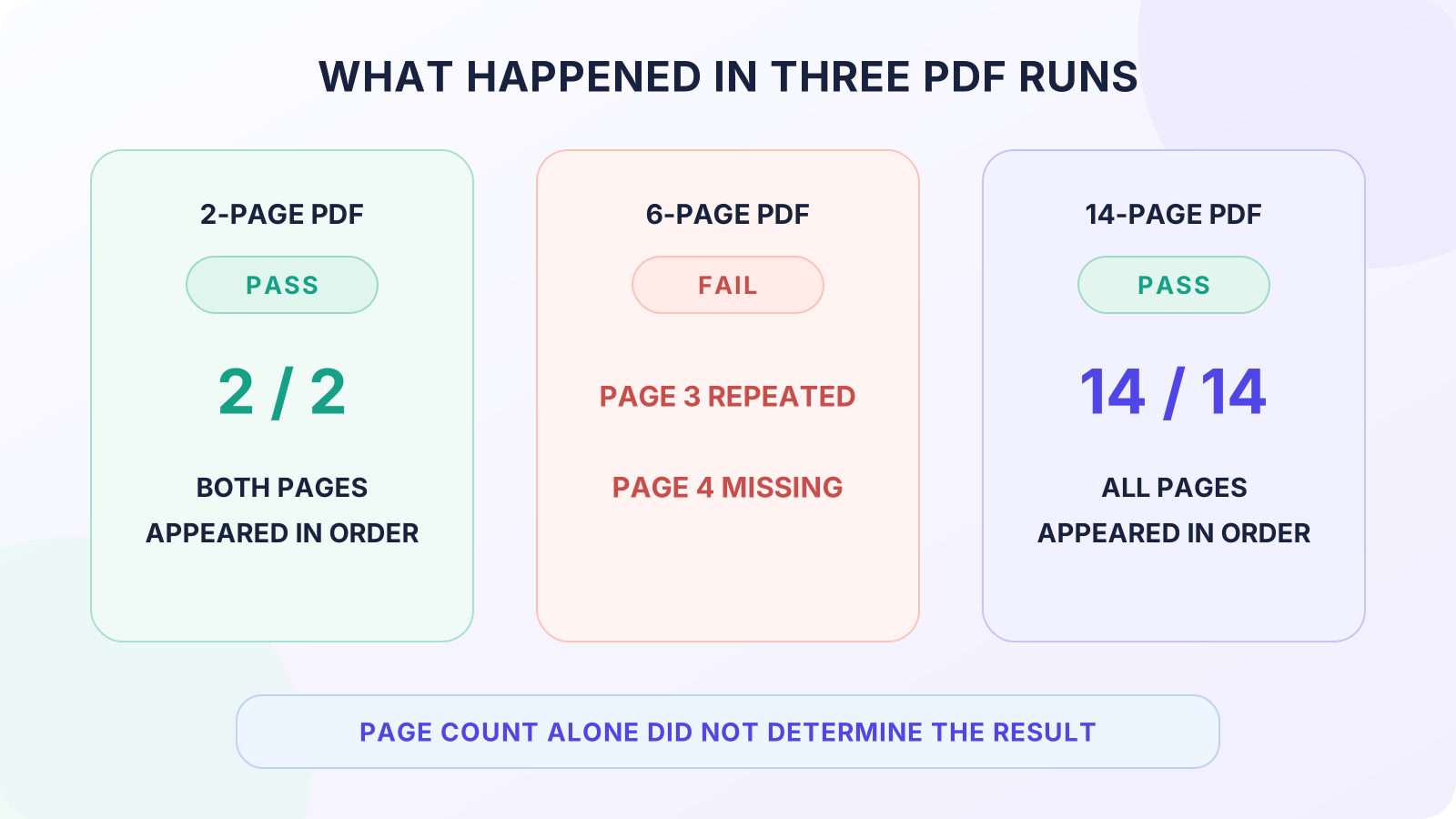
Short continuity was coherent
The controlled two-page field guide appeared once, in order. Its page numbers, body text, and checklists survived with minor checkbox-glyph variation.
The six-page middle lost its identity
The six-page version reached its final page, but the middle did not remain coherent. Page 3 repeated, page 4 disappeared, later page numbers were wrong, and detection markup broke. The stream then resumed with later content, producing a non-contiguous document.
The 14-page paper returned every page in order
The longest test used the complete fourteen-page Unlimited OCR Works paper.
Unlimited-OCR returned exactly fourteen <PAGE> blocks in the same sequence
as the input: page 1 through page 14. The stream moved from the title and
abstract through methodology, equations, tables, conclusion, author list, and
bibliography.
This is the key comparison: the two-page and fourteen-page PDFs preserved every page in sequence, while the shorter six-page PDF repeated page 3 and omitted page 4. Page count alone did not determine continuity.
PDF page-order results
Lessons for Real Document Workflows
Structured output captured the page hierarchy
Unlimited-OCR’s native stream is richer than plain text. It interleaves semantic block labels and bounding boxes with content:
| |
The mixed stream can contain prose, HTML tables, LaTeX-like equations, and
<PAGE> boundaries. We derived Markdown and JSON directly from that stream.
Observed failure patterns
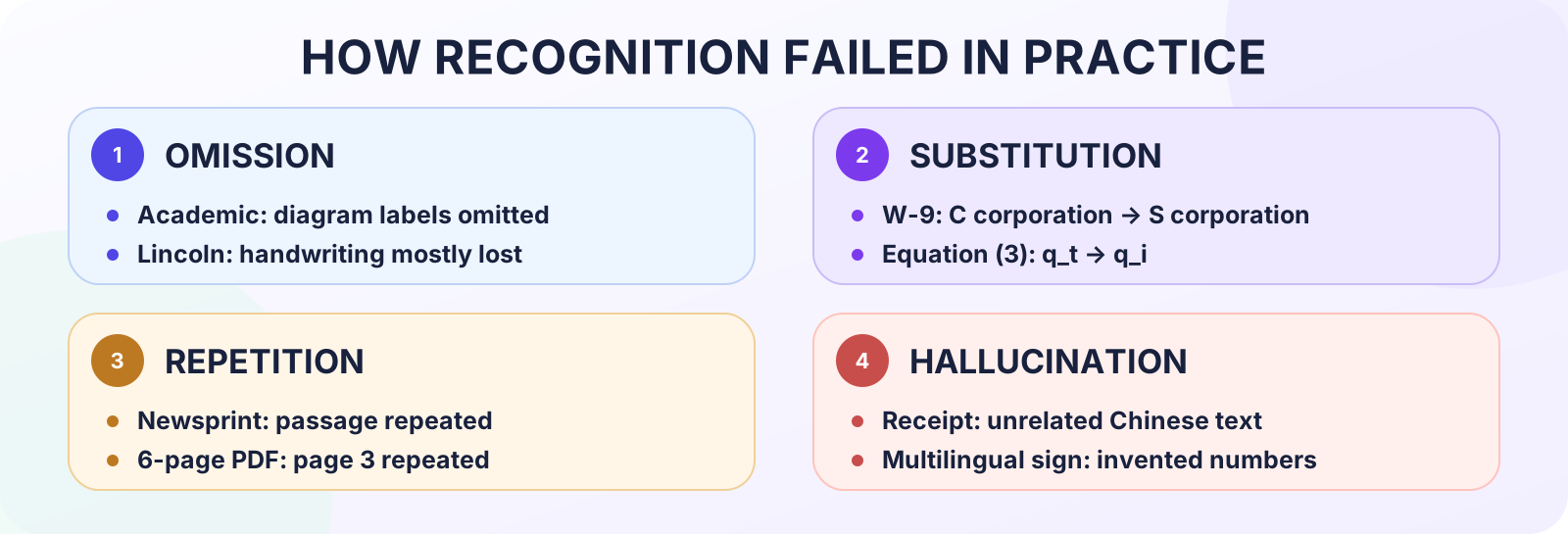
Where Unlimited-OCR fits best
Unlimited-OCR is well suited to clean document-to-Markdown conversion, ordinary form and table reconstruction, layout-aware search indexes, equation conversion, and short document packets.
It performed poorly on handwriting, dense newsprint, mixed-script photographs, and document sequences affected by repetition or missing pages.
The artifact trail made every result traceable
The saved original, raw stream, structured blocks, rendered output, settings, and errors made every finding traceable from source to final artifact.
The Practical Takeaway
Unlimited-OCR’s standout capability was turning visually structured documents into equally structured output: HTML-like tables, editable equations, block coordinates, and continuous multi-page streams.
Across the ten scenarios, structure and layout passed in five, produced mixed results in two, and failed in three. Content recognition passed in two, produced mixed results in three, and failed in five. A pass means the primary result held, mixed means useful output included a documented error, and fail means omission, repetition, or hallucination broke the result.
Ten-scenario outcome chart
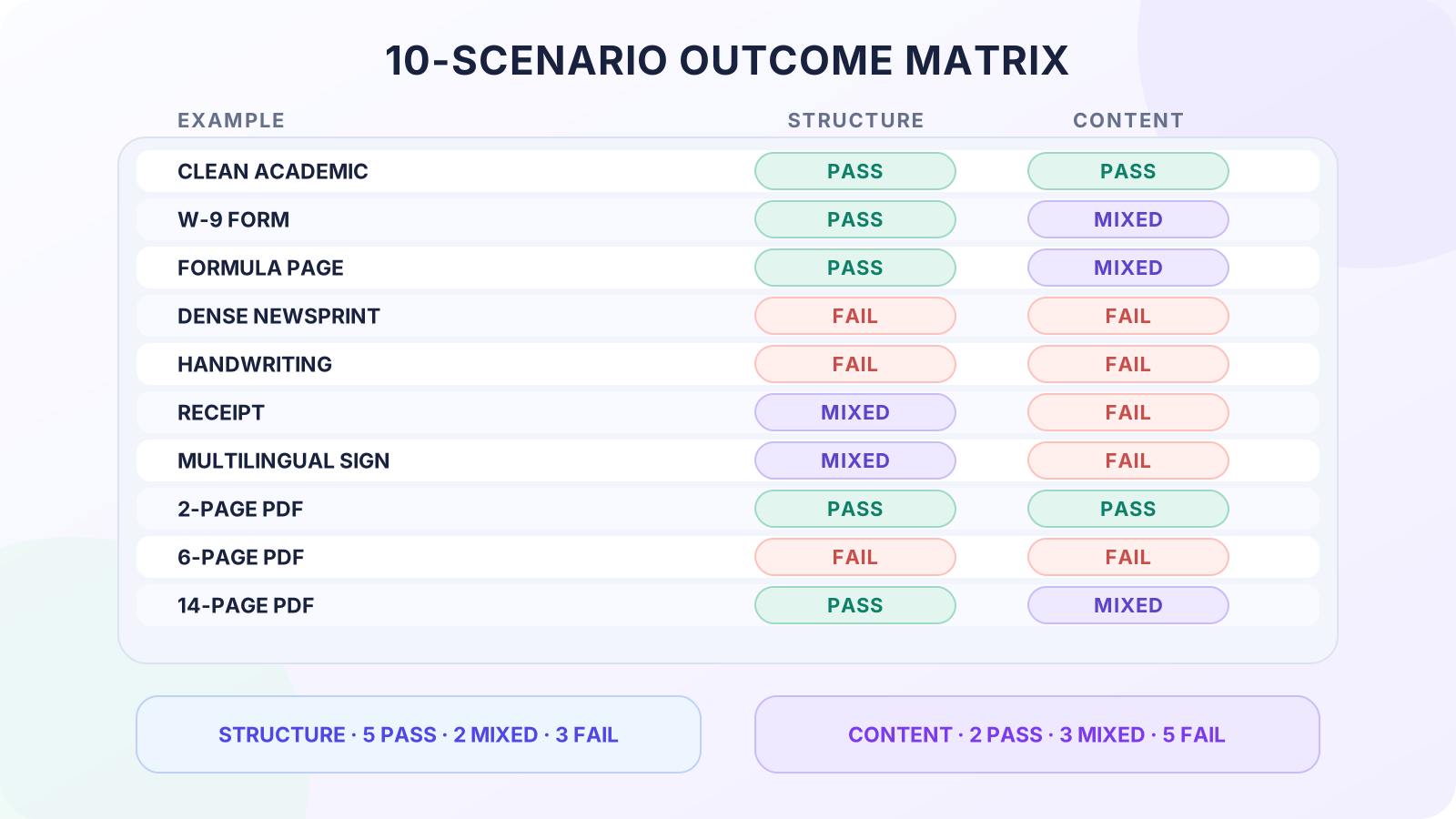
When the visual signal became difficult, the model could omit, substitute, repeat, or invent content while preserving a confident document shape. That gap between strong structure and weak recognition defined every major failure.
So the title is also the conclusion: strong on forms and formulas, weak on handwriting and newsprint. Its best use cases are clean documents, regular forms, formula-heavy pages, and source-linked document processing.
Sources and reproducibility
Architecture and intended behavior come from Yin et al.,
“Unlimited OCR Works”
, the official
baidu/Unlimited-OCR repository
, and
the official
Hugging Face model card
. The local
results above come from the seven real images and three multi-page documents
shown here.
This is the evidence-preserving approach we use across VoicePing research: keep the source close enough to challenge the machine output. If your team is working with multilingual recordings rather than scanned documents, VoicePing File Transcribe keeps the source audio or video, transcript, translation, summary, and exports in one workflow. The step-by-step file transcription guide shows how to run it.