In this article
Speaker-identification benchmarks often foreground small equal-error-rate differences and a model ranking. We instead organize this study around the decision that matters in an open-set system: whether the top match is strong and unambiguous enough to accept when the probe speaker may not be enrolled.
Executive conclusion
All five models perform similarly once four seconds of speech and four enrollment examples are available. At two seconds, ReDimNet-B6 and w2v-BERT-SV form the leading group. ReDimNet has the strongest overall research case because its compact checkpoint is consistently strong across the primary held-out evaluation and the clean and large-gallery supporting checks. This is not enough evidence for a production replacement.
The most important operational result is that rejection calibration is model-specific. A universal cosine threshold compares differently scaled embedding spaces rather than only speaker-discrimination quality. Each checkpoint needs a threshold and top-one-versus-top-two margin selected on representative development identities.
The rest of the article answers four questions in order: Which models remain reliable when speech is short? Do model differences persist once four seconds are available? How should unknown speakers be rejected? And do the combined accuracy, compute, and licensing results support a production decision?
Primary held-out evaluation
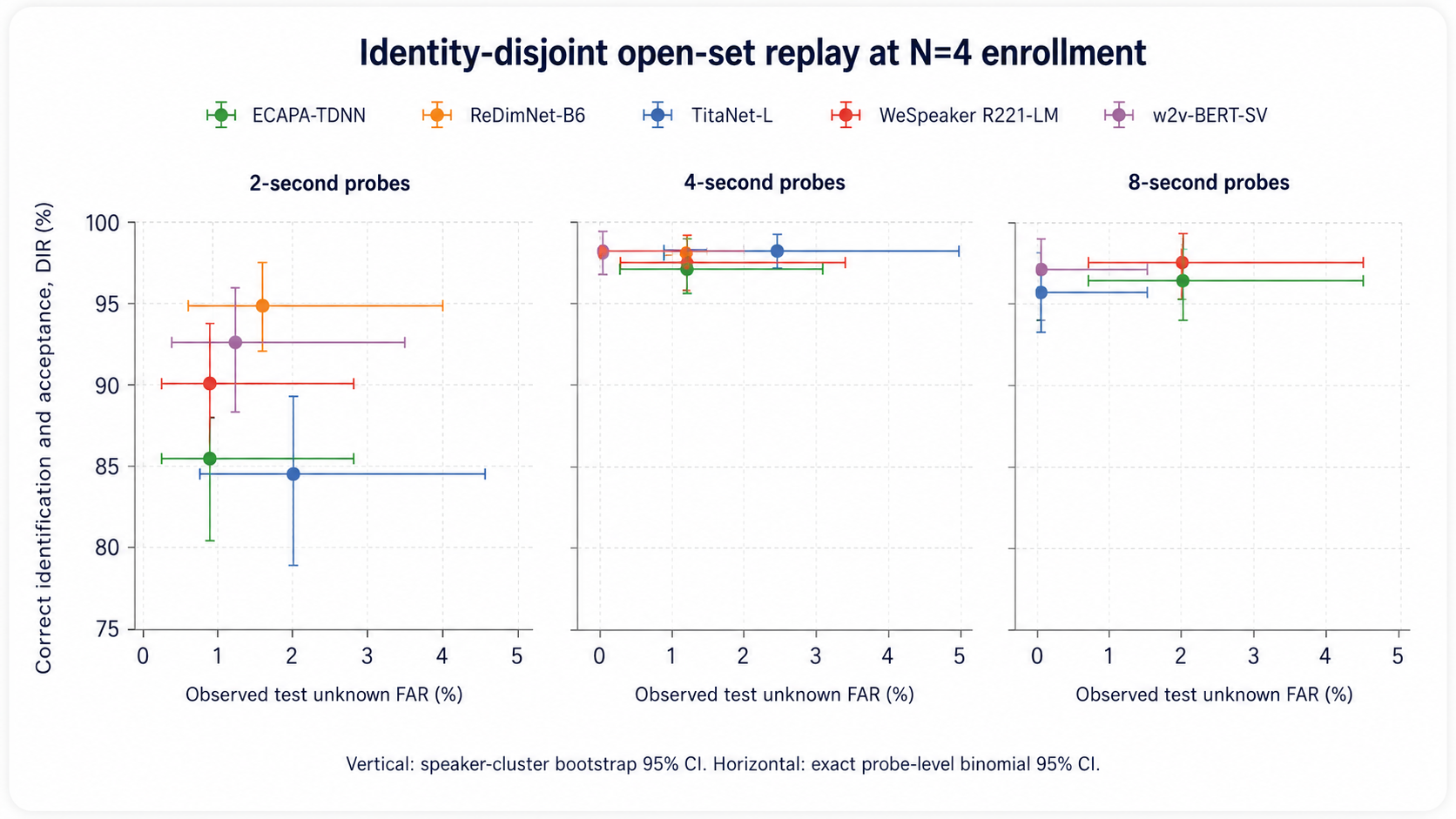
Which evidence should carry the most weight? The identity-disjoint open-set comparison is primary because it separates calibration speakers from final test speakers while comparing all five models. For each language, 20 identities remain in the gallery and 10 are removed completely. Five removed identities select the similarity threshold and top-two margin; the other five test those choices unchanged. This gives a 100-speaker gallery, 25 development-unknown identities, and 25 separate test-unknown identities. Every model receives the same hashed probe cohorts.
Open-set identification contains two coupled decisions: which enrolled speaker has the highest similarity, and whether that match is confident enough to accept. We report equal error rate (EER), detection-and-identification rate (DIR)—the fraction of known probes both correctly identified and accepted—and false accept rate (FAR) on unknown speakers.
Thresholds and margins are selected only on development identities under a development-unknown FAR target of at most 1%, then applied unchanged to the test cohort. Confidence intervals use 2,000 speaker-cluster bootstrap replicates, and 50 deterministic identity splits measure sensitivity to the selected speakers. This separation makes the held-out evaluation the most credible open-set evidence in the study.
The primary split with four enrollment embeddings produced:
| Probe | Model | EER (95% CI) | DIR (95% CI) | Observed test FAR |
|---|---|---|---|---|
| 2s | ReDimNet-B6 | 1.40% (0.54–1.98) | 94.80% (91.60–97.60) | 1.60% |
| 2s | w2v-BERT-SV | 1.05% (0.51–1.53) | 92.20% (87.80–96.00) | 1.20% |
| 2s | WeSpeaker R221-LM | 1.80% (0.75–2.81) | 89.60% (85.00–93.60) | 0.80% |
| 2s | ECAPA-TDNN | 2.20% (1.12–3.31) | 84.80% (79.80–89.20) | 0.80% |
| 2s | TitaNet-L | 2.22% (1.22–3.04) | 83.80% (78.20–88.80) | 2.00% |
| 4s | TitaNet-L | 0.60% (0.15–1.04) | 98.80% (97.60–99.80) | 2.40% |
| 4s | ReDimNet-B6 | 0.20% (0.01–0.60) | 98.60% (97.20–99.60) | 0.00% |
| 4s | w2v-BERT-SV | 0.62% (0.11–1.39) | 98.40% (96.80–99.80) | 0.00% |
| 4s | WeSpeaker R221-LM | 0.60% (0.11–1.54) | 98.20% (96.20–99.60) | 1.20% |
| 4s | ECAPA-TDNN | 0.80% (0.20–1.42) | 97.80% (96.00–99.20) | 1.20% |
This evaluation establishes the strongest overall evidence. The next section separates that evidence by operating condition so the model choice is clear for short speech, four-second speech, and unknown-speaker rejection.
Results by operating condition
The primary table answers three operational questions. Each subsection begins with the stable conclusion, then shows the point estimate and uncertainty that support it.
Which models hold up with only two seconds?
ReDimNet and w2v-BERT form the leading group when only two seconds are available. On the primary split, ReDimNet has the highest DIR. Paired speaker-bootstrap comparisons against TitaNet estimate an 11.0-point DIR gain for ReDimNet (95% CI 7.4–15.2), an 8.4-point gain for w2v-BERT (4.6–12.4), and a 5.8-point gain for WeSpeaker (2.2–9.6). All three remain significant after Holm correction; ECAPA’s one-point gain is not significant.
The stability analysis qualifies that point estimate rather than contradicting it. Across 50 deterministic splits, median DIR is 92.8% for w2v-BERT and 92.0% for ReDimNet, with substantially overlapping 5th-to-95th percentile ranges. The evidence therefore supports a leading short-speech pair, not a strict one-through-five ranking.
Does model choice still matter at four seconds?
Not meaningfully in the current evidence. At four seconds, none of the candidate-versus-TitaNet operational differences remains significant after correction. The intervals overlap and all five models are close to saturation. TitaNet’s 98.8% observed DIR therefore does not establish superiority, just as ReDimNet’s 0% observed FAR does not establish zero unknown-speaker risk. With 250 test-unknown probes, zero false accepts still has a 1.46% upper 95% exact binomial bound. Once four seconds are available, uncertainty and operating risk matter more than the model ranking.
How should unknown speakers be rejected?
Use model-specific calibration rather than a universal cosine threshold. The selected similarity threshold controls absolute match strength, while the top-one/top-two margin rejects ambiguous matches. Both must be chosen without using the identities reserved for final testing. The held-out results show that this rule transfers to unseen unknown speakers, but the small test cohort leaves material uncertainty.
These are the primary held-out conclusions. Before applying them more broadly, the next section asks whether they remain consistent under a simpler clean benchmark and a much larger gallery.
Supporting checks
Do the primary findings depend on one protocol? Two supporting checks answer different parts of that question. The clean benchmark tests baseline model strength and duration sensitivity across all five models; the 900-speaker diagnostic tests gallery growth for TitaNet and ReDimNet only. Neither replaces the held-out evaluation.
Clean multilingual benchmark
Are all five models fundamentally strong on clean speech? Yes. The clean benchmark uses 30 known and 10 unknown identities per language. Its primary condition is a balanced 150-speaker gallery with four-second probes and four enrollment embeddings. This is a supporting model-strength check, not the primary unknown-speaker or meeting-readiness result.
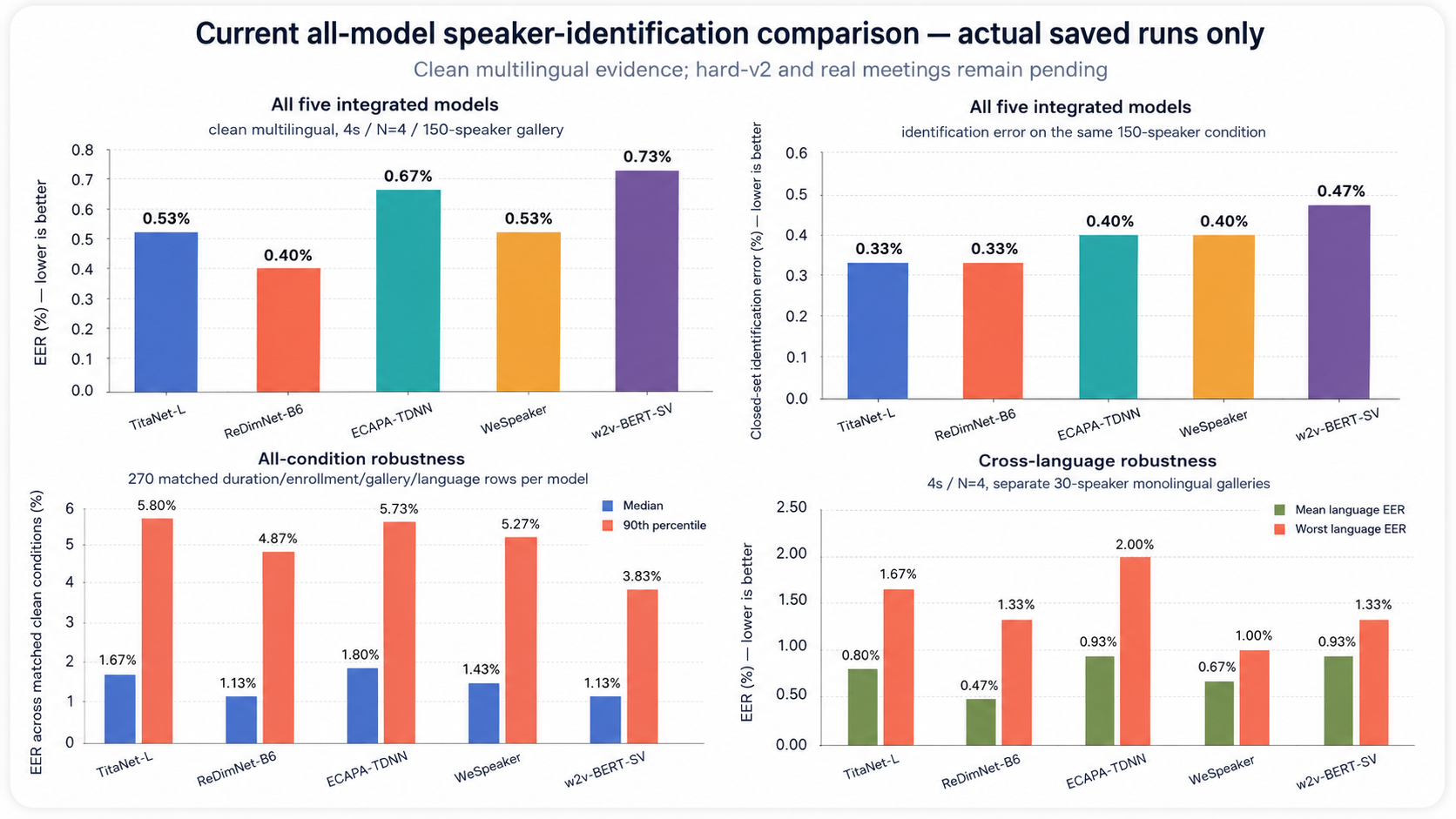
At four seconds, no model has an EER above 0.74%, and every model exceeds 99.5% closed-set top-1 accuracy. ReDimNet records the lowest EER, but the full spread is only 0.33 percentage points.
| Model | EER | Closed-set top-1 | Unknown accepted at raw 0.5 |
|---|---|---|---|
| ReDimNet-B6 | 0.40% | 99.67% | 26.8% |
| TitaNet-L | 0.53% | 99.67% | 36.4% |
| WeSpeaker R221-LM | 0.53% | 99.60% | 22.6% |
| ECAPA-TDNN | 0.67% | 99.60% | 21.4% |
| w2v-BERT-SV | 0.73% | 99.53% | 61.0% |
The 39.6-point spread in unknown acceptance at a raw 0.5 threshold illustrates why one threshold cannot be transferred across models. Duration and enrollment have more practical effect than the small four-second EER gaps: additional enrollment examples generally help, two-second probes reveal clearer differences, and the benchmark begins to saturate by four seconds.
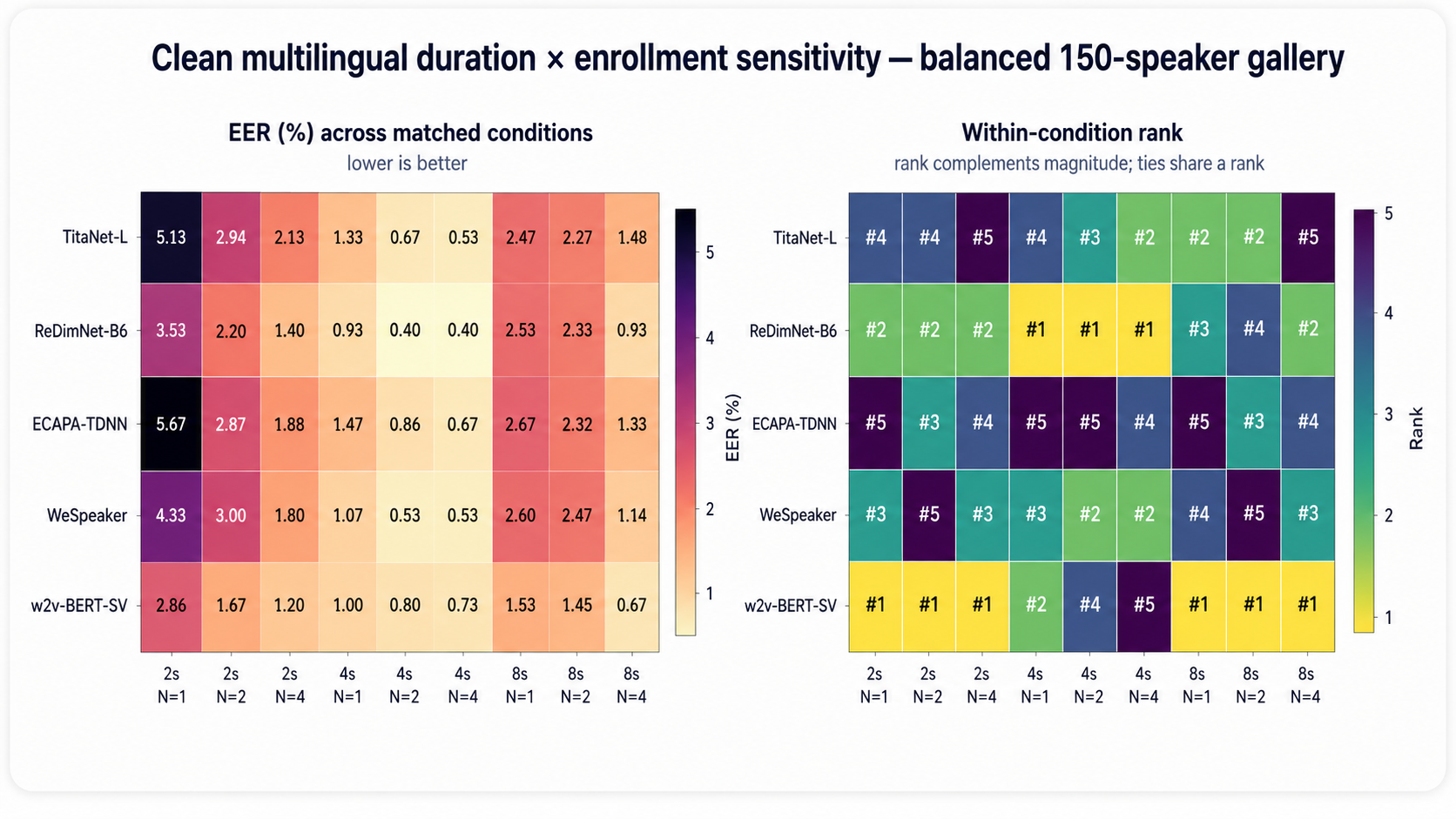
The direction is consistent with published results but is not a reproduction. The TitaNet paper reports 0.68% EER on cleaned VoxCeleb1 verification trials, and the ReDimNet paper reports 0.40% for ReDimNet-B6 SF2-LM on VoxCeleb1-O Cleaned. Those trials differ from our multilingual identification gallery in audio, duration, identities, score population, and task.
The clean check establishes baseline strength but not resilience to gallery growth. The next diagnostic asks that narrower question for the two models it covers.
900-speaker gallery diagnostic
Does ReDimNet remain competitive as the gallery expands? Directionally, yes. This supporting diagnostic expands the same clean source corpus to 900 enrolled speakers and 100 withheld identities, but covers only TitaNet and ReDimNet. At four seconds with four enrollment embeddings, ReDimNet and TitaNet have nearly identical EER (0.82% and 0.84%) and closed-set top-1 accuracy (98.92% and 98.81%). ReDimNet retains the more favorable score distribution under this diagnostic.
This result is directional, not primary evidence: the same unknown cohort was used for FAR calibration and evaluation. It suggests that ReDimNet remains competitive as the gallery grows, but it is not a held-out result or a deployment guarantee.
Together, the supporting checks strengthen the consistency case without changing the primary conclusion. Consistent accuracy still does not establish deployability, so the next section considers compute, licensing, and the measurements that remain missing.
Models and checkpoint provenance
All five public checkpoint families were evaluated with the same cosine-scoring harness:
| Model | Evaluated checkpoint/source | Embedding size | Study role |
|---|---|---|---|
| TitaNet-L | nvidia/speakerverification_en_titanet_large | 192 | Stock architecture baseline |
| ReDimNet-B6 | IDRnD/ReDimNet, B6 ft-LM VoxCeleb2 | 192 | Primary compact candidate |
| ECAPA-TDNN | speechbrain/spkrec-ecapa-voxceleb | 192 | Established baseline |
| WeSpeaker R221-LM | WeSpeaker English ResNet221-LM | 256 | Alternative deployment candidate |
| w2v-BERT-SV | ZXHY-82/w2v-BERT-2.0_SV, Adapter-MFA | 256 | Large research-quality reference |
The evaluated TitaNet is the stock public checkpoint; none of its results should be attributed to a separately fine-tuned TitaNet checkpoint.
Numbering identifies the five checkpoint families; it is not a performance ranking. The DIR values below come from the primary held-out split with four enrollment embeddings. Read them with the confidence intervals above and the model-specific rejection rules.
1. TitaNet-L
Stock TitaNet-L checkpoint , producing 192-dimensional embeddings.
Correctly identified and accepted (DIR): 83.80% with 2-second probes; 98.80% with 4-second probes. Its 4-second observed test FAR was 2.40%. These are stock-model results and must not be attributed to a fine-tuned TitaNet. The change with duration is more useful than the small four-second lead: the stock checkpoint accepted and correctly named far fewer two-second probes, while the four-second DIR differences were not significant after correction. Its 2.40% test FAR also exceeded the 1% development target. A rule that meets that target on calibration identities therefore does not guarantee the same rate on unseen people.
TitaNet supplied the fastest measured embedding time here, approximately 5.1 ms for four seconds of audio on the RTX 5090. That figure excludes loading and the rest of the identification pipeline. For an existing NeMo system, it is a useful baseline against which to test whether collecting a longer clean speech segment helps more than replacing the encoder. The preliminary cross-session pilot does not settle this choice: its labels remain provisional, and a one-clip lead is not a reliable ranking.
2. ReDimNet-B6
ReDimNet B6 ft-LM VoxCeleb2 , producing 192-dimensional embeddings.
Correctly identified and accepted (DIR): 94.80% with 2-second probes; 98.60% with 4-second probes. It had the highest 2-second DIR point estimate. The 0.00% observed 4-second test FAR does not establish zero deployment risk. Its 11.0-point two-second DIR gain over TitaNet remained significant after correction, making it a strong candidate when the system must decide from a short utterance. However, the repeated identity splits support a leading pair with w2v-BERT rather than a decisive winner. The larger-gallery diagnostic adds supporting evidence only: it compared two models and reused the unknown cohort for calibration and evaluation.
Compact weights did not produce the fastest embedding extraction in this run. ReDimNet had about 15 million parameters but took approximately 17.9 ms per four-second clip on the tested GPU, versus 5.1 ms for TitaNet. A shortlist should therefore separate model size, measured execution time, and accepted-speaker coverage. Keep its own rejection rule and test a new session before replacement. These results refer to the original B6 checkpoint, not the ReDimNet2 successor now linked from the repository.
3. ECAPA-TDNN
SpeechBrain ECAPA-TDNN checkpoint , producing 192-dimensional embeddings.
Correctly identified and accepted (DIR): 84.80% with 2-second probes; 97.80% with 4-second probes. Its gap from the leading models narrowed with four seconds of speech; observed 4-second test FAR was 1.20%. At two seconds, its one-point DIR improvement over TitaNet was not significant. By four seconds, its 97.80% DIR was close to the rest of the group, with overlapping uncertainty intervals. The useful conclusion is that this established baseline benefits substantially from more speech; the observed numbers do not establish that another encoder will improve a four-second deployment.
ECAPA also illustrates why the raw similarity score needs calibration. In the separate clean benchmark, it accepted the fewest unknown probes at a universal 0.5 cutoff, but that was still 21.4%. That result is not a safe operating threshold or proof of intrinsically better rejection. Its approximately 5.2 ms embedding time was close to TitaNet on this GPU. Evaluate the full identification rule with representative unknown speakers, and preserve the distinction between this checkpoint’s published verification results and the multilingual gallery task tested here.
4. WeSpeaker R221-LM
WeSpeaker English ResNet221-LM , producing 256-dimensional embeddings.
Correctly identified and accepted (DIR): 89.60% with 2-second probes; 98.20% with 4-second probes. Observed test FAR rose from 0.80% at two seconds to 1.20% at four seconds. Acceptance thresholds remain model-specific. The two-second DIR gain over TitaNet was 5.8 percentage points, with a paired 95% interval of 2.2–9.6, and remained significant after correction. That supports keeping WeSpeaker on a short-utterance shortlist even though its point estimate trails the leading pair. With four seconds, the comparison no longer establishes a meaningful advantage over the baseline.
The measured embedding stage took approximately 6.3 ms per four-second clip. Its 256-dimensional output is a different representation from the 192-dimensional baselines: a replacement requires new enrollment embeddings and calibration, not reuse of the previous vectors or cosine cutoff. The toolkit includes broader speaker-processing functions, but this study evaluated the named R221-LM embedding checkpoint with a shared harness. It does not benchmark every WeSpeaker model or its complete diarization pipeline. The small cross-session pilot is a reason to test session changes, not a production accuracy estimate.
5. w2v-BERT-SV
w2v-BERT 2.0 SV with Adapter-MFA , producing 256-dimensional embeddings.
Correctly identified and accepted (DIR): 92.20% with 2-second probes; 98.40% with 4-second probes. It had the lowest 2-second EER point estimate (1.05%), but uses a much larger encoder. The study records a separate license-review requirement; a strong score is not production approval. The lowest two-second EER and the highest two-second DIR belonged to different models: w2v-BERT led the former point estimate, while ReDimNet led the latter. EER summarizes a score trade-off; DIR measures correctly accepted identities under the selected rejection rule. Repeated splits place both in a leading group, so choosing solely by the smallest EER would hide the actual operating decision.
The clean benchmark accepted 61.0% of unknown probes at an uncalibrated 0.5 cutoff, the highest rate in that table. This does not contradict its strong calibrated result; it shows how misleading a shared cutoff can be. Its roughly 580-million-parameter encoder plus adapter took about 15.7 ms for the measured embedding stage. CPU behavior, peak VRAM and sustained capacity remain unmeasured. Keep it as a research reference until runtime fit and checkpoint licensing are resolved; neither model size nor the observed zero four-second false accepts establishes production suitability.
Deployment evaluation
Do these findings support a production choice? Not yet. Accuracy is only one part of deployment selection. The current run recorded embedding real-time factor (RTF) on an NVIDIA GeForce RTX 5090. Multiplying RTF by the four-second input length gives the approximate embedding time below; it does not include model loading, audio transfer, gallery scoring, networking, concurrency, or application logic.
| Model | Approx. parameters | Embedding / 4s | License status |
|---|---|---|---|
| TitaNet-L | 23–25M | 5.1 ms | Model card : CC BY 4.0 |
| ECAPA-TDNN | 20M | 5.2 ms | SpeechBrain checkpoint : Apache 2.0 |
| WeSpeaker R221-LM | 23M | 6.3 ms | WeSpeaker : Apache 2.0 |
| w2v-BERT-SV | 580M + 6.2M adapter | 15.7 ms | Repository : no machine-readable license; review required |
| ReDimNet-B6 | 15M | 17.9 ms | ReDimNet : MIT |
Peak VRAM, checkpoint size, cold-start time, CPU production performance, sustained throughput, and hardware sizing were not measured in this publication run. A deployment decision therefore needs a separate benchmark on the intended runtime and concurrency profile; the table does not establish a deployment winner.
Those missing measurements are not side notes; they define the boundary of the evidence. The next section makes that boundary explicit.
Limitations
What does this study not establish? It does not establish robustness outside clean, mostly single-session audio. Although enrollment and probe windows do not overlap in time, 4,398 of 4,469 identities—98.4%—have only one source recording. The results may therefore retain microphone, channel, room, background, and session characteristics and do not establish cross-session or real-meeting robustness.
The held-out unknown-speaker test contains only 25 identities and 250 probes per condition. The study does not cover overlapping speech, diarization errors, noisy rooms, production concurrency, or end-to-end latency. Its conclusions support model and calibration research, not an immediate production replacement.
These limits constrain how the results should be used. The appendix documents how each result was produced and why the three evaluation protocols carry different evidentiary weight.
Methodology appendix
How were the results produced and made comparable? The appendix records checkpoint provenance, deterministic sampling, enrollment construction, calibration search, uncertainty estimation, and the role of each protocol.
Data, sampling, and enrollment
The evaluation manifest contains 5,089 recordings from 4,469 labeled identities: English 1,665/1,489 recordings/identities, Japanese 1,704/1,476, Korean 438/438, Vietnamese 425/209, and Chinese 857/857. These curated single-speaker talks and long-form interview or channel recordings include TED and language-specific collections. They are evaluation data, not descriptions of the models’ training corpora. An overlap audit found no public evaluation recordings in the documented pretraining corpora of the evaluated checkpoints.
For each duration, the harness deterministically samples fixed 2-, 4-, or 8-second windows. A known identity contributes four enrollment and ten probe windows; an unknown identity contributes ten probe windows. Time bins do not overlap. Audio is read as float32, mixed to mono, and resampled to 16 kHz when necessary. The harness adds no VAD, denoising, loudness normalization, augmentation, or diarization.
Each crop embedding is L2-normalized. The first one, two, or four enrollment vectors are averaged and the mean is normalized again to create a centroid. Each normalized probe is scored against every centroid by cosine similarity. Stable hashes and seed 1337 give every model the same identities and crop plan.
Rule selection and uncertainty
Similarity-threshold candidates are empirical quantiles of development-unknown top scores, using up to 101 evenly spaced levels plus one value above the maximum. Margin candidates are zero plus up to 51 empirical quantile levels of development-known and development-unknown top-one-minus-top-two margins.
The harness keeps rules with development-unknown FAR at or below 1% and selects the highest development DIR. Ties prefer lower FAR, then a lower similarity threshold, then a lower margin. The rule is applied unchanged to identity-disjoint test speakers. Uncertainty uses 2,000 speaker-cluster bootstrap replicates, and 50 deterministic identity splits test result stability.
Role of each evidence source
The clean 150-speaker benchmark establishes baseline model strength and duration/enrollment sensitivity. The 900-speaker diagnostic tests gallery growth for TitaNet and ReDimNet but reuses its unknown cohort for calibration and evaluation, so its operating figures are directional. The identity-disjoint five-model evaluation separates development and test unknown speakers and is therefore the primary evidence reported above. These protocols answer different questions and must not be substituted for one another.
Extended appendix: preliminary cross-session meeting pilot
Does the clean-audio ordering carry into a real meeting recorded in a different session? This small pilot is an initial diagnostic, not a new benchmark. Speakers A–C were enrolled from Session A using three 2-second clips per speaker. Session B supplied five 2-second known probes per enrolled speaker (15 total) plus three 2-second probes from withheld Speaker D. Gallery centroids were formed by averaging raw enrollment embeddings, then applying L2 normalization for cosine scoring.
All 27 source labels—the nine enrollment clips and 18 probes—are provisional pending manual listening confirmation. The anonymous letter assignment is fixed across models.
| Model | Known top-1 | Speaker A | Speaker B | Speaker C | Speaker D uncalibrated top-match cosine range |
|---|---|---|---|---|---|
| TitaNet-L | 11/15 (73.3%) | 3/5 | 3/5 | 5/5 | 0.148–0.626 |
| WeSpeaker R221-LM | 10/15 (66.7%) | 2/5 | 5/5 | 3/5 | 0.304–0.597 |
| w2v-BERT-SV | 9/15 (60.0%) | 3/5 | 3/5 | 3/5 | 0.474–0.640 |
| ReDimNet-B6 | 8/15 (53.3%) | 4/5 | 1/5 | 3/5 | 0.272–0.528 |
| ECAPA-TDNN | 7/15 (46.7%) | 2/5 | 1/5 | 4/5 | 0.341–0.433 |
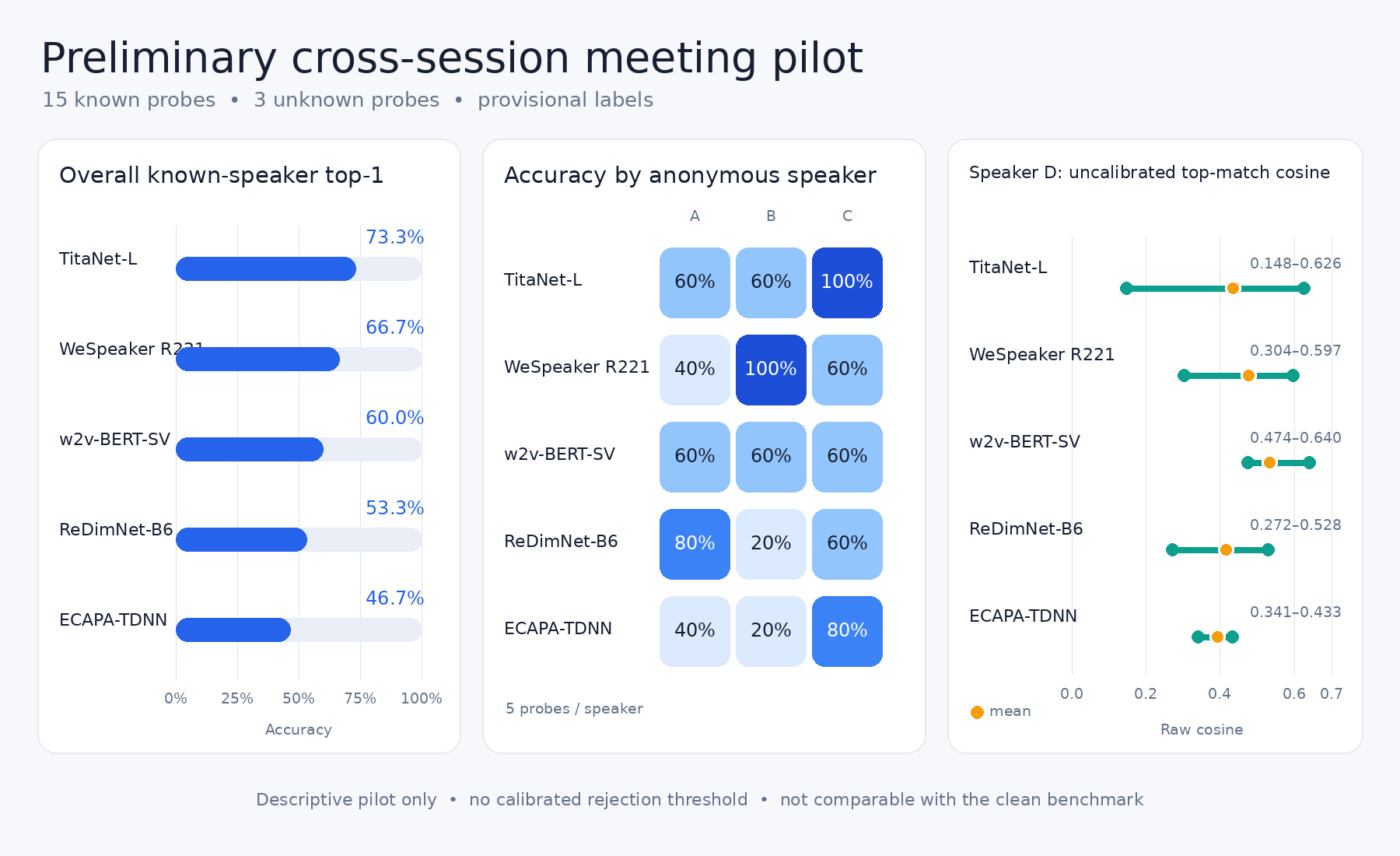
One known-probe error changes the overall result by 6.7 percentage points. TitaNet-L’s one-clip lead over WeSpeaker therefore does not establish a stable ranking. The per-speaker variation also points to identity and session sensitivity: no model leads for every anonymous speaker. This pilot supports the need for cross-session evaluation, but its sample size, source conditions, and provisional labels make it incomparable with the much larger clean benchmark above.
Speaker D’s values are descriptive top-match cosines only. With three unknown probes and no development-unknown identities, there is no calibrated acceptance threshold and no basis for claims about FAR, DIR, EER, rejection accuracy, production readiness, or a universal threshold.
Why the provisional labels still need review
Before treating the meeting labels as ground truth, a separate diagnostic scored all 15 unique pairs formed from six provisionally labeled clips. Six pairs shared the same provisional label and nine had different labels; every model scored the same pairs. The separation gap below is mean same-label cosine minus mean different-label cosine, so a positive value is the expected direction if the labels and clip boundaries are reliable.
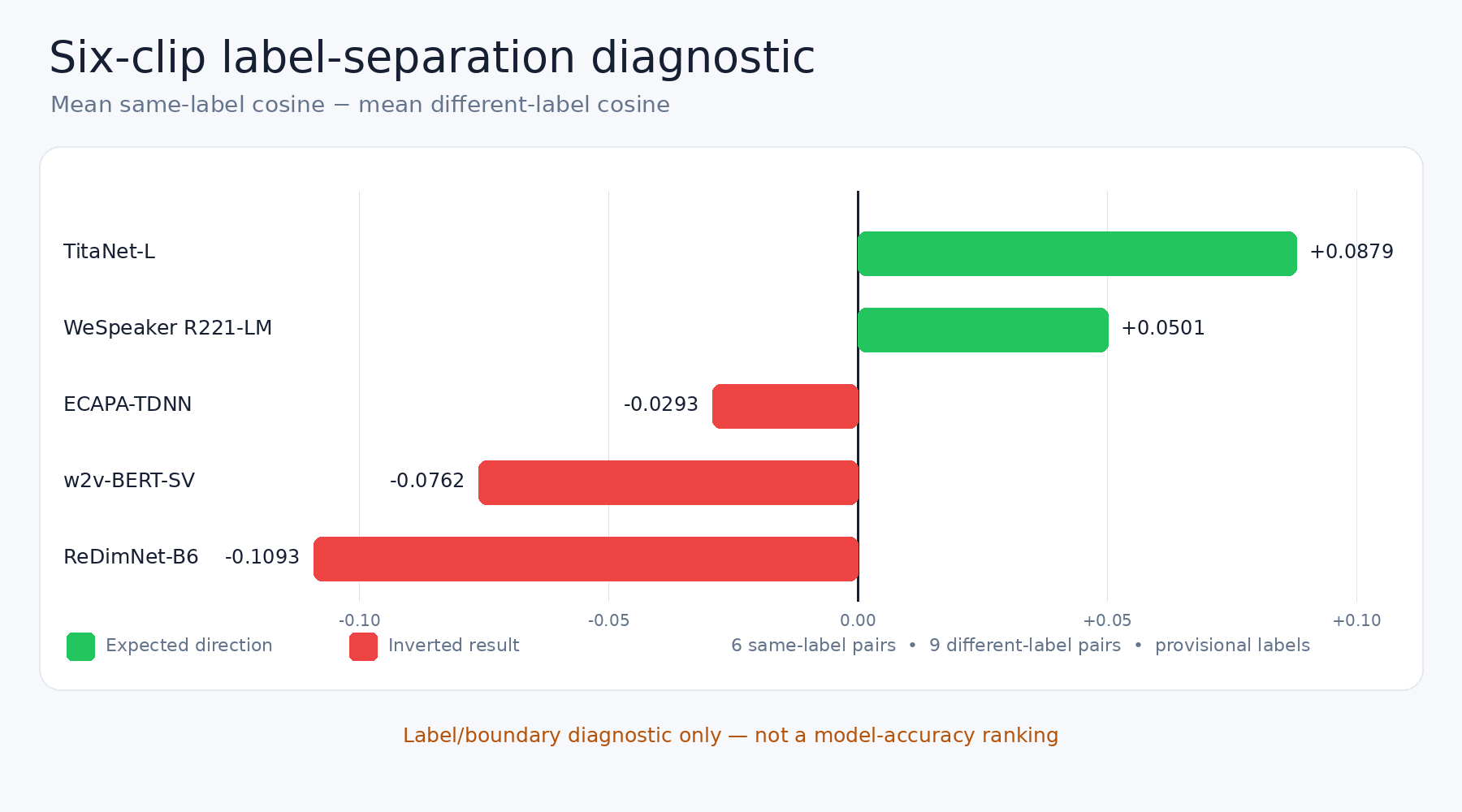
Only TitaNet-L (+0.0879) and WeSpeaker (+0.0501) separated the pairs in the expected direction. ECAPA-TDNN (-0.0293), w2v-BERT-SV (-0.0762), and ReDimNet-B6 (-0.1093) were inverted. This does not establish that those three models are worse: all six same-label pairs came from one provisional identity, and the 15 pairwise observations reuse the same six clips. The inversion is therefore a label-and-boundary warning, not a valid accuracy ranking, and strengthens the requirement for manual listening before publication.