In this article
For short calls within one building, start by testing Japan’s specified low-power radios. For a larger site without cellular service, consider a registration-required digital radio. For communication between separate locations, consider an IP radio.
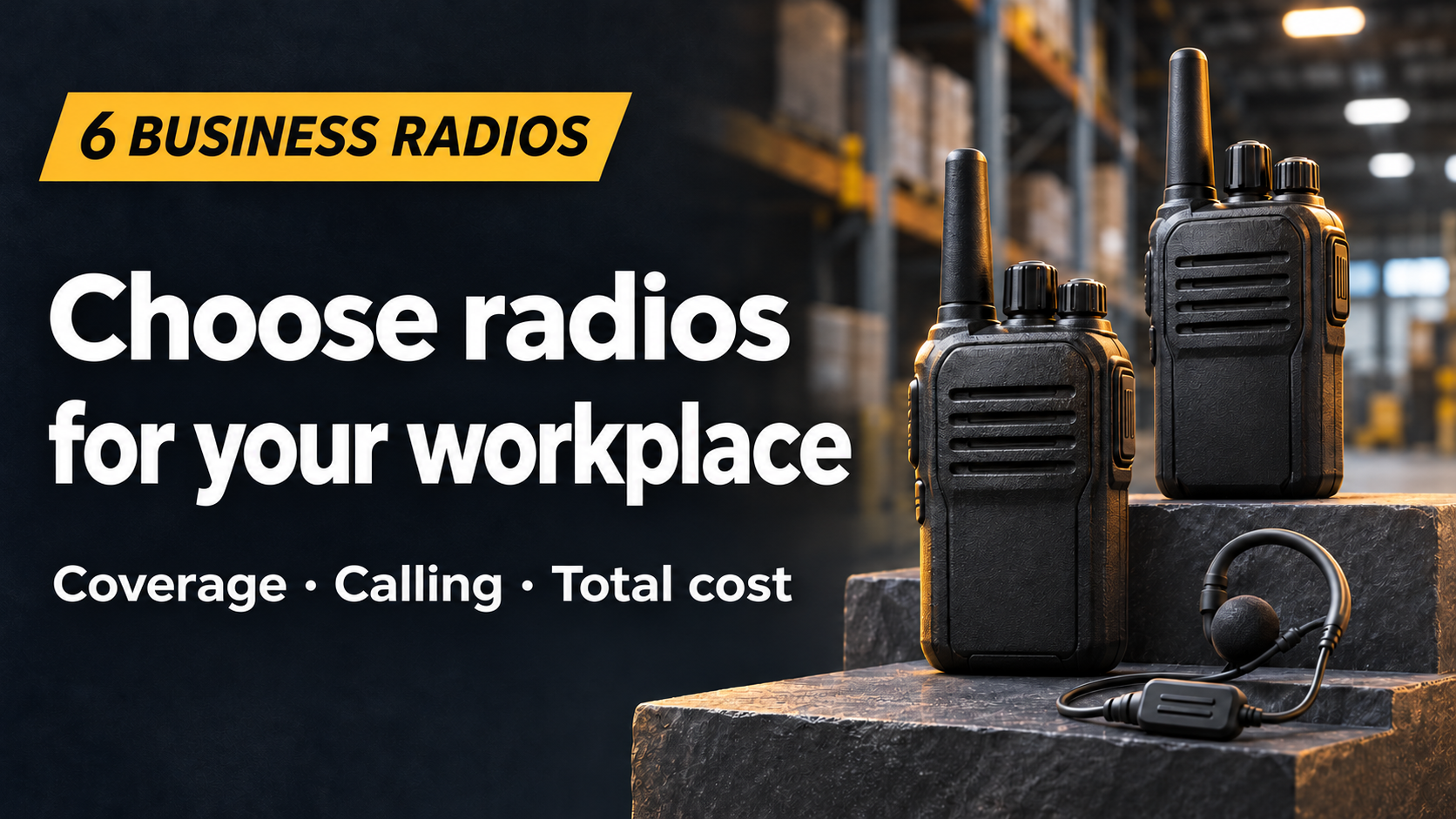
This guide covers six models for shops, warehouses, hotels and events in Japan. Prices are in Japanese yen, and registration, service and accessory conditions refer to Japanese models. They do not establish availability or lawful use in another country. Start with the shortlist , then compare the six evaluation criteria , total costs and each model’s advantages and drawbacks.
Specifications, prices and public reviews were checked on November 11, 2026. This is an analysis of manufacturer documentation and public sources, not a hands-on ranking of range or audio quality. For smartphones, see our four-app comparison . Motorcycle headsets and amateur radios are outside scope. Product screenshots below are original Japanese-market references; their captions are translated. Videos retain their original language.
Choose the radio system before the model
Numbers indicate article order, not rank. Country means the manufacturer’s headquarters, not the manufacturing location. Model links lead to official specifications; company links document headquarters.
| Model / official site | Manufacturer / headquarters | System / core functions | Suitable use / main limits |
|---|---|---|---|
| 1. IC-4400 | Icom Osaka, Japan | Specified low-power; half-duplex Up to 10-second replay, prerecorded transmission, sub-PTT | Replay short store instructions; unsuitable for long recording. Assessment |
| 2. UBZ-LU27BT | JVCKENWOOD Kanagawa, Japan | Specified low-power; half-duplex Bluetooth and compatible headset PTT | Reduce cables on the shop floor; manage pairing and headset charging. Assessment |
| 3. DJ-P321 | Alinco Osaka / Tokyo, Japan | Specified low-power; half-duplex Sub-PTT, VOX, PTT hold, Air Clone | Separate recipients on a compact radio; antenna cannot be changed later. Assessment |
| 4. SRFD10 | Yaesu Musen Tokyo, Japan | Specified low-power; half-duplex Dual-channel reception, one-click hands-free | Hear two groups; provide a spare during built-in battery charging. Assessment |
| 5. IC-DPR7SBT PLUS | Icom Osaka, Japan | Registered digital radio; half-duplex 5 W, main + two sub-PTTs, Bluetooth and VOX | Direct on-site communication without cellular service; registration and range checks required. Assessment |
| 6. IP510H | Icom Osaka, Japan | LTE / Wi-Fi; simultaneous calling Interruption, Bluetooth, automatic LTE/Wi-Fi handover | Connect separate sites; LTE contract required, manual cellular-carrier switching. Assessment |
The four specified low-power models require neither a radio licence nor registration in Japan. The IC-DPR7SBT PLUS needs no operator qualification or radio station licence, but radio station registration is required. Include application and ongoing spectrum usage fees. See the Japanese Ministry of Internal Affairs and Communications guidance for registration categories and procedures.
Test back rooms, refrigeration areas and other floors where missed calls would disrupt work. For IP radios, the network available at each location matters more than the distance between handsets.
Hands-free and simultaneous calling are different
PTT means pressing a button to transmit. VOX starts transmission when it detects speech; PTT hold keeps transmission active without holding the button down. These features reduce manual operation but do not make a half-duplex radio full-duplex.
Half-duplex can suit brief requests such as calling for help on a shop floor. For training conversations where someone must ask a question before the other person stops speaking, check interruption support. Of these six models, the IP510H supports simultaneous calling and interruption.
Receiving two channels is also different from multiple people speaking at once. Compare the SRFD10’s two receivers and other models’ subchannel PTT buttons as ways to select whom to hear and whom to contact.
Six criteria to evaluate before buying
Coverage at required locations and a suitable speaking pattern are the first requirements. Compare wearing comfort, shift changes, administration and cost only after those are met. A low price or low weight cannot compensate for a failed connection, so we do not combine them into an arbitrary score.
| Criterion | Benefit and trade-off | Decision to make |
|---|---|---|
| Coverage and network reliance | Direct radios avoid cellular service but have finite range. IP radios span locations but need a network at each one. | Reject a model that fails a required route. Arrange a fallback if contact must continue during outages. |
| Speaking and recipient controls | Half-duplex organizes turns but prevents interruption. Simultaneous calling still needs rules for overlapping speech. | Are brief calls enough, or must people ask questions immediately? Decide who listens to several channels and which buttons they use. |
| Wearing and environment | Small bodies offer more mounting options, but may have harder-to-press buttons. Water ratings have defined test conditions. | Test with battery and earpiece, gloves and uniform. Check exposure to water and dust. |
| Power and shift continuity | Replaceable batteries ease handovers but add stock management. Built-in batteries may require another radio while charging. | Test a complete shift with comparable transmit/receive conditions; do not rank by advertised hours alone. |
| Deployment and expansion | Wireless headsets reduce cables but add compatibility, pairing and charging work. | Assign responsibility for registration, contracts, existing-radio compatibility and spare-unit settings. |
| Three-year total cost | Charging equipment and one audio accessory per user can outweigh a low body price. IP subscriptions continue each month. | Use matching active/spare quantities and included items. Separate initial costs from 36 months of recurring fees. |
For brief calls within a shop, test low-power coverage first. If it already works, higher output or more functions alone do not justify moving to a registered or IP system. Communication between distant branches, however, may justify the recurring IP contract cost.
The assessments below are editorial conclusions drawn from official specifications. They are not measured comparisons of sound, wearing fatigue or performance on congested networks.
Compare hardware, accessories and recurring costs separately
Prices below were checked on November 11, 2026 and include Japanese tax, per unit. Retail listings are examples, not guarantees of the lowest price or availability. Shipping and loyalty points are excluded. Only the DJ-P321 figure is the manufacturer’s published price.
| Model | Purchase price / source | Other initial costs | Monthly / ongoing costs |
|---|---|---|---|
| IC-4400 | JPY 12,990 Connect Online listing; ordered from supplier | One AA battery and required earpiece microphone. Rechargeable battery and charger extra. | No monthly airtime fee for direct calls; batteries and maintenance extra. |
| UBZ-LU27BT | JPY 17,440 Tanaka Denki Market listing; business sales | Three AA batteries, or rechargeable batteries and charger. Compatible wireless headset extra. | No monthly airtime fee for direct calls; batteries and maintenance extra. |
| DJ-P321 | JPY 21,780 Manufacturer's published price; not a street price | One AA battery and required earpiece microphone. Charging accessories extra. 12-radio example | No monthly airtime fee for direct calls; batteries and maintenance extra. |
| SRFD10 | JPY 11,110 TELCOMSHOP listing; ordered from supplier | Audio accessories, charger and AC adapter extra; built-in battery included. | No monthly airtime fee for direct calls; built-in battery maintenance and spare units extra. |
| IC-DPR7SBT PLUS | JPY 56,536 Connect Online listing; ordered from supplier | Battery, charger and AC adapter included. Add audio accessories and registration application fees. | No monthly airtime fee; spectrum usage fees apply. Check registration category and quantities. |
| IP510H | Quote required Exseli purchase terms; business sales | Example setup fee: JPY 3,300 per unit. Quote batteries, charging and audio accessories separately. | Example JPY 1,980–2,860 per unit/month, depending on carrier and plan. Terms describe a termination charge within two years. |
IP510H examples add 10% Japanese consumption tax to the pretax figures in Exseli’s purchase terms . Hardware is excluded; confirm the applicable terms when ordering.
| SIM configuration | Standard plan | Enhanced-server plan |
|---|---|---|
| Single: au | 1,980 | Not applicable |
| Single: docomo | 2,200 | Not applicable |
| Dual: au primary / docomo secondary | 2,200 | 2,640 |
| Dual: docomo primary / au secondary | 2,420 | 2,860 |
Ten units on the single-au plan for 36 months cost JPY 712,800 in service fees (1,980 × 10 × 36), plus JPY 33,000 in setup fees. That is JPY 745,800 before radios, accessories and optional maintenance. Include this recurring expense when comparing IP models with direct-radio systems.
Example: ten users and two spare radios
This DJ-P321 example includes 12 radios and equipment to charge the ten regularly used units simultaneously. It uses tax-inclusive manufacturer prices checked on November 11, 2026, not a dealer quotation.
| Item | Unit price × quantity | Subtotal |
|---|---|---|
| DJ-P321 radio | 21,780 × 12 | 261,360 |
| EBP-179 rechargeable battery | 1,980 × 12 | 23,760 |
| EDC-312R five-position charger | 12,100 × 2 | 24,200 |
| EDC-162 AC adapter | 8,800 × 1 | 8,800 |
| Radio and charging total | Four items above | 318,120 |
Rechargeable batteries and charging equipment add JPY 56,760 to the radio-only total. Add ten earpieces, replacement supplies and a repeater if needed. Only ten radios can charge simultaneously in this configuration; charge the two spares at another time.
Ask every supplier to quote the same basis: ten active units, two spares, ten earpieces, ten simultaneous charging positions and three years of use. Avoid double-counting included accessories. Add registration and spectrum fees for registered radios, or 36 months of service for every contracted IP unit. Confirm whether spare IP units also need contracts, and separate setup from ongoing costs.
Networked repeaters or management systems can introduce infrastructure and network costs even for low-power radios. Check what a claim of no airtime fees actually covers. For a short event, also request a rental quote with the same quantities, duration and accessories.
1. Icom IC-4400: one AA battery and short-message replay
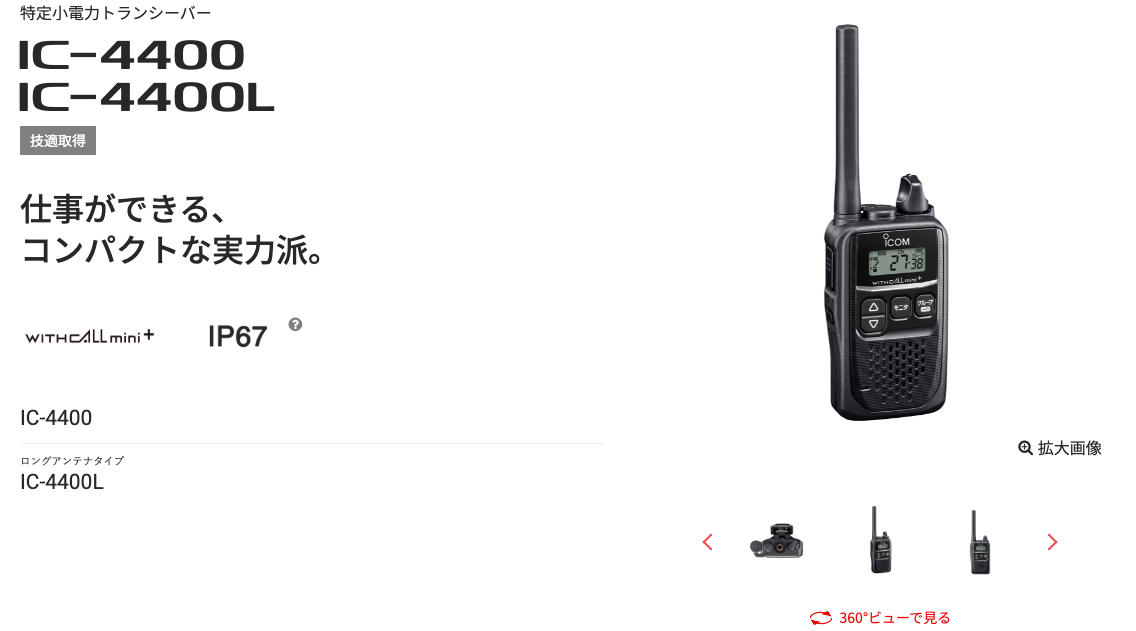
One AA alkaline battery powers the unit. Subchannel PTT separates general calls from calls to a particular group. It supports up to ten seconds of recording/replay and can transmit a prerecorded response. Official features and accessories
The body is IP67-rated and weighs about 90 g, or 117 g with a BP-260 battery. The published roughly 24-hour runtime assumes a 1:1:8 transmit/receive/standby ratio with power saving enabled. Rechargeable batteries, chargers and earpiece microphones are extra. Weight and battery conditions
Benefits
Replay a short instruction you missedStaff can replay a missed call after serving a customer. A spare AA battery offers a straightforward way to keep a radio running through a shift change.
Drawbacks
Limited recording and no mid-sentence interruptionRecording is limited to ten seconds per transmission or reception. That is insufficient for long instructions, and half-duplex operation prevents questions while the other person is transmitting.
When to choose itUseful for shops making short calls. Choose an app for longer retained recordings, or a simultaneous-calling model when interruption is essential.
2. KENWOOD UBZ-LU27BT: reduce headset cables
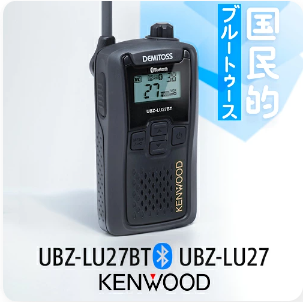
A compatible wireless headset lets users transmit with its PTT button while the radio stays on their belt. Current official guidance names the KHS-56BT. Before adding units to an existing UBZ fleet, check the compatibility table and group settings. Official product page
It weighs about 186 g including three AA batteries, excluding the belt hook, and is rated IP54. Published speaker-use runtime is about 60 hours with battery saving on, or 70 hours in ECo (H). The up-to-100-hour figure has conditions including EMC-3A use; it is not a Bluetooth runtime guarantee. Battery conditions and specifications
Benefits
Fewer cables while stocking shelvesA compatible headset handles transmission, reducing the need to reach for the radio while carrying goods. Compatible existing UBZ units may remain in use.
Drawbacks
Manage both radio and headsetShift handovers require checks of two batteries and the paired device. Personal Bluetooth earbuds may not work. IP54 does not make it suitable for immersion.
When to choose itFor shops and warehouses that can standardize accessories and manage charging and pairing. Test the exact radio/headset combination before purchase.
3. Alinco DJ-P321: try the antenna and buttons while wearing it
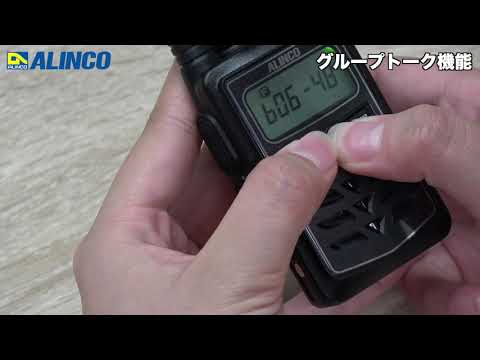
The official Japanese demonstration shows transmit/receive operation at 5:20 and key lock at 6:09 . Watch the finger movements on the side PTT and small front keys to identify what to test when worn. Published in 2020, this is a basic-operation guide, not a comparison of range or audio quality.
View the original Japanese DJ-P321 product reference (1)
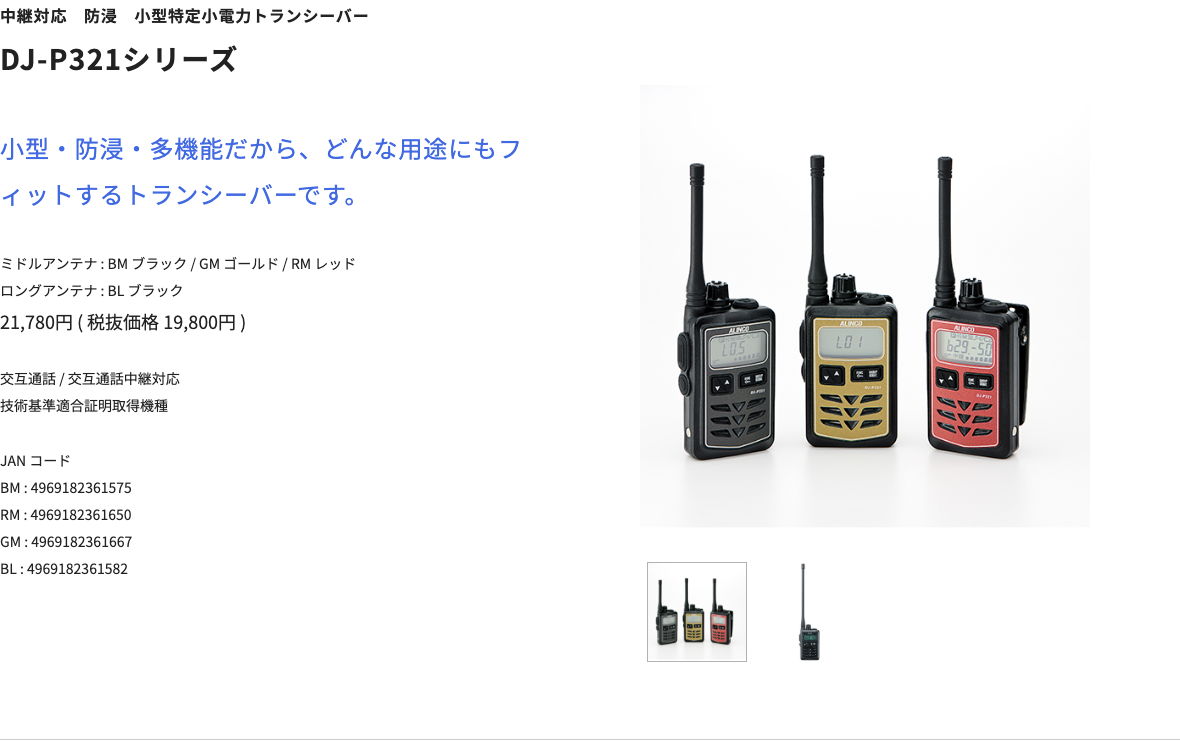
Sub-PTT separates recipients; VOX and PTT hold are supported. Air Clone copies settings across units. The radio uses one AA battery and is rated IP67. Rechargeable batteries and chargers are sold separately. Official features and accessories
Choose a roughly 7.5 cm medium antenna in black, gold or red, or a roughly 16.5 cm long antenna in black. It cannot be exchanged after purchase. Body and clip weigh about 82 g or 90 g respectively, without a battery. Compare a complete working setup with the SRFD10’s roughly 50 g battery-inclusive figure.
Benefits
Copy settings and choose who receives a callAir Clone reduces configuration work when deploying or adding radios. Sub-PTT separates all-staff calls from questions to a specific team.
Drawbacks
Test the fixed antenna and small buttons firstThe antenna cannot be swapped. A specification sheet cannot tell you whether it catches on a uniform or whether gloved fingers can operate the buttons.
When to choose itCheck wearing position and coverage before deciding quantities. Include charging accessories, using the 12-radio cost example above as a reference.
4. Yaesu SRFD10: low weight and two-channel reception
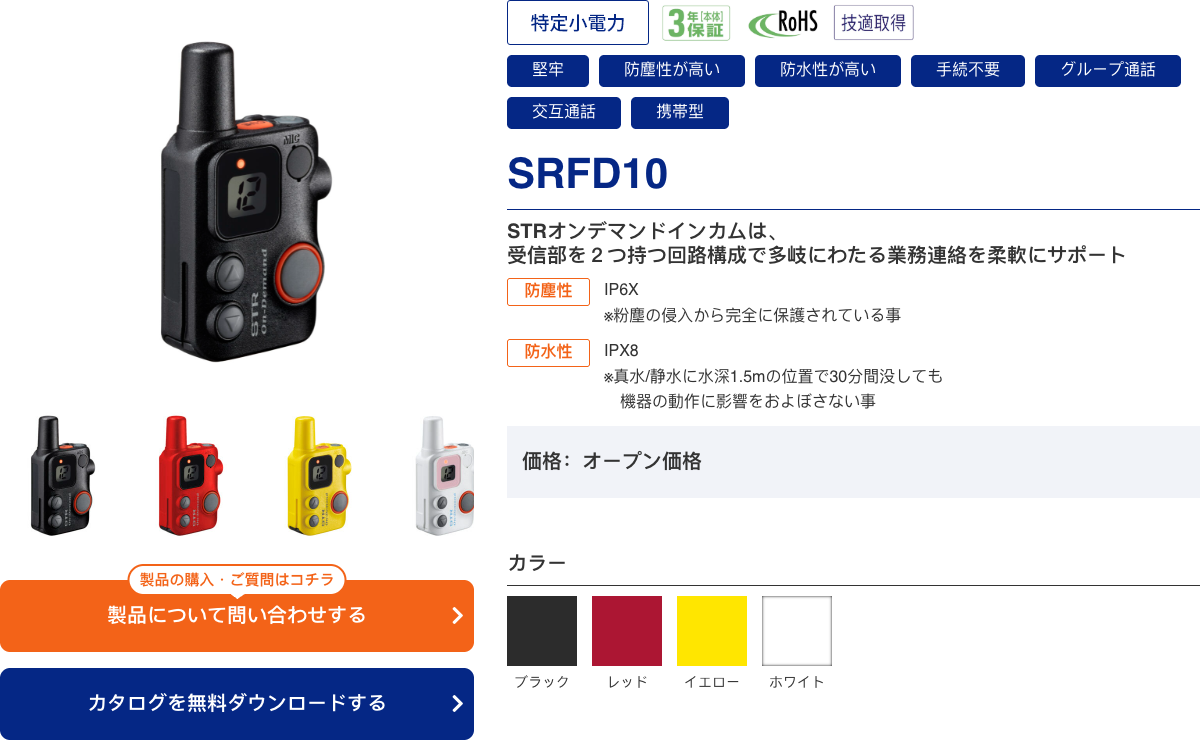
The body weighs about 50 g including its built-in battery and can receive two channels simultaneously. This suits someone listening to both a floor team and a supervisor. Earpiece weight is extra, and audio accessories and a charger are separate purchases. Official specifications
One-click hands-free remains half-duplex. Published runtime exceeds ten hours with dual reception and a repeating six-second transmit, six-second receive, 48-second standby cycle. The IP68 water test specifies 30 minutes at 1.5 m in still fresh water.
Benefits
Hear two groups with a light radioStaff can hear floor and supervisor calls without changing receiving channels. Both weight and reception mode can benefit uniformed retail or hotel staff.
Drawbacks
The battery cannot be swapped during a shiftThe built-in battery means another unit is needed during charging. Dual reception does not enable simultaneous speaking; staff still need a turn-taking procedure.
When to choose itFor customer-facing shifts followed by scheduled charging. For longer continuous shifts, test spare-unit handovers and the comfort of the actual earpiece.
5. Icom IC-DPR7SBT PLUS: direct radio across a larger site
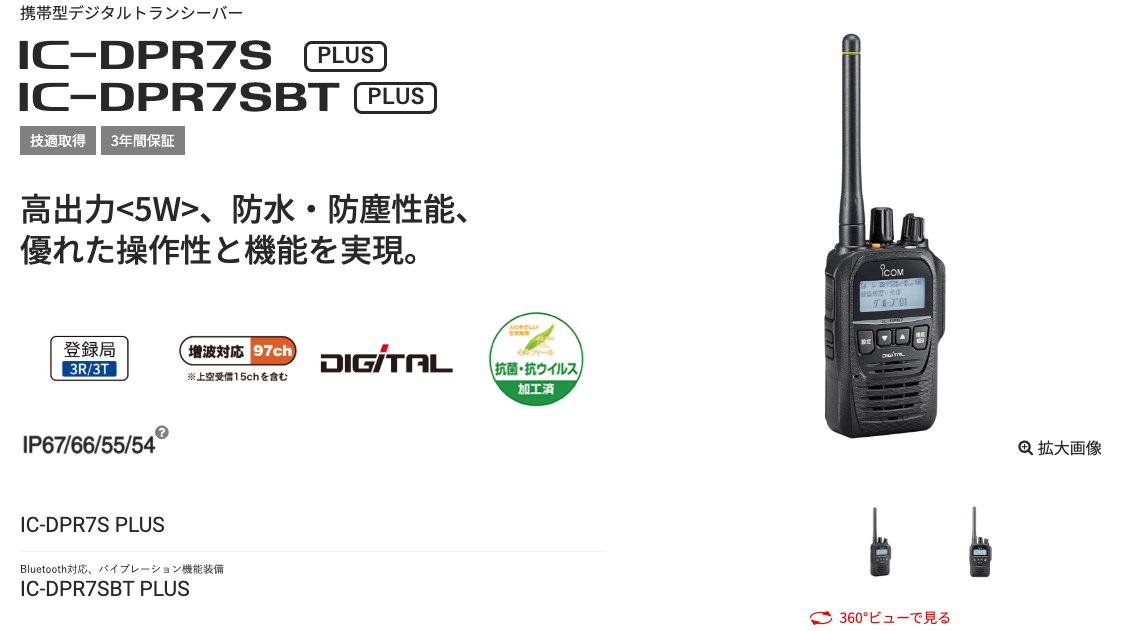
This 5 W digital radio communicates directly without cellular service. It has PTT controls for a main channel and two subchannels; Bluetooth and VOX belong to the BT model. Battery and charger are included, so distinguish its package price from bare-radio prices. Specifications and included items
Japanese station registration and spectrum usage fees apply. Individual and blanket registration have different procedures; determine quantities before consulting the ministry guidance . A 5 W rating does not guarantee penetration through buildings or terrain. Test on site, without assuming that an unsupported replacement antenna is an option.
Benefits
Direct contact where cellular service is absentIt works without a cellular network wherever the radios can reach one another. It is a candidate to test on routes that a specified low-power system cannot cover.
Drawbacks
Registration adds work; range is still finiteSomeone must handle registration and spectrum fees. Buildings and terrain can still block calls, and this is not a distance-independent connection between remote branches.
When to choose itFor sites with an assigned registration owner and verified direct coverage. A small shop already covered by low-power radios need not upgrade solely for higher output.
6. Icom IP510H: connect separate sites and interrupt a conversation

Icom UK’s official introduction includes a simultaneous-calling diagram at 0:40 and Bluetooth at 0:50 , plus side controls and connectors. It uses English labels and is a product introduction, not a live conversation or network-handover comparison. The Japanese documentation below determines this article’s feature and contract scope.
View the original Japanese IP510H product reference (1)
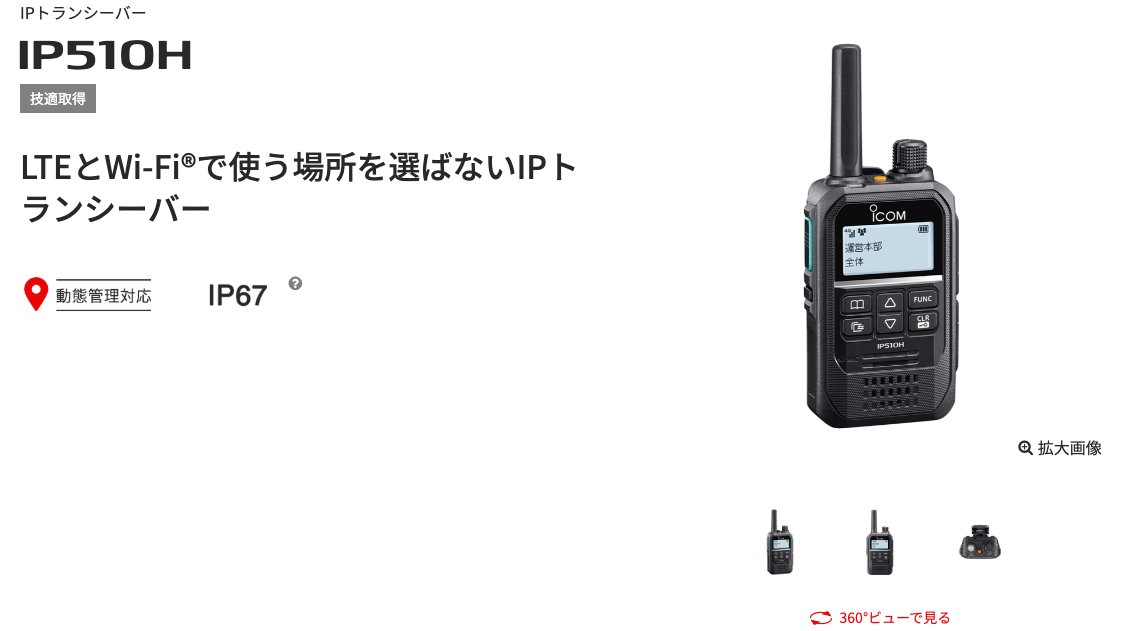
The IP510H uses LTE and Wi-Fi and supports simultaneous calling and interruption. LTE/Wi-Fi handover is automatic, but switching between the two cellular carriers on a dual-SIM plan is manual. A SIM-based LTE contract is required; Wi-Fi-only operation without a contract is not supported. Official features and FAQ
It weighs about 220 g with BP-314 and antenna, is rated IP67, and supports USB Type-C charging and Bluetooth. Official guidance supports OPENCOMM2 PTT FOR ICOM, but not OpenComm2 2025 Upgrade. Match exact accessory model names, not similar branding.
Benefits
Ask follow-up questions across locationsHead office can respond while a field worker explains a situation. The dedicated transmit button suits communication with separate stores or travelling staff.
Drawbacks
Network access and monthly contracts are essentialCalls fail where neither LTE nor Wi-Fi is available. Cellular-carrier switching is manual, so a dual-carrier contract still requires action during an outage.
When to choose itFor cross-site conversations or interruption needs. Budget 36 months of fees and agree on an outage fallback. For short calls within one building, test direct radios first.
What public reviews suggest testing
DJ-P321BL: small size does not guarantee easy buttons
A five-star review on Yamada Denki’s Pi-Chiku Park was posted on January 14, 2025 after a January 3 Yamada WEB purchase. The reviewer liked the compact body and detailed settings, but found the up/down keys and side sub-PTT hard to press and wanted larger buttons. Review page
Try switching recipients with your usual hand, uniform and gloves. Compactness and ease of operation are separate considerations.
UBZ-LU27BT: choose the Bluetooth accessory before buying
A three-star review dated March 25, 2026 appears on Mr. Transceiver’s Rakuten listing for UBZ-LU27BT/UBZ-LU27. The reviewer bought for Bluetooth, reported difficulty connecting the tested earpiece, and praised audio and other functions. The listing combines models, but the review describes the Bluetooth version. Review page
We have not adopted the reviewer’s compatibility assertions as specifications. Check the exact radio/headset combination, including officially listed options such as KHS-56BT. The store advertises review incentives, but we could not establish whether this reviewer received one.
Both are individual Japanese-language posts; detailed locations and working conditions are unknown. They cannot establish failure rates, overall satisfaction or radio quality. Comparable purchase reviews for the other four models were insufficient, so average stars are not used to rank them.
Test coverage, operation and shift handover together
Shortlist about two models and include your hardest-to-reach location and busiest hours. A quiet-office trial cannot reveal how often staff must repeat messages on a shop floor or in a kitchen.
- Walk the actual routes. Move between shop floor, back room, shelves and floors; record who missed which calls and where. Include LTE/Wi-Fi transitions for IP radios.
- Send realistic short instructions. Use names, locations and quantities that must be heard correctly. Agree on when to speak after pressing PTT and how to request repetition.
- Wear normal equipment. Try gloves, masks and hats; check buttons, earpieces and clips during work.
- Continue through handover. Test charging, battery replacement, earpiece cleaning, failure spares and transfer of settings to the next user.
Once coverage and controls pass, request a complete quote using the quantity example . If you need written conversation records or want to use issued smartphones, also compare the four intercom apps .