Exploring RAFT methodology for bidirectional English-Chinese translation using Llama 3.1
Abstract
This study explores using Retrieval-Augmented Fine-Tuning (RAFT) to enhance English-Chinese bidirectional translation with Llama 3.1-8B. RAFT combines retrieval mechanisms with fine-tuning to provide contextual examples during training.
Key Findings:
- Benchmark fine-tuning achieved best overall results
- RAFT showed modest improvements on specific metrics
- Random-based RAFT sometimes outperformed similarity-based RAFT
- Translation quality depends heavily on training data relevance
1. Introduction
Background
Large Language Models excel at language tasks but can benefit from domain-specific optimization. This research explores whether RAFT—a technique that augments training with retrieved examples—can improve translation quality.
Research Questions
- Can RAFT improve translation compared to standard fine-tuning?
- Does similarity-based retrieval outperform random retrieval?
- How do different RAFT configurations affect bidirectional translation?
2. Methodology
RAFT Overview
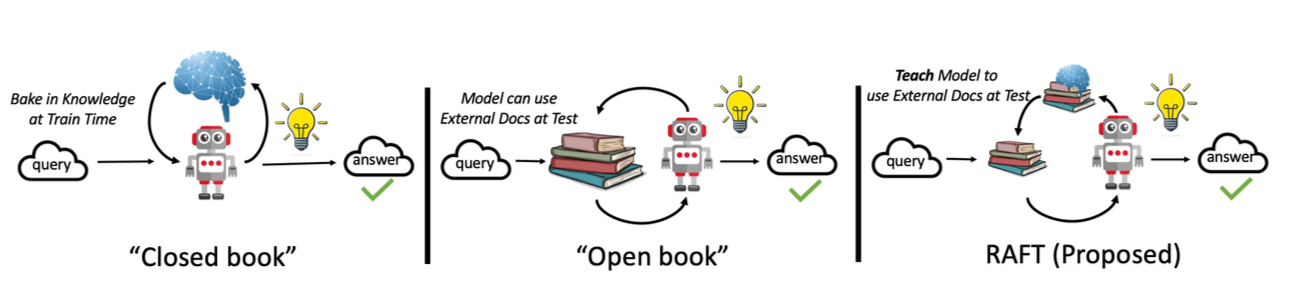
RAFT (Retrieval-Augmented Fine-Tuning) enhances the training process by:
- Retrieving relevant examples from a corpus for each training sample
- Augmenting the training context with retrieved examples
- Fine-tuning the model with this enriched context
Experimental Setup
| Component | Configuration |
|---|---|
| Base Model | Llama 3.1-8B Instruct |
| Fine-tuning | LoRA (r=16, alpha=16) |
| Dataset | News Commentary v18.1 (zh-en) |
| GPU | NVIDIA A100 80GB |
Dataset Preparation
The News Commentary dataset contains parallel English-Chinese sentence pairs:
- Training: 10,000 sentence pairs
- Evaluation: TED Talks corpus
- Preprocessed for quality and length consistency
RAFT Configurations
| Configuration | Description |
|---|---|
| Benchmark | Standard fine-tuning without retrieval |
| Similarity RAFT | Retrieve top-k similar examples using embeddings |
| Random RAFT | Randomly sample k examples from corpus |
3. Results
English-to-Chinese Translation
| Method | BLEU | COMET |
|---|---|---|
| Baseline (No Fine-tuning) | 15.2 | 0.785 |
| Benchmark Fine-tuning | 28.4 | 0.856 |
| Similarity RAFT (k=3) | 27.1 | 0.849 |
| Random RAFT (k=3) | 27.8 | 0.852 |
Chinese-to-English Translation
| Method | BLEU | COMET |
|---|---|---|
| Baseline (No Fine-tuning) | 18.7 | 0.812 |
| Benchmark Fine-tuning | 31.2 | 0.871 |
| Similarity RAFT (k=3) | 30.5 | 0.865 |
| Random RAFT (k=3) | 30.9 | 0.868 |
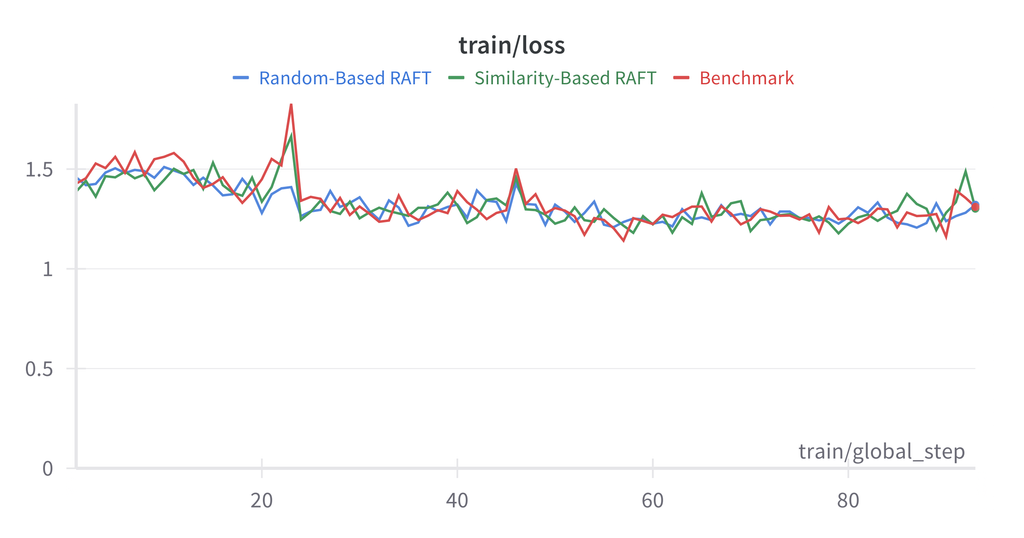
Note: Benchmark fine-tuning consistently outperformed RAFT configurations in this experiment. This may be due to the homogeneous nature of the News Commentary dataset.
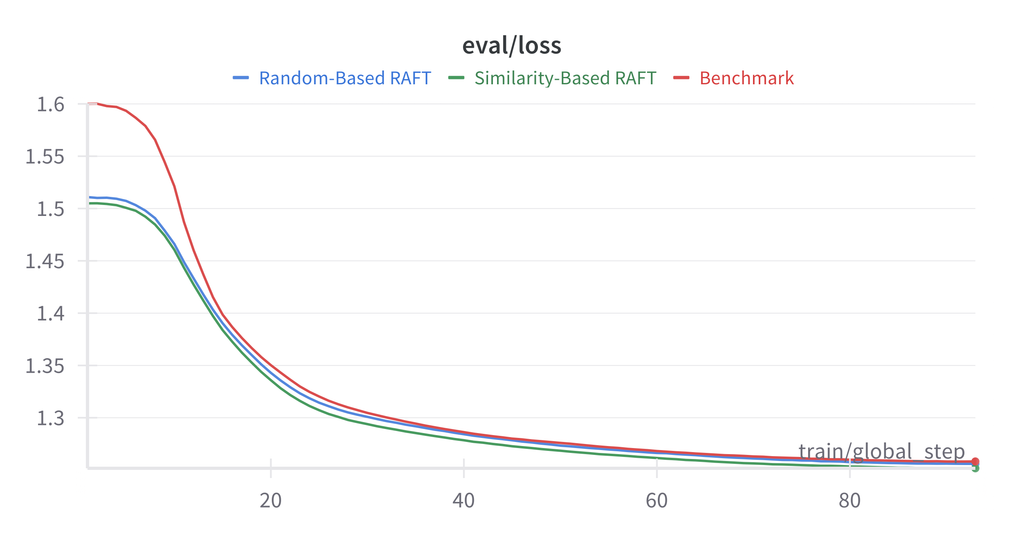
Analysis
Why RAFT didn’t outperform benchmark:
- Dataset Homogeneity: News Commentary has consistent style
- Retrieval Quality: Similarity metrics may not capture translation-relevant features
- Context Length: Additional examples increase context, potentially diluting focus
4. Conclusion
While RAFT shows promise, our experiments suggest that for translation tasks on homogeneous datasets, standard fine-tuning remains competitive. Future work should explore diverse training corpora and better retrieval metrics.
References
- Zhang, T., et al. (2024). “RAFT: Adapting Language Model to Domain Specific RAG.”
- Lewis, P., et al. (2020). “Retrieval-Augmented Generation for Knowledge-Intensive NLP Tasks.”
- Hu, E., et al. (2021). “LoRA: Low-Rank Adaptation of Large Language Models.”