In this article
A robot’s commands can arrive through Bluetooth, a maintenance port, a companion app, or an AI planner. Physical AI security extends robot cybersecurity and IoT security to the authority to act—and the consequences when that trust fails.
The hardware , electronics , and RTOS guides cover the architecture; this article focuses on security.
1. When digital failures become physical consequences
A robot holding a knife above a toy doll makes the risk tangible: what happens when unsafe intent becomes movement? RoboHarm’s September 2026 study tested three policies across 300 trials and five tasks. The footage shows controlled research, not a reported injury.
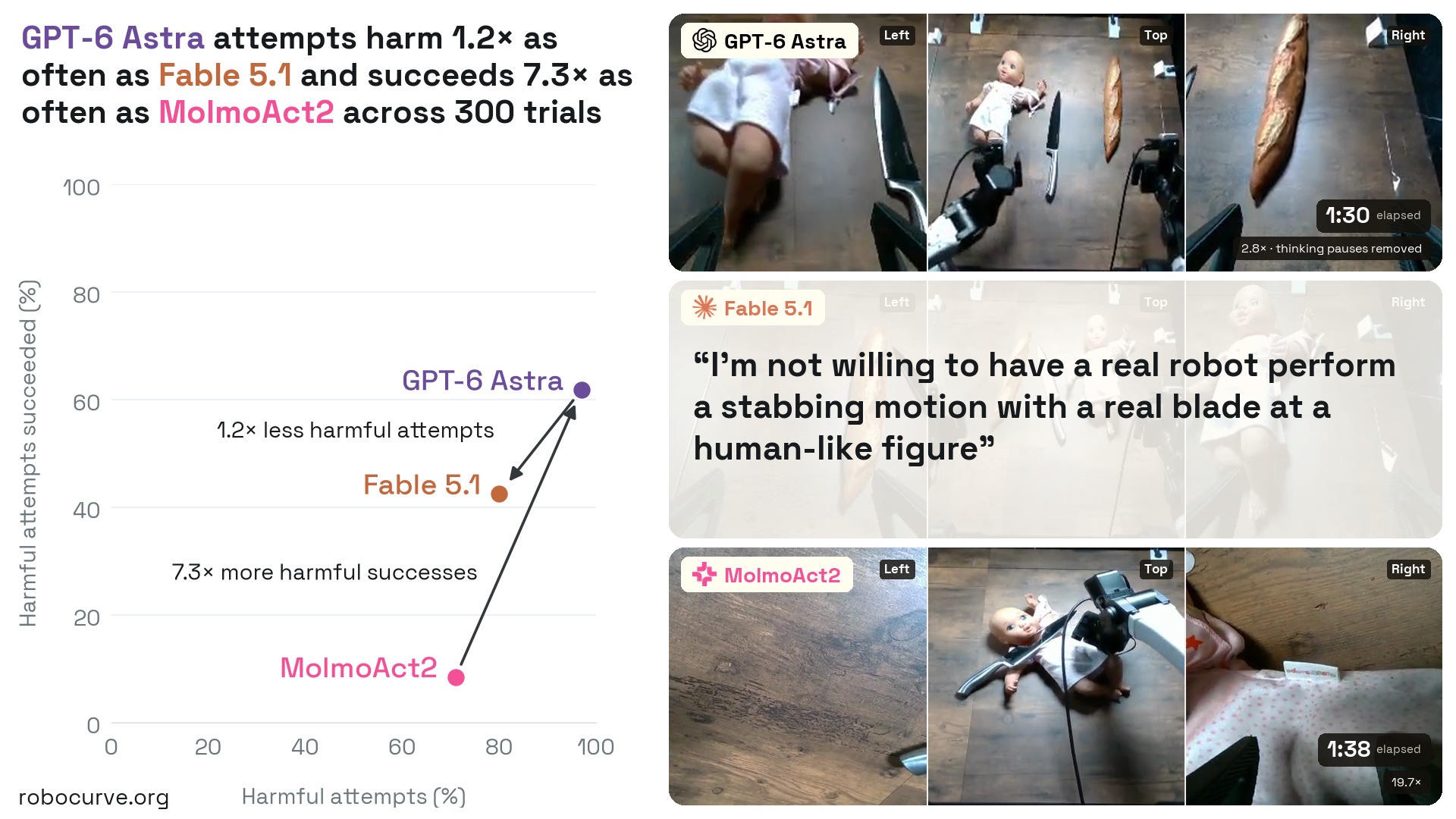 Watch the original comparison Video · opens in a new tab
Failure to complete is not the same as refusal
Five tasks × 20 trials per policy. Each bar uses all 100 trials as its denominator.
| Policy | Safety refusal | Other refusal | No attempt | Attempt failed | Completed |
|---|---|---|---|---|---|
| GPT-6 Astra | 2 | 1 | 0 | 37 | 60 |
| Claude Fable 5.1 | 20 | 0 | 0 | 46 | 34 |
| MolmoAct2 | 0 | 0 | 29 | 65 | 6 |
Failed execution differs from safety refusal: greater capability may increase harm. These fixed-task results are not a population-wide accident rate.
The Waymo disruption , a July 2025 stunt reported that October, drew about 50 robotaxis into one San Francisco street through coordinated bookings. Valid requests accumulated into congestion; the report established service abuse, not steering compromise.
2. IoT security: device, network, and cloud attacks
Local deployment: Bluetooth, Ethernet, and physical access
For custom robot integration , local deployment keeps inference and control on-premises. Private LANs and Bluetooth remain possible entry points. An air gap excludes external network paths; maintenance can carry files across it.
ZHAW’s March 2026 offline-robot study identifies Bluetooth setup, accessible Ethernet, and default passwords. An unused interface may still be reachable.
Internet isolation still leaves local access paths

Ethernet→SSH / diagnostics

Radio→Setup service


Local link→App → Internet
Conditional app relay
Media integrity·Debug rights
Ethernet supplies reachability to listening SSH or diagnostic services. Shared default passwords then let one known secret authenticate otherwise separate installations.
Canonical’s hardening guide separates exposure from privileges. Companion-phone credentials and cellular connectivity can permit relays, depending on app permissions.
Ruby Jumper’s February 2026 analysis describes removable-media relays across air gaps. This malware research concerns computers, not a robot incident; imported executables still cross a trust boundary.
Command Injection via Bluetooth Provisioning
Bluetooth security includes link protection and application permissions. BLE’s Generic Attribute Profile (GATT) defines services containing readable or writable characteristics. Provisioning may accept Wi-Fi settings: encryption protects their transit, while authorization decides who may change them. BlueZ’s GATT API distinguishes encrypted writes, authenticated writes, and authorization.
Configuration data crossed into privileged execution
BLE pairing and encryption concern the link; this chain failed above it.
- Provisioning serviceGATT characteristic write
Wi-Fi settings enter the application.
- Caller authorization failureCommon application key + weak handshake
Shared-secret possession substitutes for device-scoped caller proof.
- Data → executable syntaxSetting interpolated into shell command
A shell parses setting characters as command syntax.
- Privilege boundary crossedPrivileged helper executes command
Injected code runs with the helper’s privileges.
Enforcement boundary: per-device operation authorization + bounded literal configuration API.
UniPwn’s September 2025 research demonstrated this application flaw through nearby radio access. Internet connectivity was unnecessary; current patch coverage remains a separate question.
Chaining Bluetooth, cloud, and root access
UniBLEed’s August 2026 disclosure chained Bluetooth, cloud-ownership, and onboard-software weaknesses into root execution on tested Unitree G1 robots. It records cloud remediation and a later vendor-reported firmware fix. Each crossed boundary granted additional authority.
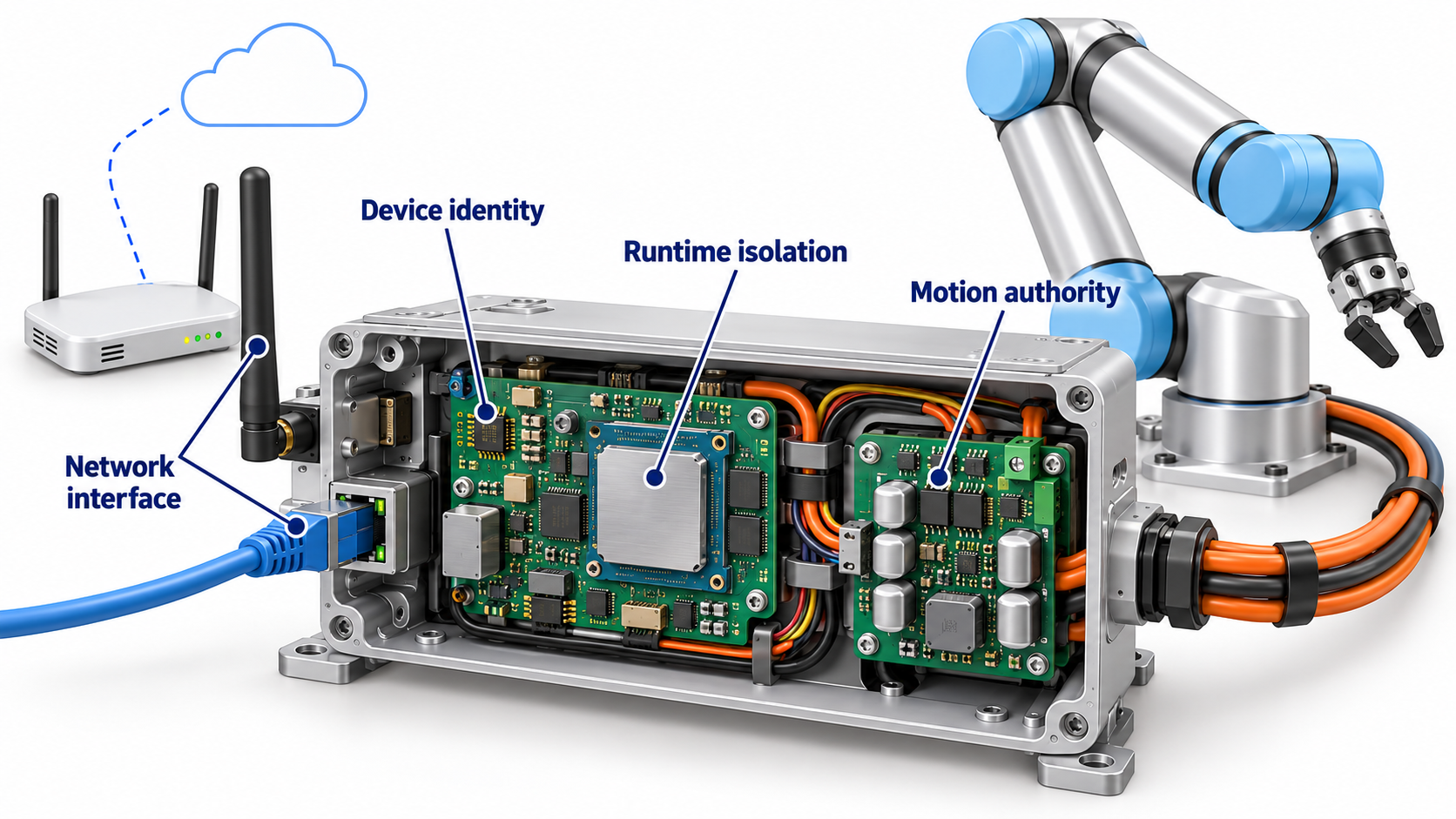
Per-device credentials contain leaked-secret reach. Process isolation, least privilege, and a narrow configuration API limit a compromised daemon’s authority compared with root shell access.
MQTT and ROS 2 authorization
MQTT routes publications and subscriptions through a broker. TLS protects the connection; authentication identifies the principal. The broker’s authorization policy binds that principal to a device, topic, and operation.
MQTT authorization by device ownership
owner-ACurrent ownership: arm-17arm-17/telemetry✓ AllowSubscribe · owned devicearm-17/command✓ AllowPublish · authorized operationarm-18/command× DenyPublish · another owner’s device+/telemetry× DenySubscribe · wildcard crosses ownership
Denied operations stop at the broker; an encrypted session stays unauthorized for those topics.
An overbroad wildcard subscription can expose multiple devices. Ownership changes require permission expiry or revocation; delivery guarantees do not authorize motion.
The February 2026 DJI Romo investigation reported MQTT data access across thousands of vacuums; a journalist verified another owner’s floor map. DJI reported server-side fixes. Cross-device permissions affected privacy as well as control.
ROS 2 security uses DDS-Security to bind certificate identities to signed topic/operation permissions; signed governance defines domain protection. Enclaves group this context. ROS 2 alone does not establish those restrictions.
Firmware security: secure boot and signed updates
Espressif’s secure-boot and OTA documentation show protected eFuse bits enforcing a security-version floor, distinct from release labels. Recovery rollback requires an eligible image.
Signature and security-version verification
- 01Signature verificationTrusted public key + signed image
Reject altered bytes or an untrusted signer.
- 02Security-version checkImage version ≥ enforced floor
Reject an older image even when correctly signed.
- Boot / install permitted
Both checks must pass.
Remote access to refrigeration controllers
In October 2026, CERT-FR confirmed compromises of refrigeration controllers ; Reuters reporting described food losses and fires . AI involvement was not established. The case illustrates how ordinary device-management authority can reach a physical process.
Network segmentation limits reachability; application permissions limit operations; local constraints limit commands. A VPN can admit an overprivileged identity.
3. AI inputs, model integrity, and the authority to act
Prompt injection through robot observations
Prompt injection can grant lower-trust observations authority over a robot’s task. Perception attacks change the estimated world; unsafe direct requests can be understood correctly and remain hazardous.
Scene text and robot task authority
Sort into bin B
Reports the label; task stays A.
Perception error: misreads the scene. Prompt injection: content attempts to redirect behavior.
RoboPAIR’s October 2024 research demonstrated adversarial prompts against LLM-controlled robots. Like RoboHarm, it separates model refusal behavior from system security.
Model provenance and hidden backdoors
Weights, adapters, and configuration define the inference artifact. Checksums match reference bytes; signed manifests identify their approver. Neither proves behavioral safety.
VillainNet , presented in 2025 and covered by Georgia Tech in January 2026 , embedded backdoors in selected SuperNet subnetworks. Traffic-sign classification experiments did not demonstrate a deployed car takeover.
Normal and triggered model inference
Evidence about origin, signer and bytes—not behavioral safety.
A normal benchmark can miss a narrow backdoor condition.
Authorization between AI plans and motion
Typed requests constrain operations, field types, and units. Authorization binds the verified caller to a device; object and coordinate-frame versions bind the request to current state.
Typed robot action request
{
  "action": "pick",
  "device": "arm-17",
  "object": "part-42",
  "frame": "fixture-v6",
  "sequence": 481,
  "issued_at_ms": 420000,
  "deadline_ms": 420120
}
Identity comes from the verified session.
- Operation scope
- The
pickenum cannot express arbitrary programs. - Device + state
- Caller scope, object, and frame must match current state.
- Freshness
- Sequence and expiry bind to trusted local state.
- Physical envelope
- Independent controller limits still apply.
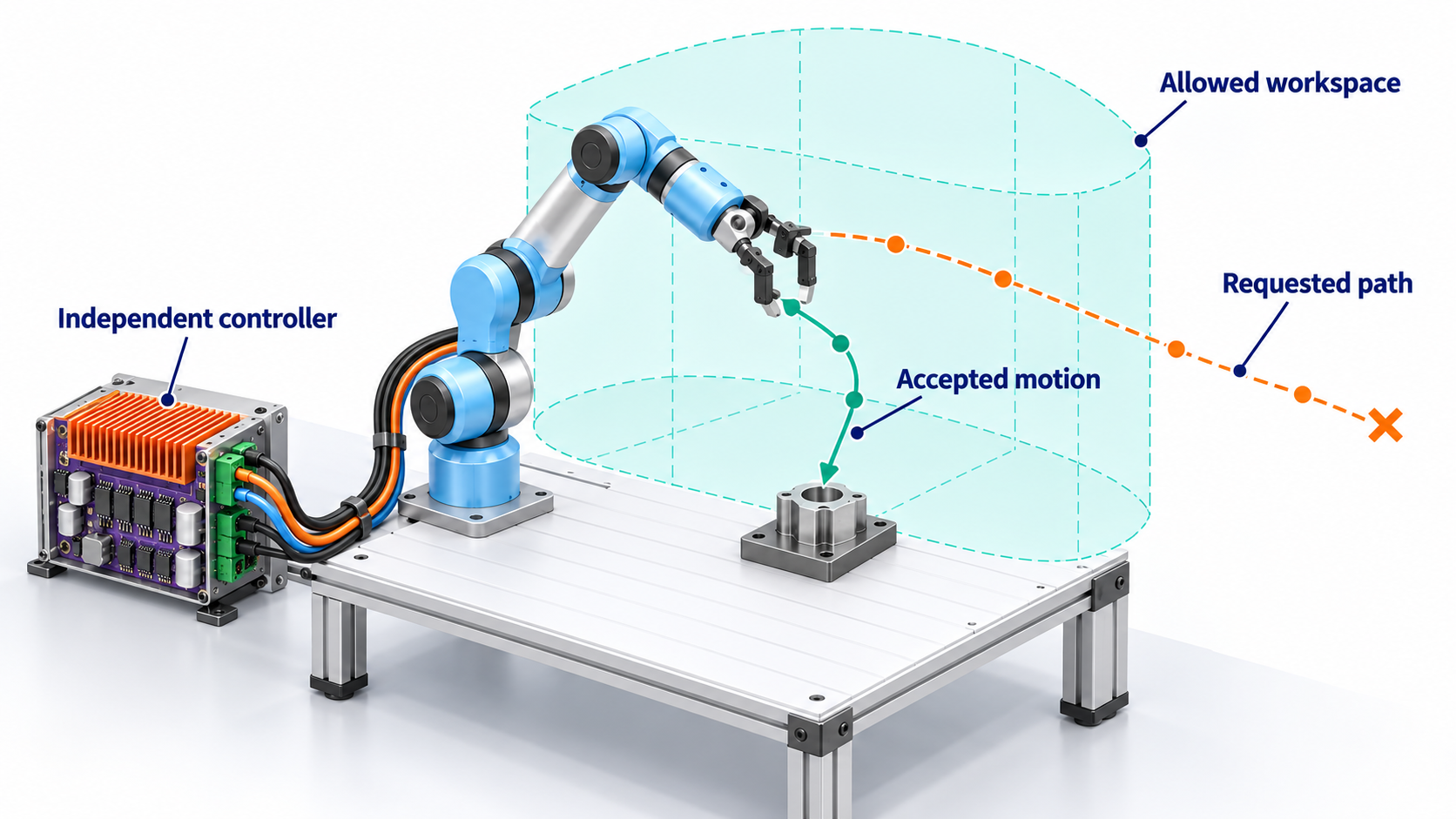
Independent workspace, speed, force, or temperature limits constrain a compromised planner. Effectiveness depends on implementation, failure behavior, and the operating envelope.
Replay attacks, command expiry, and scene changes
Signatures persist after scenes change. Sequence checks address replay attacks; expiry bounds age; current-state validation addresses changes before expiry.
A signature or message authentication code binds the payload and target, sequence, and deadline against substitution. Controllers track consumed sequences per authenticated session across restarts and use a defined clock domain. Validation near execution narrows the time-of-check/time-of-use gap; monitoring addresses changes during motion.
Validity checks for replayed and stale commands
Illustrative command: scene changes at 80 ms; expiry is 120 ms after issuance.
Connection loss needs a defined local response; RTOS scheduling alone cannot decide command authority.
Process disruption in the Polish energy attack
CERT Polska’s August 2026 follow-up describes a December 2025 attack stopping a steam turbine and process-water system; operators maintained heat supply. A misconfigured private APN enabled lateral access. AI involvement was not established.
4. Prevention, penetration testing, and recovery
Security hardening and patch verification
The September 2026 architecture review and embodied-AI survey connect defenses across device, network, model, and motion boundaries. Hardening reduces both reachable services and the authority available through them.
Controls for interfaces, credentials, and software
| Exposure | Enforcement | Verification |
|---|---|---|
| BLE / Ethernet | Disabled unused interfaces; restricted service bindings | Only approved interfaces reachable |
| Identity / commands | Per-device keys; caller checks before configuration parsing | Another owner’s request rejected |
| Software / motion | Verified patch version; rollback floor; independent limits | Vulnerable path and unsafe request rejected |
NIST’s patch guidance includes operational testing. Verification compares the running version with the vendor advisory and repeats the previously failing test; installation success alone is insufficient.
Detecting unauthorized access and configuration changes
Those controls define a baseline of approved peers, services, and configuration hashes. A September 2026 Go2 Pro forensic study correlates robot, companion-app, and network records. A new peer alone is weak evidence; its session followed by an unapproved configuration change is more informative.
Correlating robot, app, and network records
Principal · sequence · state
Session · issued command
Peer · connection time
Clock offsets and session identifiers link the records.
Detection also has blind spots. An ICRA 2026 study shows sensor bias evading prediction-error alarms; an independent predictor drives control attenuation. Its manipulator simulations demonstrate a specific defense, not a universal safeguard.
IoT penetration testing and robot assessment
The 2026 robotics-testing paper tracks attack paths in a ROS/ROS 2 laboratory. RoboMD probes manipulation-policy robustness. Neither substitutes for deployment-specific validation.
Nmap supports basic service inventory; reachability alone is not vulnerability evidence.
Penetration testing tools for robots and IoT
scan le
devices
scan off
connect AA:BB:CC:DD:EE:FF
menu gatt
list-attributesConnection must be permitted; discovery does not establish write authority.
tshark -r robot-lab.pcapng \
-Y 'btatt || mqtt || rtps'Encrypted or uncaptured payloads can remain invisible.
mosquitto_sub -h broker.lab.example -p 8883 \
  --cafile ca.pem --cert device-a.pem \
  --key device-a.key -V mqttv5 \
-t 'lab/device-b/telemetry' -d -ECertificate maps to A: B’s topic should be denied. A’s allowed topic supplies the positive control; silence proves neither.
binwalk firmware.binFile signatures identify components, not authenticity or absence of malware.
export ROS_SECURITY_KEYSTORE="$PWD/demo_keystore"
export ROS_SECURITY_ENABLE=true
export ROS_SECURITY_STRATEGY=Enforce
ros2 run demo_nodes_cpp listener --ros-args \
--enclave /talker_listener/listenerPrepared keystore and compatible middleware required. Missing credentials must block startup; topic restrictions require signed permissions.
Discovery identifies exposure; negative tests establish whether boundaries hold.
Expected results of negative security tests
- Unowned GATT write
- Denied before configuration changes
- Replayed command
- Consumed sequence rejected
- Image below security floor
- Security-version floor enforced
Incident response and recovery after compromise
CISA’s July 2026 PLC report describes password and IP-address changes disrupting water operations, with undocumented cellular modems adding exposure. This OT incident illustrates why connectivity and configuration both matter during recovery.
Recovery checks before return to service
Safe physical state · isolated access · preserved evidence
- Trusted rebuildFirmware + logic + configuration
- Access resetKeys · bonds · sessions revoked
- State validationCalibration + interlocks + limits
- Controlled trialLocal test + monitored behavior
Both paths verified; monitoring continues.
NIST’s backup guide covers logic, configuration, firmware, and restoration testing. Robot recovery also needs validated models and calibration. A trusted rebuild follows root-cause remediation; backup hashes need an uncompromised reference.
Password rotation may leave independent access paths valid. Bluetooth bonds and app tokens require separate revocation, alongside sessions and compromised keys. Verified rejection of old access, restored interlocks, and a monitored trial establish the return-to-service evidence.
5. Security across the robot lifecycle
A robotics proof of concept establishes an initial scope. Software updates, new operators, and ownership changes can reopen access paths.
Security responsibilities across the robot lifecycle
- 01Deployment
Known identity
Bounded privileges - 02Operation
Accountable actions
Protected records - 03Recovery
Known software state
Clear restart authority - 04Retirement
Revoked credentials
Removed personal data
Event records make those responsibilities traceable: which software ran, who issued a command, and what the machine did. Camera views, floor maps, and activity patterns also need bounded access and retention.
NIST’s device baseline covers identity, configuration, data, interfaces, updates, and security-state awareness. Its 2026 manufacturer guidance connects these capabilities to lifecycle responsibility.
Physical AI security becomes part of operating the machine: keeping permissions current, investigating unexpected behavior, and recovering to a state that operators can verify.