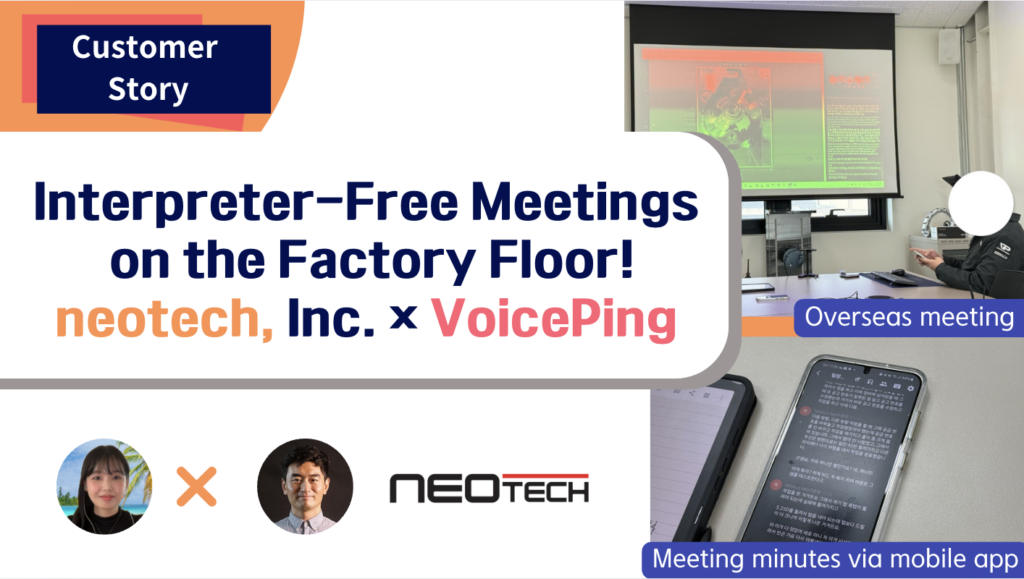
Discover how neotech, Inc. overcame multilingual communication barriers in production meetings using VoicePing's real-time translation. A true story of teamwork without interpreters.
Building Global Teamwork – Why Neotech Chose VoicePing
Interview with Junmo Lee, Director of R&D at Neotech
Hello, this is VoicePing. Today, we’re excited to share our conversation with Junmo Lee, Director of R&D at Neotech, a global automotive tuning parts manufacturer.
Neotech employs a diverse team with members from multiple countries. But how do they overcome the language barriers that inevitably arise in such an environment? And what role has VoicePing played in bridging that gap?
Neotech: Turning Tuning into Culture, and Culture into Global Business
*We conducted this interview via a VoicePing virtual meeting room*Could you briefly introduce yourself and your work?
Mr. Lee: Hello, I’m Junmo Lee, Director of R&D at Neotech. Our company specializes in the manufacturing of automotive tuning components, including suspension systems and brake kits.
My role spans both product development and broader organizational improvements, such as enhancing the internal information flow between our Korean and overseas teams. While exploring ways to make that communication smoother, we came across VoicePing. After several rounds of testing, we decided to implement it company-wide.
Could you tell us a bit more about Neotech’s business?
Mr. Lee: Of course. To many consumers, the idea of automotive tuning might feel somewhat niche or unfamiliar. However, in Japan, for example, the JDM (Japanese Domestic Market) tuning culture is well-established and even considered a subculture in its own right—there are manga and other media dedicated entirely to it.
At Neotech, we help customers bring their tuning ideas to life, whether they’re thinking:
- “What kind of part should I install?”
- “Would upgrading to larger brakes improve performance?”
- “Could lowering the chassis make the car look cooler?”
We provide customized solutions for those seeking more than just factory specs.
Although the motorsports and tuning markets in Korea are still relatively small, the global market is a different story—think F1 and beyond. The scale is massive. We’ve built a solid foundation in Korea, especially in brake and suspension tuning, and are now actively expanding into the global tuning market.
Last year, we established a local subsidiary in the United States. Currently, we have around five globally-minded team members, including foreign sales professionals and staff with international experience.
Language Barriers, Cross-Team Collaboration & Talent Recruitment – All Tied Together
What led you to seek out an AI translation solution in the first place?
Mr. Lee: The need for an AI translation solution came directly from the growing multinational nature of our internal communication. In our sales team alone, we currently have five international employees—two of whom were raised overseas, while the others come from places like Singapore and Central Asia. We plan to continue expanding our global talent recruitment as our business grows.
Naturally, as communication between our Korean HQ and international staff became more frequent and essential, we began looking into AI-based tools that could help streamline multilingual collaboration.
Of course, we did consider other options—like having bilingual staff act as interpreters, or even hiring dedicated interpreters. But that only works if someone can speak Korean, English, and their native language at a fairly high level. For instance, one of our Indonesian staff members isn’t fluent in either Korean or English, so assigning a personal interpreter for one employee wasn’t a practical or scalable solution.
Through this experience, we realized the urgent need for a flexible solution that could support multilingual communication while embracing a diverse, global team.
What kind of difficulties did you face before implementing VoicePing?
Mr. Lee: There was no fixed approach—we handled things on a case-by-case basis. Some international employees could understand Korean, but many could not.
For example, in our manufacturing division, we have a number of team members from Vietnam and other Southeast Asian countries, and not all of them are fluent in English either. Providing formal language training in either Korean or English wasn’t realistic in terms of time or cost.
As a company aiming for the global market, we decided to prioritize hiring capable talent over language skills—and to address the language barrier through systems and tools.
How did you discover VoicePing, and what made you choose it over other tools?
Mr. Lee: We found VoicePing through a simple online search. As we compared various translation tools, we realized that VoicePing was the only one that met all our key requirements.
The biggest factor was its ability to automatically detect and translate speech without requiring manual input. With most tools, users need to press a button to speak, and the other person has to do the same. That gets tedious really quickly in real meetings.
In contrast, with VoicePing, you just leave the app running, and it automatically listens and translates in real time. That kind of intuitive, hands-off experience was exactly what we needed for actual business use.
When we did our research, VoicePing was the only mobile solution we found that could translate speech automatically just by running the app.
At one point, we also experimented with using ChatGPT for translation. But for real-time conversation, it just wasn’t fast enough for live interactions or on-the-spot decisions. That was another reason we ultimately chose VoicePing.
From Weekly Meetings to the Production Floor – A Field-Tested Communication Tool
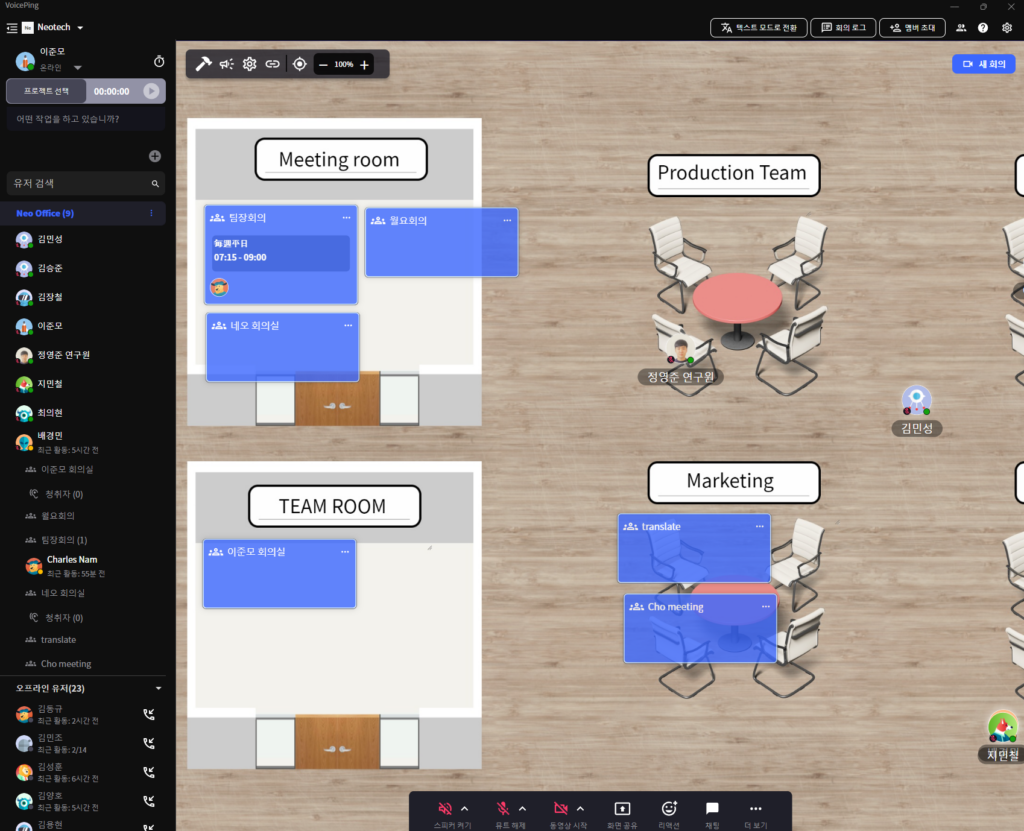 A weekly team meeting at Neotech using VoicePing. Image courtesy of Neotech.
In what kind of work situations is VoicePing used the most at Neotech?
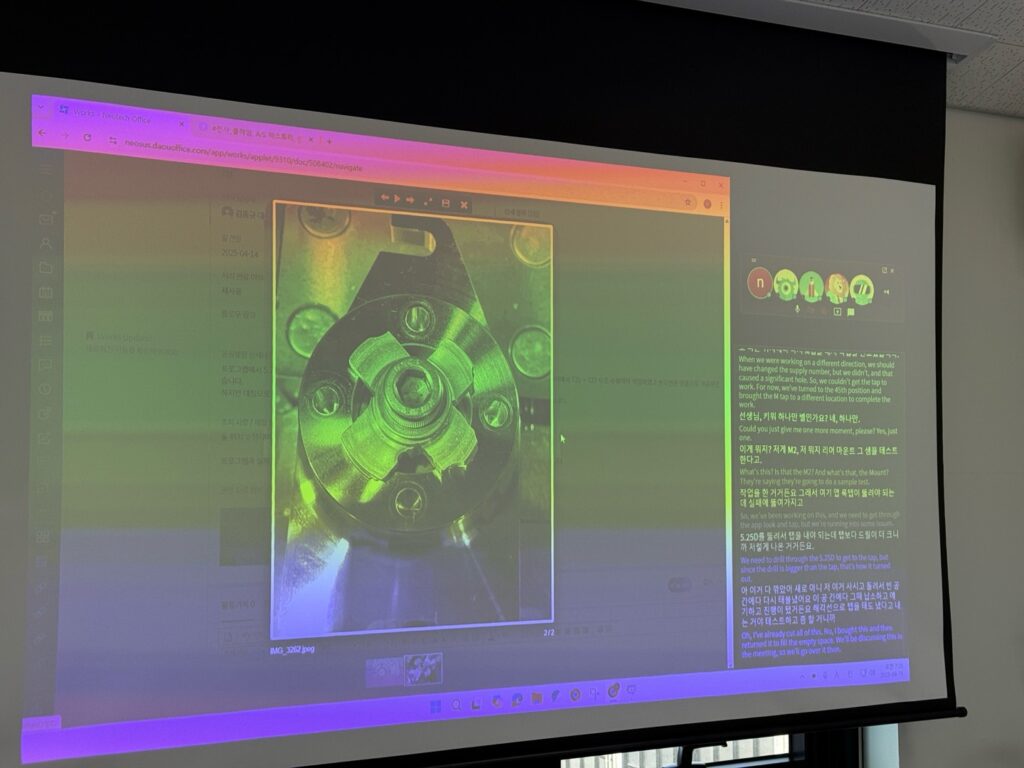 Actual meeting in progress at neotech Inc. Photo courtesy of neotech Inc.
Mr. Lee: We use VoicePing most actively during our weekly all-hands meetings every Monday. When someone speaks in Korean, our international staff follow along in real time through their own devices—receiving live translations in English or Indonesian, depending on their language preference.
We also use VoicePing during our daily morning meetings with team leads. One of our team leaders in charge of international sales is from Singapore. He’s lived in Korea, so he understands some Korean, but when it comes to detailed discussions, there are still things he might miss. That’s where VoicePing really helps him stay fully engaged and catch up with precision during the meetings.
Are you satisfied with the translation speed and overall quality?
Mr. Lee: Yes, overall we’re very happy with it. The translation is fast, and the output sounds quite natural, so it’s easy to use in real business contexts. In terms of functionality, VoicePing delivers exactly what we hoped for.
One thing I’ve noticed, though, is that translation accuracy can vary depending on pronunciation. When someone speaks clearly, the voice recognition and translation are very accurate. But for employees whose pronunciation differs slightly from standard Korean—like some of our overseas staff—the recognition can be a bit off, which affects the translation result.
What’s been the most impressive aspect of using VoicePing so far?
Mr. Lee: What stood out the most for me is how versatile the tool is across different use cases.
The fact that you can just leave the app on and it will automatically pick up and translate speech in real time—that’s already a huge plus. But beyond that, we’ve found it to be useful in a wide range of situations, including:
- Internal meetings
- Team-level operational discussions
- Presentations involving global partners
It’s easy to use regardless of the setting, and that’s incredibly convenient. I’ve heard that other companies also use VoicePing for product launches or live events, and I’m not surprised. It really feels like a universally adaptable tool.
Real Feedback from the Field – Feature Requests from a Hands-On User
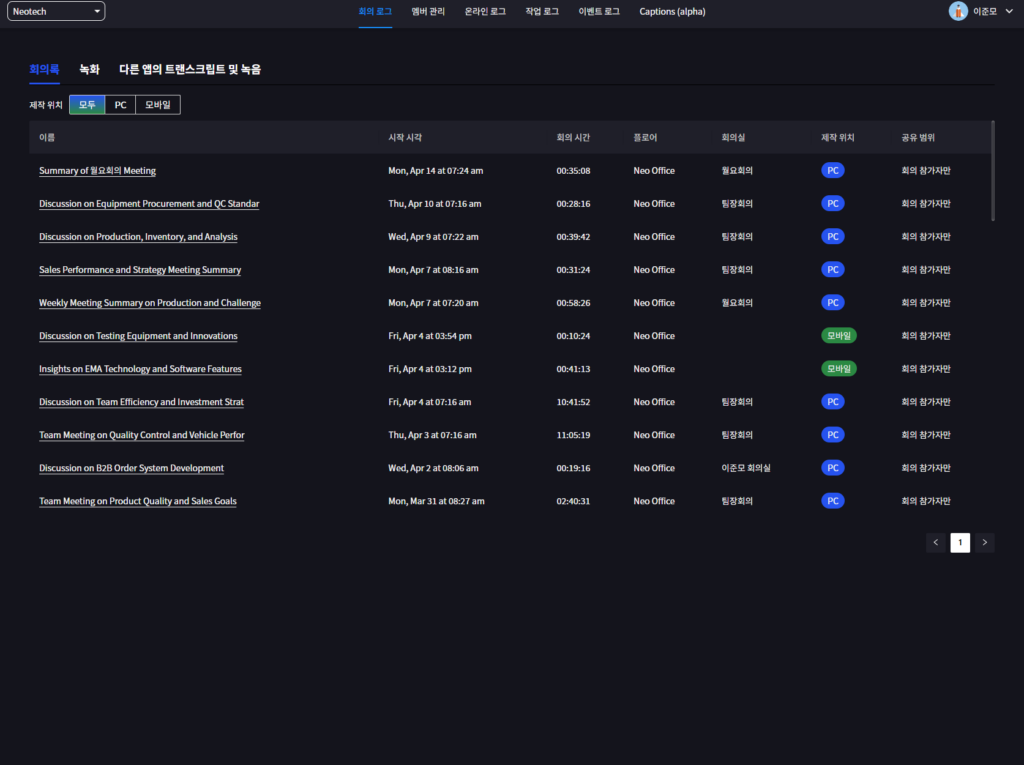 Neotech team using VoicePing to record meeting transcripts. Image courtesy of Neotech.
Are there any features you’d like to see improved in VoicePing?
Mr. Lee: Yes, absolutely. One of the first things that came to mind is the dictionary registration feature. In our industry, we use a lot of specialized terms—especially product names and auto parts—that regular translation models often fail to recognize.
I’ve personally registered over 200 terms manually so far. But doing that all by hand can be quite tedious. On top of that, when new or unexpected terminology comes up in meetings, it can easily lead to mistranslations.
So for example, it would be amazing if the AI could say: “This word appears frequently but isn’t in your dictionary. Would you like to add it?”
A feature like that, where the system learns from word usage patterns, would be incredibly helpful. A similar word suggestion feature would be nice too.
Also, if possible, it would be great to pre-register the voices of our frequent users, and let VoicePing learn their pronunciation over time. That could boost the accuracy of voice recognition, especially for non-native speakers.
We heard you also use VoicePing to keep meeting records on-site. Could you share your experience with that?
Mr. Lee: Yes—we typically have around 10 people sitting around a long table for meetings, and we use VoicePing not just for translation, but also to record transcripts.
To capture everything, we usually place 3 to 4 phones on the table. The issue is that devices closer to the speaker pick up audio clearly, but those further away often don’t. So the quality of the transcripts varies between devices, depending on distance.
I understand that’s a physical limitation, but imagine if each VoicePing device could sync with others nearby, and prioritize only the voices closest to it—automatically filtering out more distant sounds. That kind of feature would really help standardize transcript quality and improve the overall user experience.
Neotech Inc. continues to use VoicePing for their daily operations, enabling seamless communication across their multinational team without the need for dedicated interpreters.