In this article
How Brave group uses VoicePing for Korean real-time translation, multilingual meetings, and meeting transcription after integrating with StelLive.
Brave group Inc. operates a diverse range of businesses centered on VTuber operations, including contracted development, hardware planning and sales, and trading card games. With offices in Europe, English-speaking regions, Thailand, and other parts of the world, the company operates numerous subsidiaries. In July 2025, Brave group completed a business integration with StelLive, one of Korea’s largest VTuber productions. This created a daily need for real-time communication in Korean, leading the company to introduce VoicePing.
We spoke with Mr. Kosei Nishi, General Manager of the Information Systems Department in the Group Administration Division, who led the introduction of VoicePing, about the background of the implementation, concrete use cases, and future plans.
At a Glance
- Challenge: Brave group needed Korean real-time translation after integrating with StelLive, while keeping multilingual meetings practical for Japanese, Korean, English, and Thai speakers.
- Solution: VoicePing was used for real-time translation, bilingual transcription, and multilingual meeting support across back-office and business-division meetings.
- Results: Interpreter workload decreased, employees felt less intimidated about joining overseas meetings, and teams could focus on the important points of each meeting.
- Relevant use cases: Korean-Japanese real-time translation, multilingual meeting transcription, overseas subsidiary communication, and VTuber event support.
This case study is useful for teams evaluating real-time translation for meetings and events , automatic meeting transcription , and global communication workflows for overseas subsidiaries.

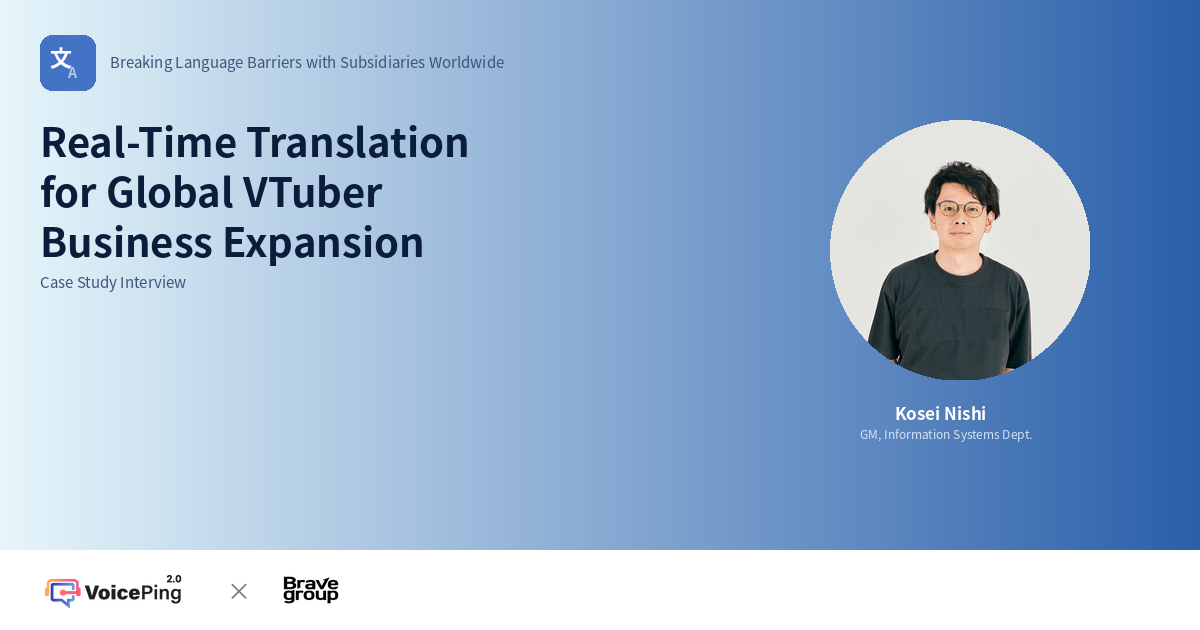
Kosei Nishi, General Manager of the Information Systems Department, Group Administration Division, Brave group Inc.
An Entertainment Company Expanding Globally Around IP
First, could you tell us about your role and Brave group’s business?
Mr. Nishi: My name is Nishi from Brave group Inc. I serve as General Manager of the Information Systems Department in the Group Administration Division of the holding company. We have many subsidiaries, and the most well-known area is our IP business with VTubers. We operate VTuber productions such as “VSPO!” and “StelLive.” We also have a contracted development business, a business that plans and sells hardware such as keyboards using IP, and more recently a trading card game business. Because we operate in many areas, it is hard to describe the company in one sentence, but we are mainly a company that develops IP in many different forms.
Business Integration with a Korean Company Created an Urgent Need for Real-Time Translation
What prompted you to introduce VoicePing?
Mr. Nishi: In July 2025, we integrated with StelLive, a Korean company operating a VTuber business. We had already established overseas offices in Europe, English-speaking regions, and Thailand, and had mainly operated using English. However, the Korean case was very different. The main language for real-time conversations was not English, but Korean.
That was the initial trigger for us to start looking for tools that could provide simultaneous interpretation and transcription compatible with Korean.
There are many translation tools available. What challenges did you face?
Mr. Nishi: Since we use Google Workspace, we also tried generative AI translation features. When there is text to input and translate, the accuracy is very good, but real-time handling was difficult.
After trying several tools, we also realized that many of them used what is essentially two-step translation: Japanese is translated into English first, and then into Korean. Visually it may appear as though Japanese is translated directly into Korean, but we have members who speak Korean, and when they checked the translations, they often felt the nuance was a little distorted.
Why VoicePing Was Chosen: Different AI Models for Different Languages
Brave group logo
Why did you choose VoicePing among those options?
Mr. Nishi: When VoicePing was explained to us, we heard that the model changes depending on the language being adjusted. We felt that this would likely avoid the two-step translation feeling we had experienced, and that became a major reason for choosing VoicePing.
Even when members who speak Korean checked it, the naturalness of the translation was better than other tools.
Used Across Back Office and Business Divisions in Multilingual Meetings
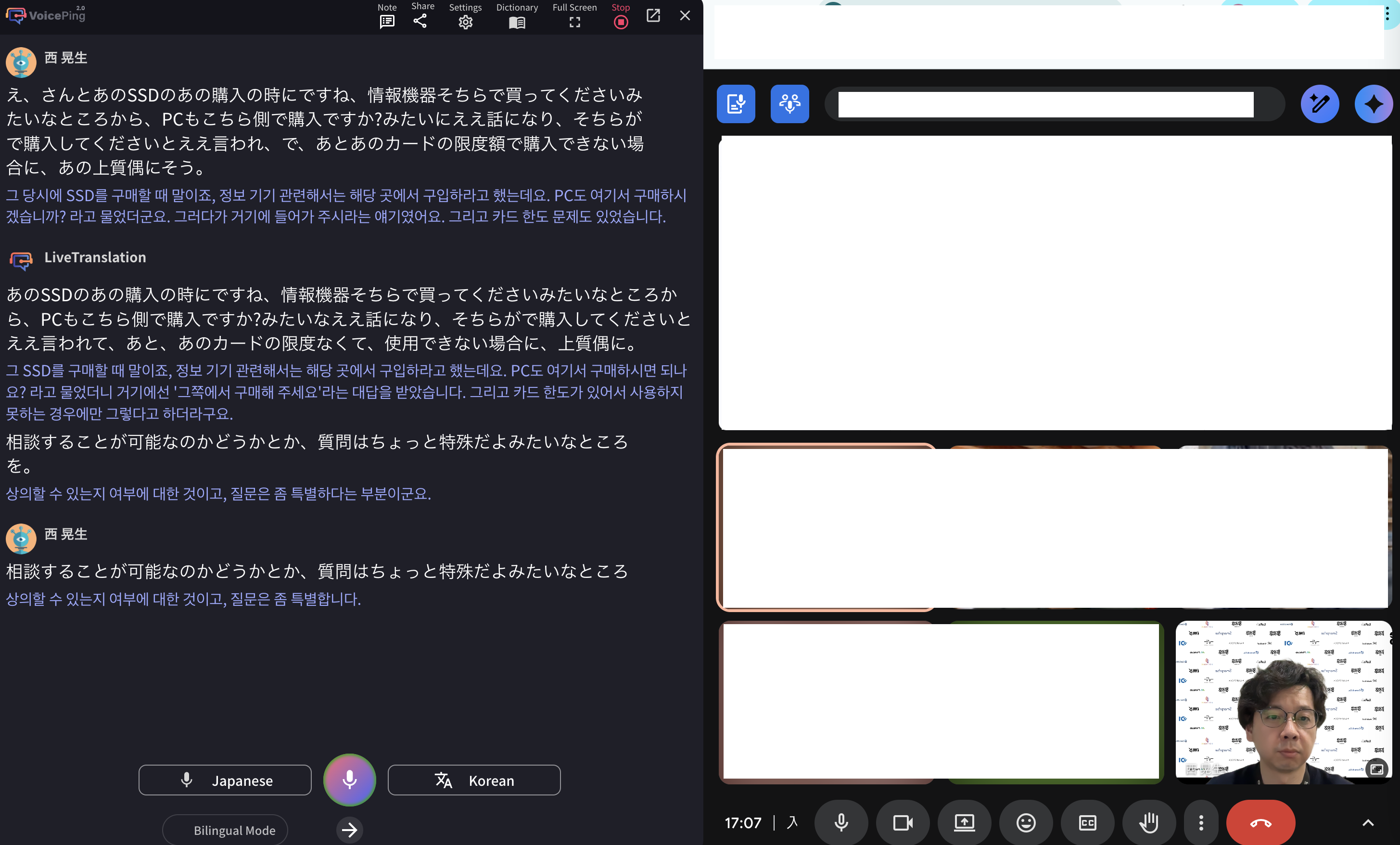
VoicePing bilingual mode translating Japanese and Korean in real time. Image provided by Brave group Inc.
In what specific situations do you use it?
Mr. Nishi: The Brave group holding company itself is in a position to support subsidiaries through back-office work and event support. Some of the IP is overseas, and there are many cases where Japanese members mediate communication.
In those meetings, we use VoicePing not only for Korean, but also for combinations of Japanese and English. For example, when a business partner is from an English-speaking region, and Japanese members and staff from an IP company are also in the meeting, we are there as intermediaries for the on-site staff, and multiple languages are involved. We use VoicePing often in those situations.
So it is also used for languages other than Korean.
Mr. Nishi: Yes. It seems that some people are using it for Thai as well. We have not yet collected all the feedback, but usage is spreading across various language situations.
Interpreter Workload Dropped Significantly: “We Can Join Meetings Without Feeling Intimidated”
What impact has the introduction had?
Mr. Nishi: The biggest impact is that the workload on members who speak Korean has decreased. Previously, those members provided real-time interpretation. After introducing VoicePing, we first convert the conversation into text, and then they only point out parts where the nuance is different. I think the workload, or the amount of effort required, has decreased considerably.
There was also another major change for Japanese staff. If someone has an account, even if no Korean-speaking member is present, they now have the assumption that they can use the tool to achieve at least a minimum level of communication. Because of that, they can join overseas meetings without feeling intimidated. I think it has been very effective in helping people focus properly on the important points of the meeting.
How do you evaluate the cost-effectiveness?
Mr. Nishi: Honestly, it is difficult to quantify cost-effectiveness, but it is certain that the hurdle for joining meetings has gone down. I think that is the biggest value.
The implementation created several practical changes in day-to-day meetings:
- Korean-speaking members no longer needed to interpret the full meeting in real time.
- Japanese staff could join overseas meetings even when no Korean-speaking member was available.
- VoicePing transcripts gave multilingual participants a shared text record to confirm nuance.
- Teams could use the same workflow for Korean, English, Thai, and other multilingual meeting situations.
Bilingual Mode Is Well Received: “Both Sides Are Visible in One App”
Were there any features released after introduction that were especially well received?
Mr. Nishi: At first, transcription and translation were one-way from language A to language B. The ability to switch both ways in bilingual mode was quite good.
What we say is transcribed as-is and shown to the other party, and then what the other party says is also visible to us. Conversation is a back-and-forth exchange, so previously it was troublesome for the other side to switch languages as well. Now both sides can be seen in a single app, and our members told us it has become much easier.
Around that time, members had just been asking us, “Isn’t there a feature like that?” We had said, “We’ll send the request to the developer, so please do your best,” and then about a month later it was released. The timing was excellent, and we were very happy.
Candid Feedback on Translation Accuracy
Please share your honest thoughts on translation quality.
Mr. Nishi: For Japanese and English, there are no issues. For Korean, we have received some feedback from local staff that the nuance could be a little better.
That said, we always check the release notes and update details, so we understand the development pace. If VoicePing continues working on quality improvements, I think we will be able to use it even more.
There is also a dictionary registration feature for proper nouns, but because we have so many subsidiaries, there are many dictionaries that would need to be registered. For now, our operation is to ask people to rephrase technical terms in simpler words.
Use Cases for Global Entertainment Teams
Brave group’s use of VoicePing shows several patterns that apply to global entertainment and IP businesses:
- Overseas subsidiary meetings: Korean-Japanese real-time translation supports daily communication after business integration.
- Cross-border project coordination: Japanese, Korean, English, and Thai speakers can participate in the same meeting with translated text visible.
- Meeting documentation: VoicePing’s transcription gives teams a record they can review after multilingual discussions.
- Offline and streaming events: VTuber music festivals, esports events, and OBS-based streams create future opportunities for real-time captions and translation.
Future Plans: Multilingual Support at Offline VTuber Events
How would you like to use VoicePing going forward?
Mr. Nishi: First, as we expand to various overseas locations and countries, language barriers are always present. We are grateful that VoicePing supports many translatable languages. If it can quickly support the languages of countries we want to enter in the future, that would be very helpful.
Another internal request is to use it at offline events. Our business divisions are increasingly holding offline events such as VTuber music festivals and esports events.
At those venues, people who speak many different languages are present. If there were a system that allowed people to use their smartphones to understand what is happening in real time through text, I think it would create a better experience.
Are you also considering use in VTuber streams and live performances?
Mr. Nishi: In our case, we use streaming tools such as OBS, so if VoicePing could be integrated as a component that connects via Webhook or WebSocket and displays translations on screen, I think each IP team would find it very helpful. If there is an opportunity, we would definitely like to discuss it.
Summary
Brave group introduced VoicePing after its business integration with a Korean company and solved challenges in daily multilingual communication. VoicePing’s approach of optimizing AI models for each language pair overcame the unnaturalness of two-step translation that had been an issue with other tools. It reduced the burden on interpreting staff and lowered the psychological barrier for employees participating in overseas meetings.
What was especially striking was the comment that the team had gained the assumption that “even if there are no members who can speak the language, we can still achieve a minimum level of communication.” VoicePing is not simply a translation tool; it has become something that raises the overall sense of communication security for a globally expanding organization.
Going forward, new entertainment-industry use cases are expected to expand, including multilingual support at offline events such as VTuber music festivals and esports events, as well as embedding translation into streams through OBS integration.
Interview date: March 10, 2026
Interview cooperation: Kosei Nishi, General Manager of the Information Systems Department, Group Administration Division, Brave group Inc.
| Item | Details |
|---|---|
| Company | Brave group Inc. |
| Business | IP production business, contracted development business, hardware planning and sales business, trading card game business, and more |
| Address | PMO Tamachi III 8F, 4-1-28 Shiba, Minato-ku, Tokyo 108-0014, Japan |
| Website | https://bravegroup.co.jp |
Make Multilingual Team Communication Smoother with VoicePing
VoicePing is a modern communication tool with real-time translation for meetings and events , multilingual transcription, and virtual office features. It removes language barriers in multinational team meetings and events, enabling smoother communication.
- Language is a barrier in meetings with overseas offices
- Interpretation work is concentrated on specific staff members
- Employees hesitate to participate in overseas meetings
VoicePing can be used with all features for free by teams of up to five people. Try it first and see the impact.