In this article
How Formula Consulting used VoicePing for live Japanese–English translation across startup pitches and one-on-one matching at AI×MedTech 2026 in Nagoya.
At an international medical-technology event, the language challenge changes from one moment to the next. A startup founder may be pitching to a full room in English. Later, the same founder may be seated across from a Japanese healthcare company, discussing a possible collaboration one-on-one.
That was the setting for the AI×MedTech Asia Innovation Challenge 2026 (AI×MedTech アジアイノベーションチャレンジ), jointly held by Aichi Prefecture and Fujita Health University from July 27 to August 5, 2026. The startup pitch program brought 19 companies from Japan and overseas to STATION Ai in Nagoya for pitches and individual matching with medical institutions and medical-device companies.
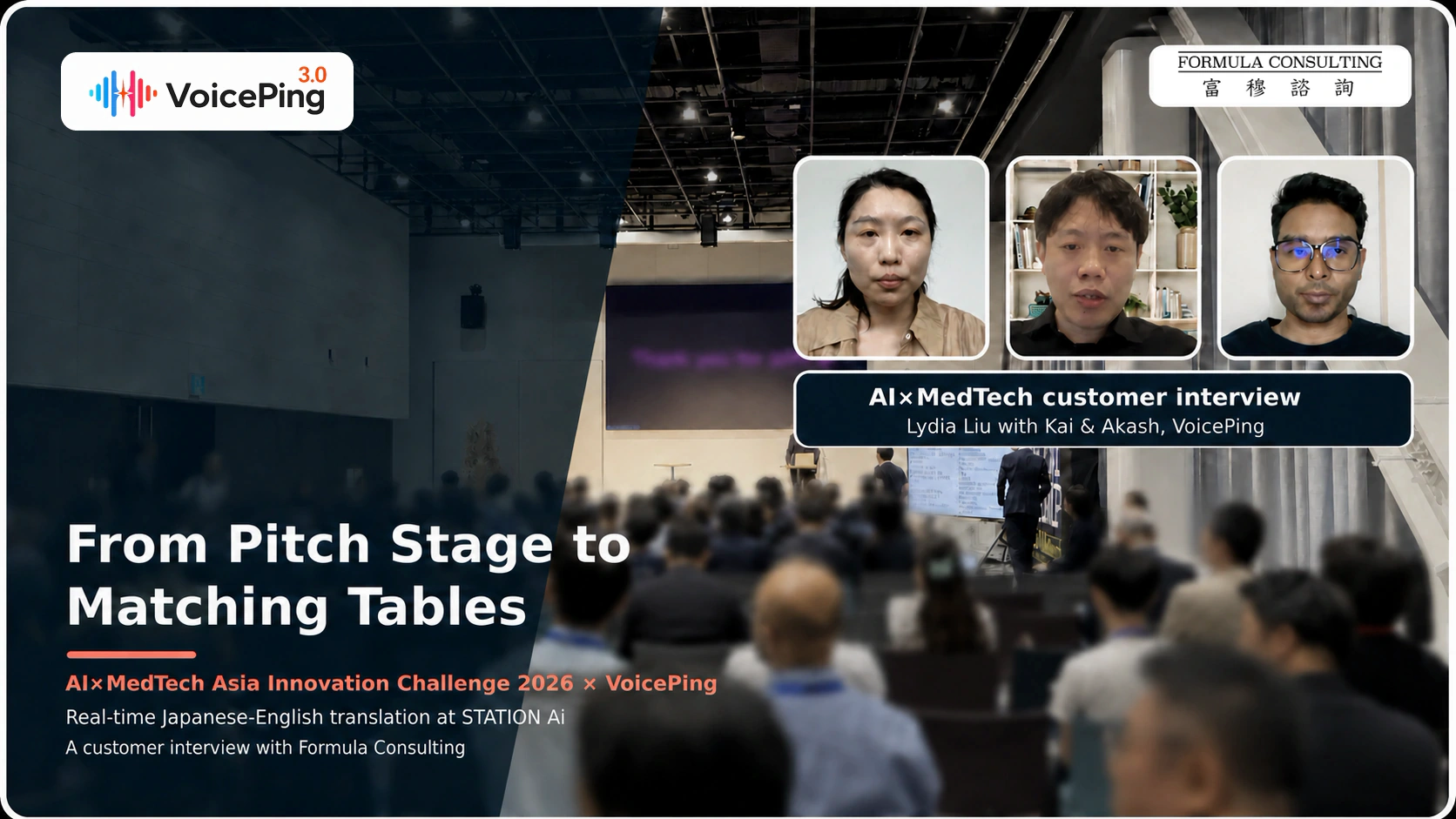
VoicePing supported both communication settings: translated captions on the venue’s shared screen during startup presentations, plus Japanese–English speech translation during one-on-one meetings. We spoke with the Formula Consulting team that operated the pitch program under commission from Aichi Prefecture about what worked, where the event environment created friction, and what they would like to see next.
Two event formats, one multilingual challenge
— Could you introduce Formula Consulting and explain the focus of the pitch program?
Formula Consulting: We are a consulting firm, and many of our clients are Japanese companies. This program had two main parts for the participating startups: pitch presentations, and one-on-one meetings with Japanese healthcare and medical-device companies.
Those two formats needed different kinds of language support. During the pitches, the translated captions had to be easy for a room to follow on a large screen. During the matching meetings, the priority was helping two parties communicate directly across Japanese and English.
Formula Consulting was formally listed by Aichi Prefecture as the commissioned operator for the pitch program. The wider challenge also included a separate entrepreneurship program for university students run by Fujita Health University; VoicePing’s customer interview and this article focus only on the startup pitch and individual-matching program at STATION Ai.
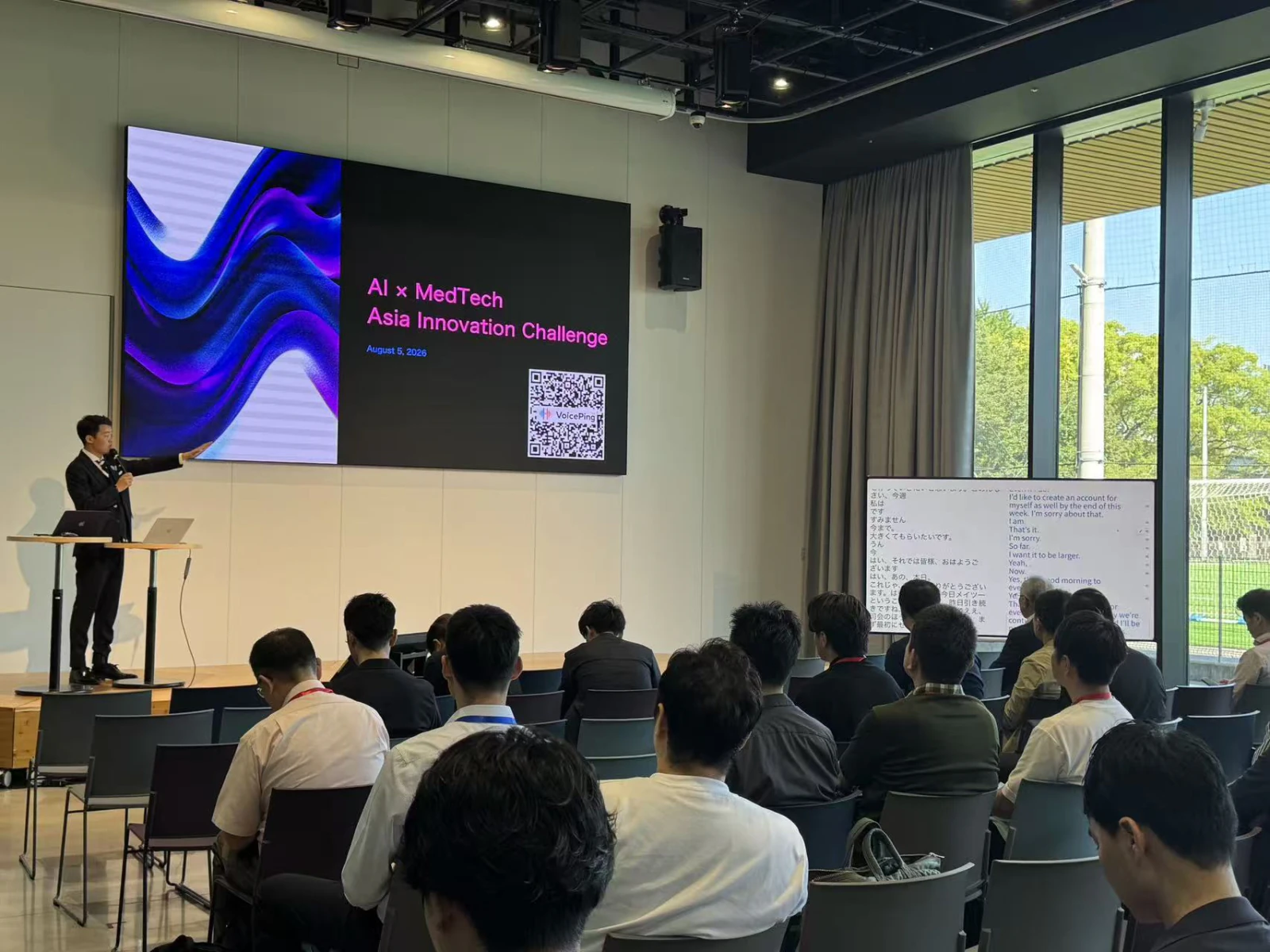 The AI×MedTech pitch program at STATION Ai, with VoicePing QR access on the main screen and Japanese–English captions on the adjacent display.
A referral from someone who had used VoicePing before
— Before the event, did you compare VoicePing with other translation options?
Formula Consulting: A member of our team had worked on another project where VoicePing was used and recommended it to us. For this event, we did not evaluate other products.
That recommendation led to a deployment designed around the two moments where the teams most needed help: presenting to the room, and talking directly at the matching tables.
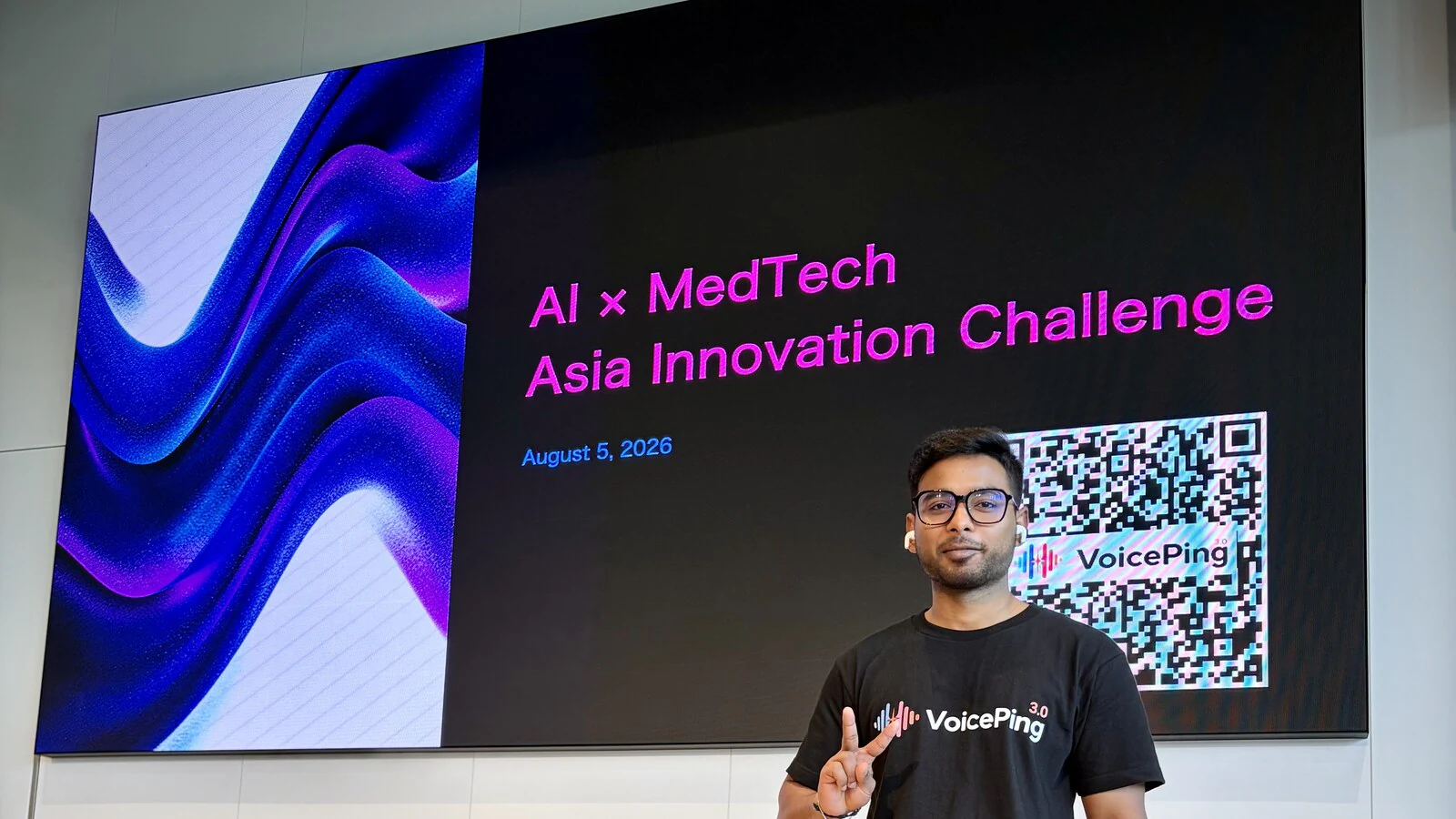 Akash from VoicePing at the AI×MedTech venue on August 5, with the event display and VoicePing QR access point behind him. Source photo supplied by the VoicePing on-site team.
“Overall, it was smooth” on the pitch screen
— What was your experience with the translated captions during the startup presentations?
Formula Consulting: Overall, it was quite smooth. There were occasional recognition issues with individual words, so it was not perfectly accurate, but the captions generally conveyed the speaker’s intended meaning well.
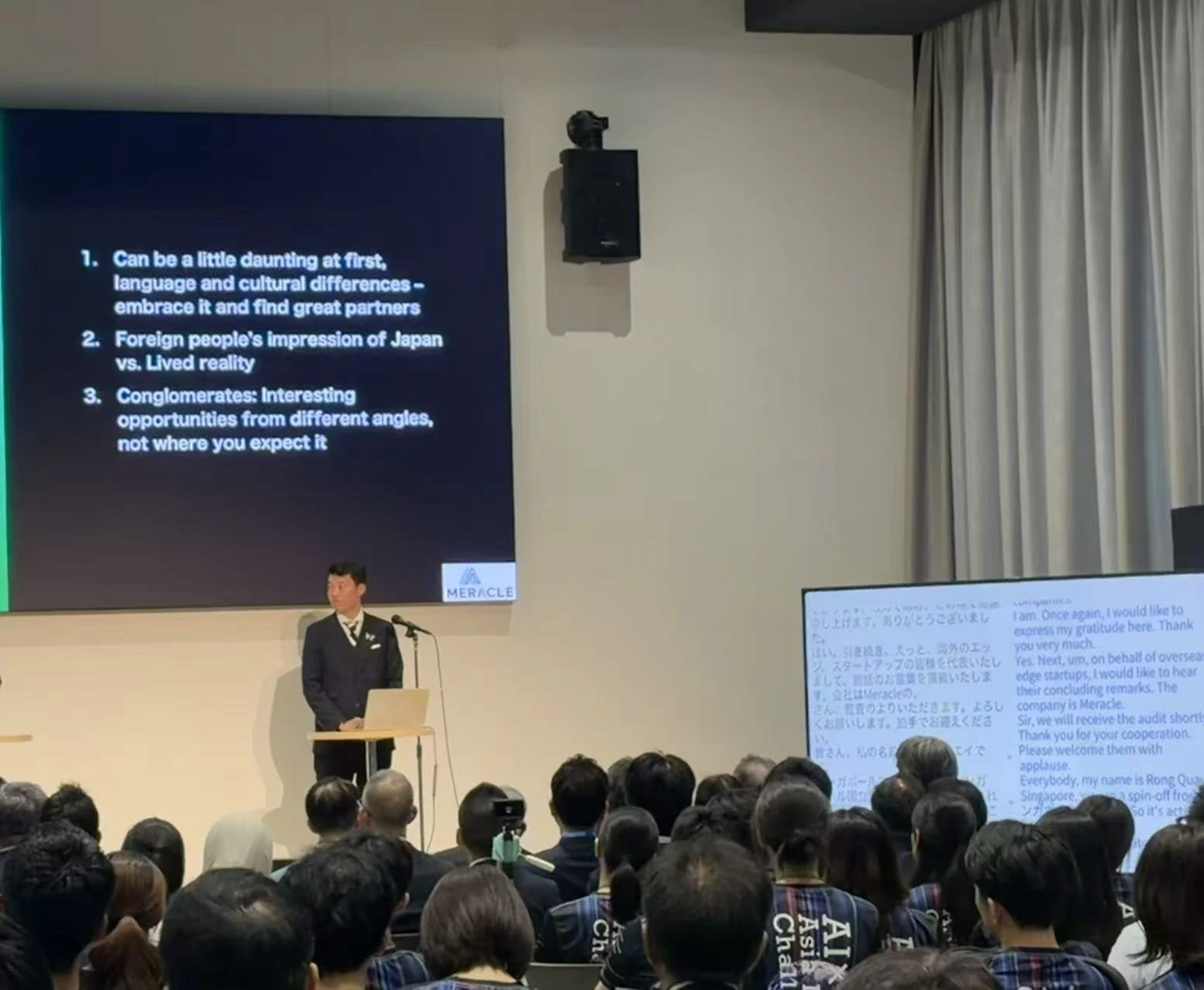 A pitch session at STATION Ai, with presentation points on the main screen and Japanese–English captions displayed beside the stage.
— Did proper nouns create a particular problem?
Formula Consulting: We did not feel that proper nouns were less accurate as a category. Recognition seemed more likely to drop when a word’s pronunciation was difficult for the system to pick up. Some Japanese sounds were occasionally recognized incorrectly, but proper nouns did not stand out as a separate weakness.
The team did not report a notable issue with caption size, layout, or update speed. Their feedback was more specific: the overall flow was readable, while individual recognition errors still left room for improvement.
One-on-one meetings exposed the room-acoustics problem
— How did VoicePing perform during the one-on-one matching meetings?
Formula Consulting: It helped the two sides communicate, and the translation quality was acceptable overall. The more difficult part was the environment. Many meetings were happening at the same time in the same space, so background conversations could affect audio pickup.
This is an important operational distinction. Translation quality does not depend only on the language model; it also depends on the sound that reaches the system. A pitch microphone in a controlled presentation setup and several simultaneous conversations in an open room are different audio conditions, even when the language pair is the same.
The feedback suggests a practical planning lesson for future matching events: room layout, microphone placement, and separation between tables should be treated as part of the translation setup—not as unrelated venue details.
The shared screen won the audience’s attention
— Did attendees use the QR code to follow the translation on their own phones?
Formula Consulting: We were still collecting direct feedback from attendees, so we did not yet have survey responses to share. Based on what we observed, most people followed the translated captions on the large screen. The QR code was available, but fewer people appeared to use the phone view.
That observation does not make the mobile option unnecessary. It shows that audience behavior follows the event format. In a pitch room where attendees are already looking toward the presenter and slides, a clearly positioned shared translation screen can become the natural focal point. Personal-device access remains useful for attendees who need a closer view or prefer to follow independently.
Because the organizer was still collecting feedback at the time of the interview, this article does not claim a measured satisfaction score or a formal attendee outcome.
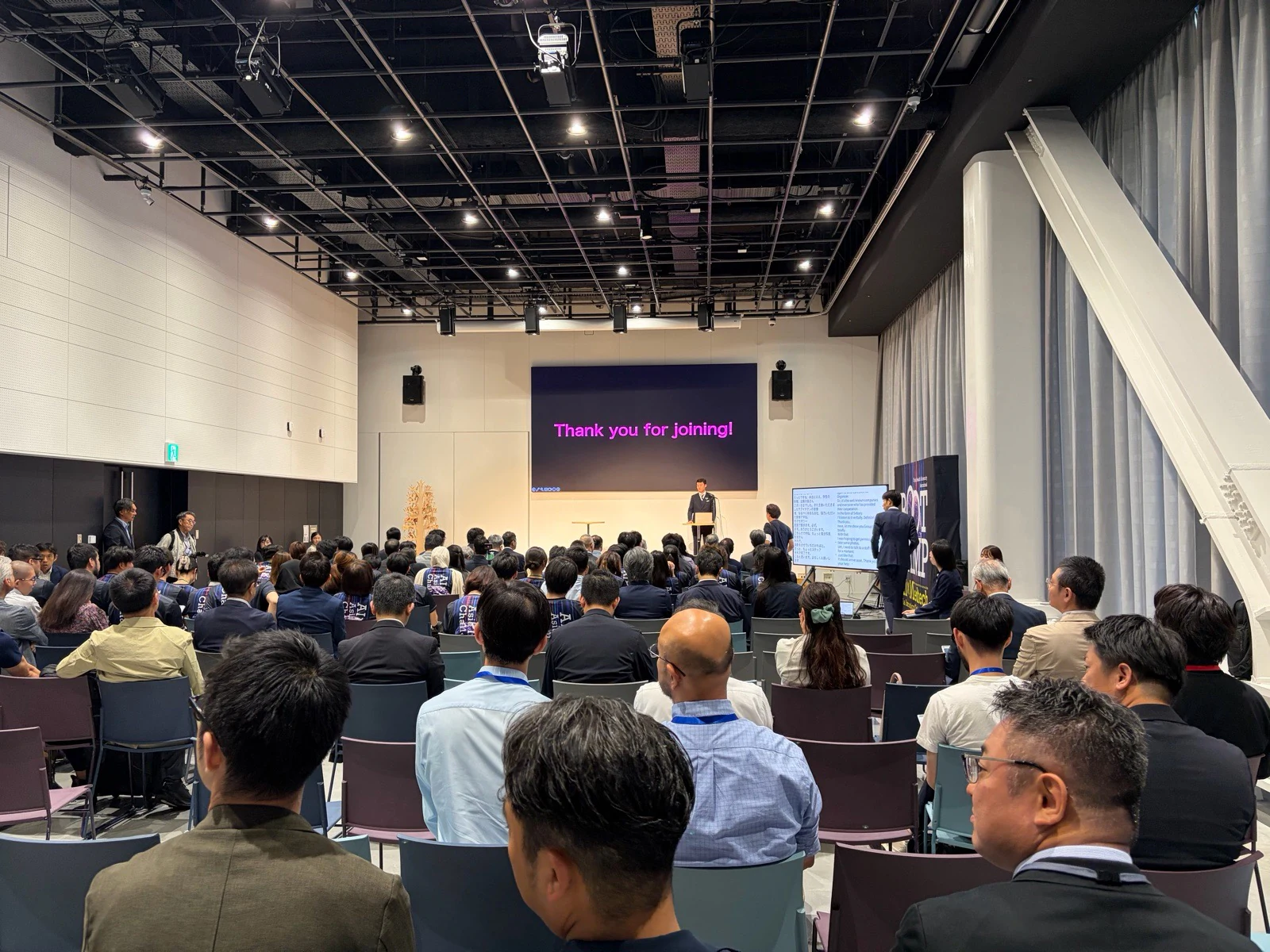 The AI×MedTech audience follows the main stage and the adjacent Japanese–English caption display at STATION Ai.
The next request: show captions with the presentation material
— What would make the experience more convenient at a future event?
Formula Consulting: During one-on-one meetings, it would be more convenient if the translated captions and the presentation material could appear on the same screen. At the moment, VoicePing runs in a browser while the material being discussed may be open in another page or application. That makes it difficult to view both at the same time.
The request is concrete: not a new translation claim, but a better way to place translation inside the conversation. When a startup is explaining a chart, product image, or clinical workflow, both sides need to see the material and the translated speech without repeatedly switching views.
VoicePing is treating this as product feedback, not as a committed release. The customer is asking for a presentation overlay or side-by-side viewing experience that keeps shared content and live captions visible together.
Where VoicePing could fit next
— Would you consider using VoicePing again?
Formula Consulting: We would consider it when organizing similar events in the future. At this point, we do not have another specific use case to share.
That is intentionally softer than a renewal announcement. The team identified a fit for future events with the same combination of international pitches and Japanese corporate matching, but it did not make a public commitment about a next deployment.
Key takeaways
- Two settings required two delivery modes. Shared-screen captions supported startup pitches; speech translation supported one-on-one matching meetings.
- The pitch experience was generally smooth. The organizer said the captions conveyed the intended meaning, while noting occasional word-recognition errors.
- Audio conditions mattered during matching. Concurrent conversations in the same room sometimes interfered with audio pickup.
- The room screen drew more attention than the QR flow. This was an organizer observation, not a measured usage rate.
- The clearest product request was visual integration. The team wants live captions and presentation materials visible on the same screen.
- Future use remains a possibility, not a commitment. Formula Consulting would consider VoicePing for similar events.
At a glance
| Event | AI×MedTech Asia Innovation Challenge 2026 |
| Overall event dates | July 27–August 5, 2026 |
| Pitch-program dates | August 4–5, 2026 |
| Venue | STATION Ai, Nagoya, Aichi |
| Pitch-program scale | 19 startups as of July 21: 8 from Japan and 11 from overseas |
| Customer | Formula Consulting (フォーミュラ総合研究所株式会社), Aichi Prefecture-commissioned pitch-program operator |
| Use case | Live translation for startup presentations and one-on-one business matching |
| Delivery | Shared-screen captions, QR-code access on personal devices, and speech translation at matching tables |
| Languages | Japanese and English; direction varied by event segment. |
| Organizer feedback | Pitch captions were generally smooth and conveyed meaning; concurrent meetings sometimes affected audio pickup |
| Attendee feedback | Still being collected as of the August 17 interview |
| Requested improvement | Display live translated captions alongside presentation materials on the same screen |
About Formula Consulting
 Formula Consulting official logo.
Formula Consulting (フォーミュラ総合研究所株式会社) is a cross-border consulting firm serving Japanese companies and other clients across Asia. Its work spans research, strategy, and implementation support. Aichi Prefecture identifies the company as the commissioned operator responsible for inquiries and operations relating to the AI×MedTech pitch program.
- Website: Formula Consulting
- Event role: Commissioned operator for the startup pitch program
- Official event information: Aichi Prefecture — AI×MedTech Asia Innovation Challenge 2026
Planning a multilingual pitch or matching event?
VoicePing provides real-time translation for presentations, seminars, and face-to-face conversations. Attendees can follow translated captions on shared screens or join from their own devices by QR code, without installing an app.
Learn more about VoicePing for events.
Interview conducted on August 17, 2026, with Formula Consulting’s event operations team. The interview used live translation; customer answers were translated into English and lightly edited for length and clarity. Organization-level attribution is used because the supplied transcript did not reliably separate individual customer speakers.