In this article
VoicePing’s goal is to build intelligent robots that do useful work and adapt as that work changes. Knowledge gained from one task should help with the next, reducing the data, retraining and engineering needed for each new use case. We are starting with the SO-101 arm to investigate that goal across perception, planning and control.
Our evidence through September 18, 2026 includes a human demonstration interpreted and executed in simulation, plus a separate simulated sequence with two placements. Physical commissioning, successful transfer to the arm and broader skill learning remain unverified.
What should a robot be able to adapt to?
Imagine a workbench assistant sorting parts into trays. Moving a tray requires updated coordinates. Requesting familiar placements in a different order requires composing existing skills. Introducing a new shape or material may require a different grasp and more experience. The challenge is to recognize which kind of change has occurred and reuse what still works.
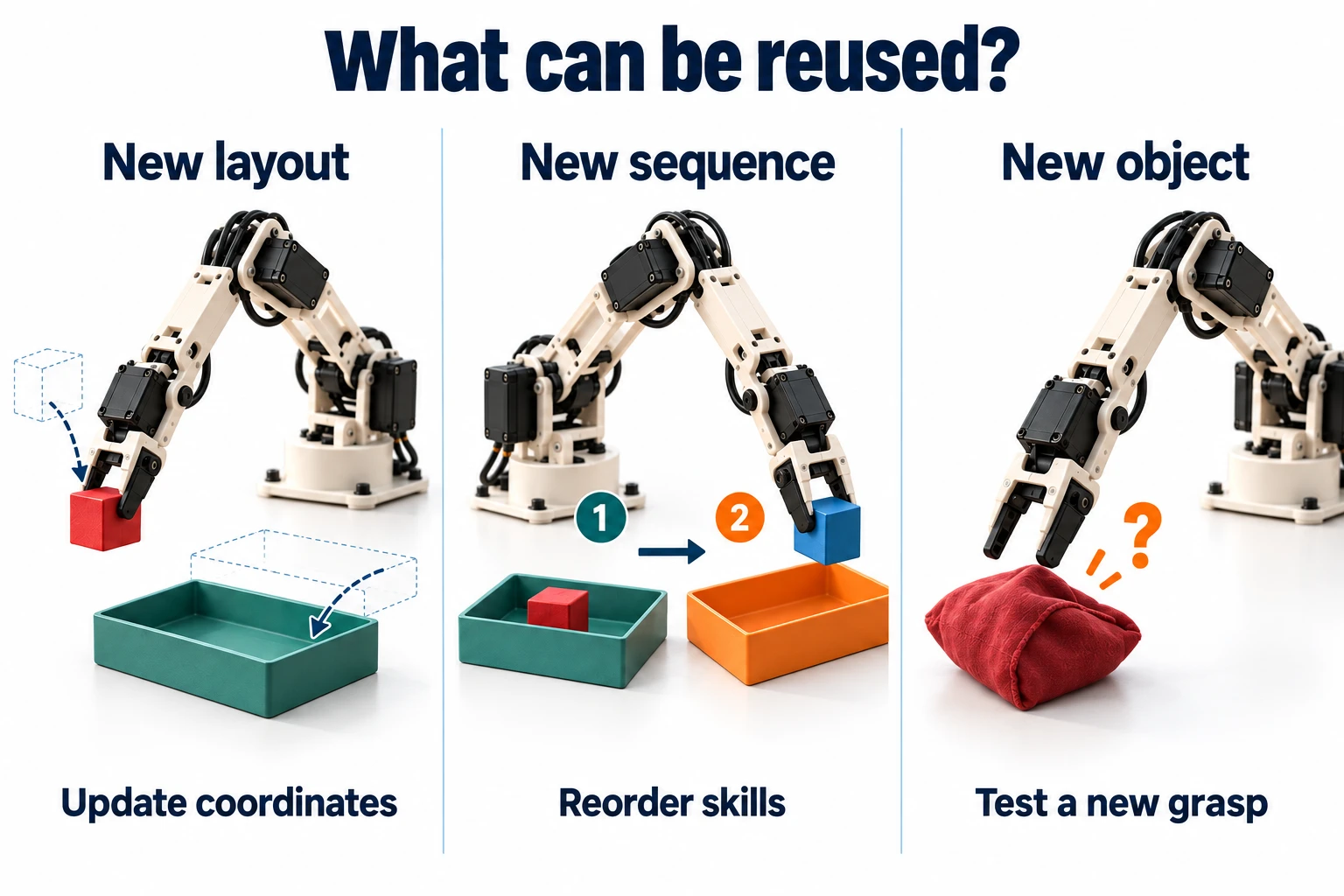
Open X-Embodiment shows that pooling experience across robot platforms can improve manipulation policies. It motivates our investigation of reuse; our own gains still need measurement. For deployment, the practical question is how much setup, new data and human help each change requires.
Why start with the SO-101?
The SO-101’s open mechanical design and LeRobot support make it an accessible platform for studying the complete manipulation loop. Even tabletop placement requires identifying an object, locating it, making contact and checking the outcome. We can vary one condition at a time and inspect what fails.
Operating the arm also exposes constraints that model evaluation alone misses: camera placement, mechanical behavior and the quality of recorded experiments. This develops reusable software and practical judgment before we choose larger platforms. Future hardware should follow the use case’s reach, payload, environment and reliability requirements.
What leading robotics platforms teach us
These examples address different layers of robotics, from commercial integration to research and factory trials. Primary sources were checked on September 24, 2026; the comparison is not a market-share or performance ranking.
Integration
Universal Robots
AI Accelerator
Available to orderEvaluate the complete workflow
Setup · task success · fault diagnosis
Sensing & control
Franka Research 3
Research arm
Research hardwareMatch the hardware to the question
Precise force research may need another arm.
Robot models
Google DeepMind
Gemini Robotics 2 / ER 2
Preview modelsER 2 access: Google AI Studio / Gemini API
Test reasoning and action separately
Then validate their integration on hardware.
Deployment
Figure at BMW
Figure 03 + Helix 02
Production-site projectHelix 02: whole-body control, per Figure
Prove a complete operational task
A factory project has a defined scope.
- Ground goals
- Reuse skills
- Measure adaptation
How the whole system fits together
A demonstration or instruction supplies a goal. Perception locates the relevant objects; planning selects and sequences available skills; control produces movement. Fresh observations guide execution, while outcome checks determine whether to continue, retry or ask for help. Separating these responsibilities lets us diagnose and improve each component.
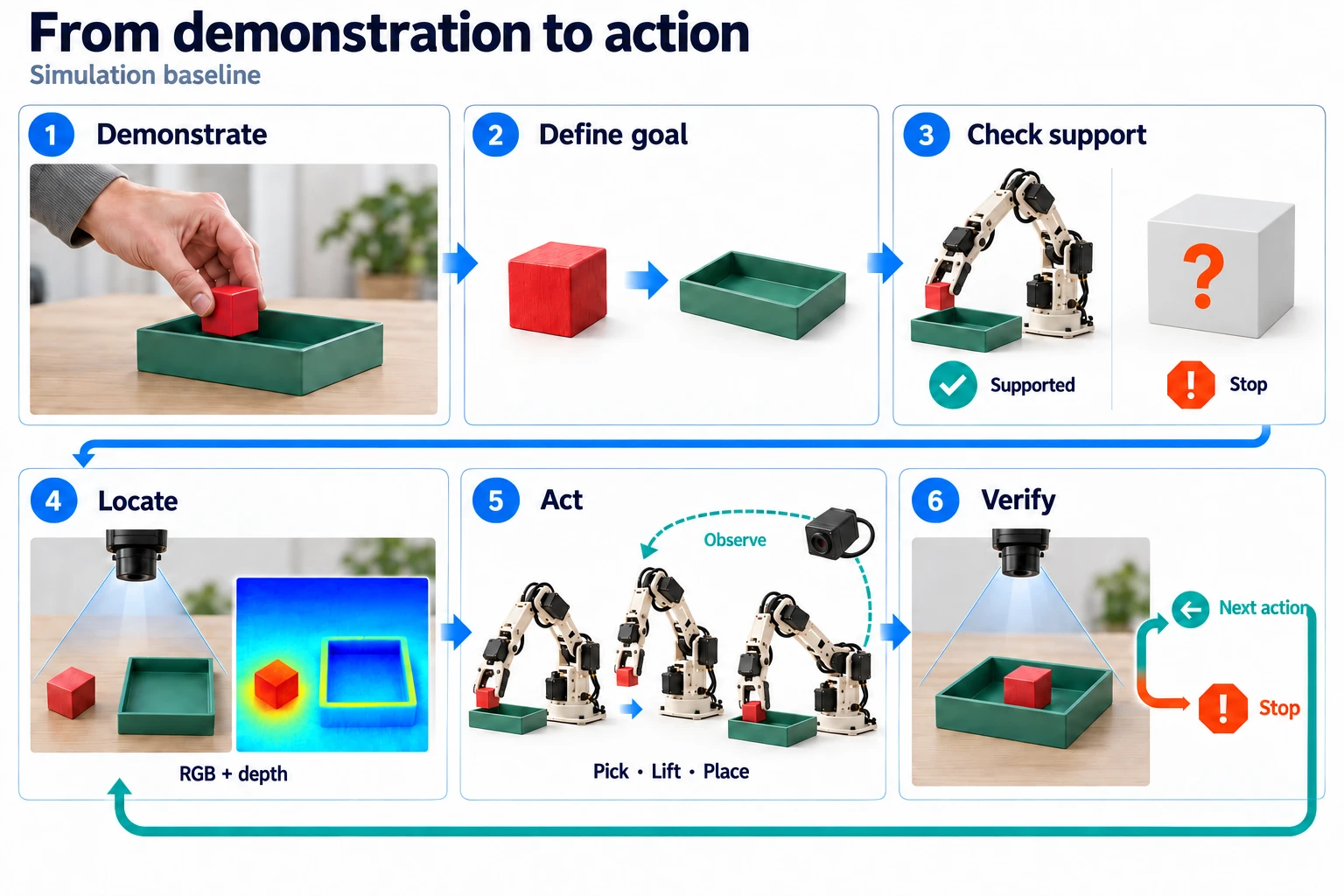
Our current system interprets a short human video as a supported pick-and-place goal and invokes a programmed geometric motor skill. The clip does not train a new manipulation policy. That baseline gives us a reference for evaluating learned perception, policies and task composition. Reliable execution from live perception remains open work.
Simulation and hardware should improve each other
Simulation lets us repeat tasks, vary conditions and compare methods before physical trials. Hardware then reveals what the simulator missed: lighting and occlusion, camera calibration, contact behavior or response delays. Measurements should feed back into the simulator, controller or training process.
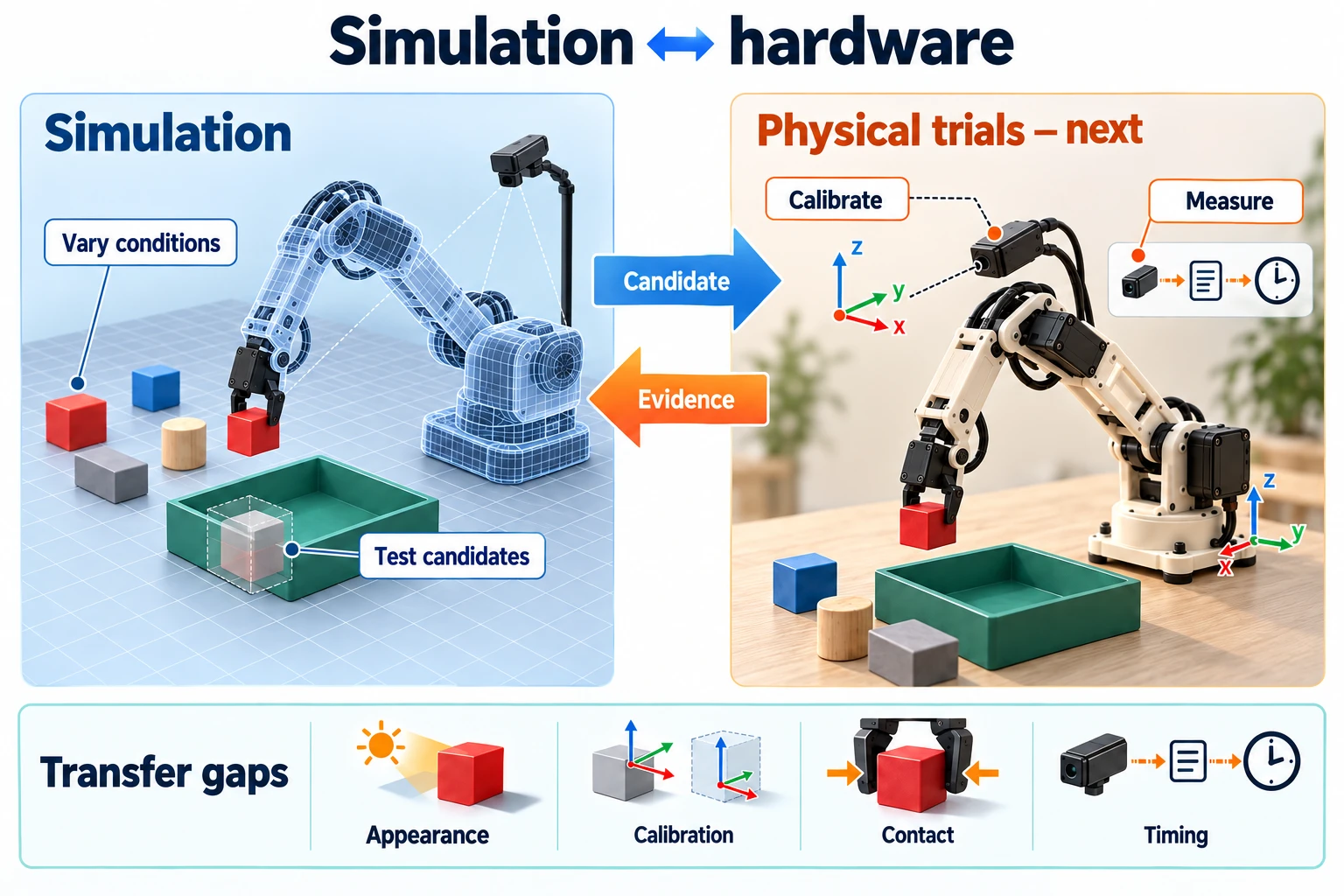
Domain randomization is one relevant approach: varying simulated appearances can reduce dependence on a single visual setting. The original study demonstrated transfer for object localization, without establishing that arbitrary robot behavior transfers automatically. We need a calibrated physical trial and a comparison of expected versus observed behavior to assess our own system.
How we will measure progress
Task success and the robot’s judgment of success are separate measurements. In our simulation, an object can reach the correct place while visual confirmation fails. An independent physics check helps distinguish that verification error from a failed grasp or placement; the controller does not receive the evaluator’s ground-truth state.
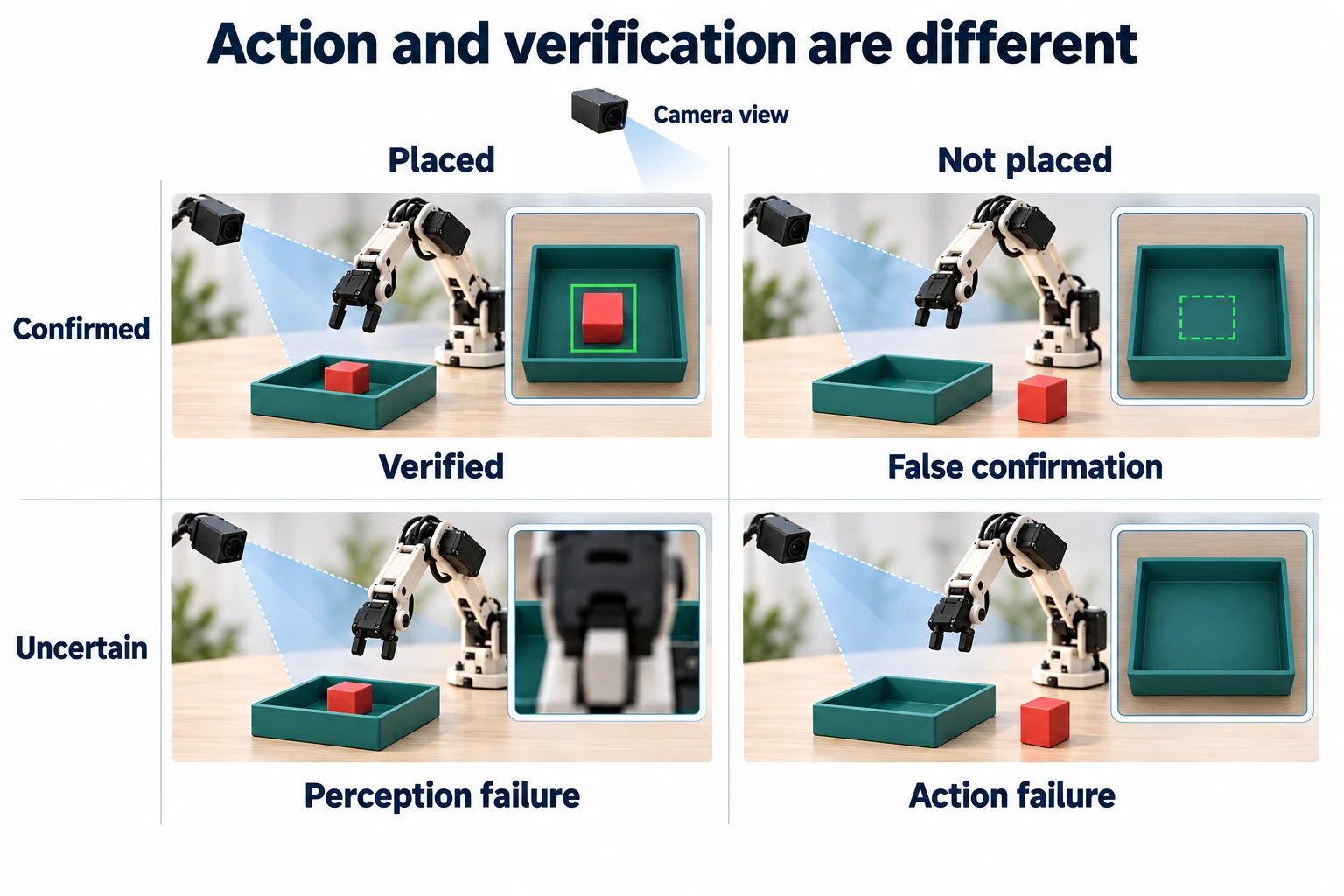
Our proposed comparison keeps the task family and held-out layouts fixed, changes one component—perception, planning or the motor skill—and retains the programmed baseline. We would measure:
- Complete-task success, including whether earlier placements stay correct.
- Retries and human assistance, including failures the system cannot resolve.
- Adaptation effort: extra demonstrations and tuning needed for each variation.
This makes an improvement useful only when its benefit, cost and failure conditions are visible.
What comes next
The next milestone is a bounded task performed and measured on the physical arm, followed by tests under changed conditions. Those results will guide which skills, interfaces and evaluation methods we carry into a broader task family and future robots.
For VoicePing, this is how a small research platform supports a larger ambition: building the capability to turn robot intelligence into dependable work. If these questions interest you, explore opportunities at VoicePing and our research articles .